The Week The Week
flag of US
US
flag of UK
UK
https://cdn.mos.cms.futurecdn.net/flexiimages/jacafc5zvs1692883516.jpg

SUBSCRIBE & SAVE

Less than $3 per week

Sign in
  • View Profile
  • Sign out
  • The Explainer
  • The Week Recommends
  • Newsletters
  • Cartoons
  • From the Magazine
  • The Week Junior
  • Student Offers
  • More
    • Politics
    • World News
    • Business
    • Health
    • Science
    • Food & Drink
    • Travel
    • Culture
    • History
    • Personal Finance
    • Puzzles
    • Photos
    • The Blend
    • All Categories
  • Newsletter sign up Newsletter
  • Brand Logo
    House rejects war, Hungary backs Ukraine and screwworm hits Texas

     
    TODAY’S IRAN WAR story

    House votes to end Iran war in bipartisan rebuke

    What happened
    The House yesterday voted 215-208 to force President Donald Trump to stop military operations in the Iran war unless he gets authorization from Congress. Four Republicans joined all Democrats in passing the war powers resolution, which a bipartisan coalition pushed to the floor over the objections of House Speaker Mike Johnson (R-La.). It was the first legislation to end the Iran war approved in either chamber, though the Senate two weeks ago advanced a similar measure in a bipartisan procedural vote. 

    Who said what
    The resolution’s adoption was a “remarkable rebuke” to Trump and his “handling of the conflict” from a GOP-led Congress that has “largely ceded its prerogatives” to curb his power, The New York Times said. Republicans initially backed Trump on the war, The Wall Street Journal said, but as the conflict has “dragged on with no clear resolution in sight,” gas prices continuing to climb and Trump’s poll numbers “sagging,” some Republicans have “started to waver.”

    What next?
    The vote was “largely symbolic,” as the resolution is unlikely to gain the force of law, Politico said. But it “further stymies the White House’s political priorities” after Republicans recently “scuttled several Trump goals,” including funding his White House ballroom and paying off supporters with a $1.8 billion “anti-weaponization” fund. Later yesterday, the House “bucked” Trump and Johnson on a “second foreign policy issue, voting 218-204 to advance” funding for Ukraine and “impose additional sanctions on Russia’s finance and energy sectors.” 


    TODAY’S INTERNATIONAL story

    Hungary drops veto of Ukraine’s EU membership

    What happened
    Hungarian Prime Minister Péter Magyar yesterday announced a deal with Ukraine that should clear the way for Kyiv to begin the process to join the European Union. Magyar’s predecessor, Viktor Orbán, had “fiercely opposed Ukraine’s EU accession,” Politico said, and used Hungary’s veto in the 27-member bloc to thwart Ukraine and Moldova’s “twinned” membership bids, “ostensibly over minority rights for Hungarians living in Ukraine.”

    Who said what
    Hungary’s “shift in position unfolded suddenly” yesterday during a meeting of EU ambassadors in Brussels, Euronews said, and after weeks of negotiations between Hungary and Ukraine. Magyar said Kyiv had agreed to expand the “linguistic, educational, cultural and political rights of the 100,000-strong Hungarian minority” in Ukraine’s western Transcarpathia region.

    What next?
    With Hungary’s objections lifted, accession negotiations are expected to “officially move to the next stage” at a June 15 meeting between the EU, Moldova and Ukraine, Politico said. Still, Magyar yesterday “reiterated his opposition to fast-track Ukraine’s accession,” Euronews said. “If Ukraine manages to close all 33 accession chapters within 10 or 15 years,” he said, Hungary “will hold a legally binding referendum on the issue.”


    TODAY’S AGRICULTURE Story

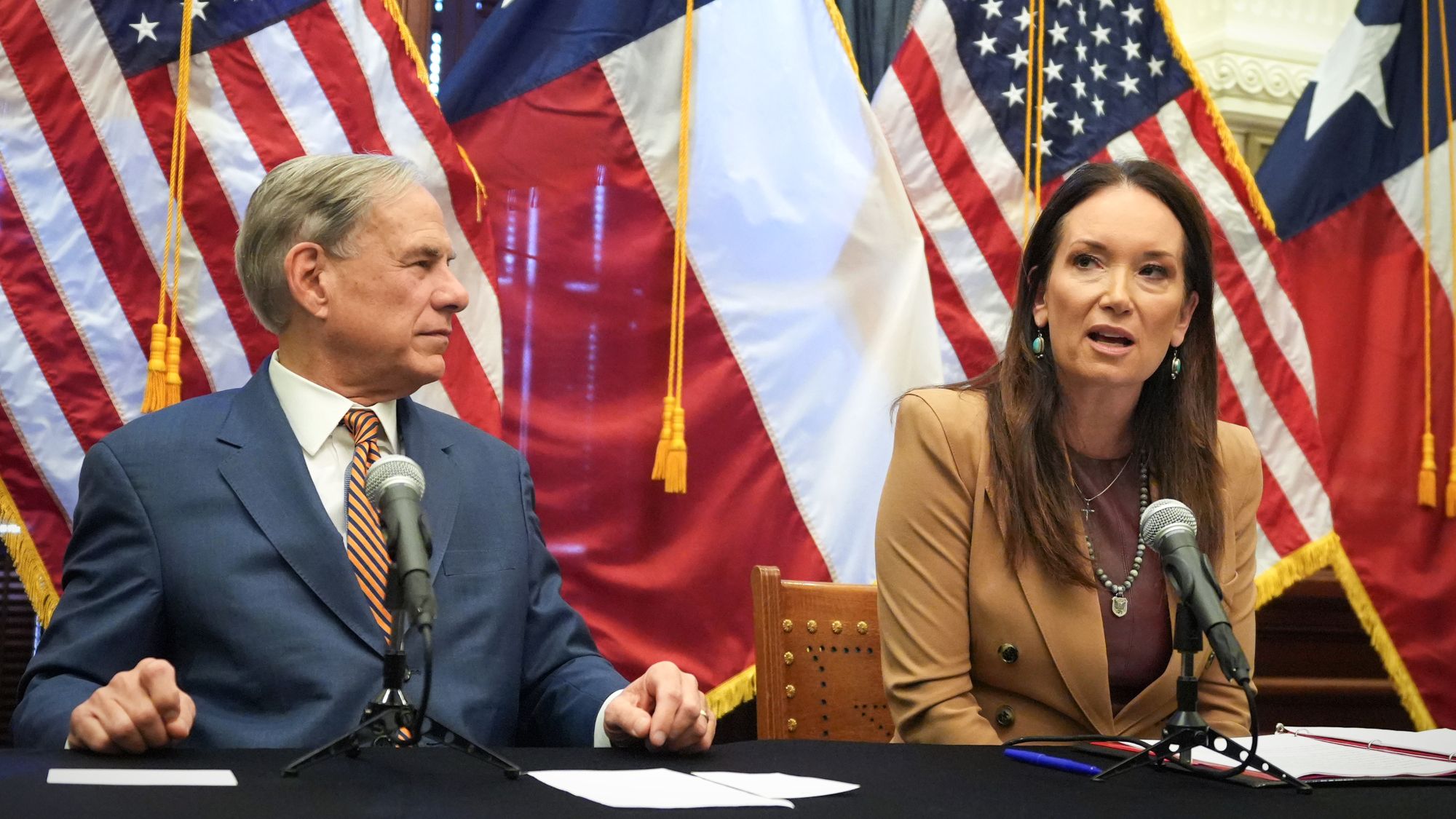
    Flesh-eating screwworm found in Texas calf

    What happened
    New World screwworm, a deadly flesh-eating parasite, has been confirmed in a calf in south Texas, the U.S. Department of Agriculture said late yesterday. It was the first instance of the fly-borne parasite found in U.S. livestock since 1966, when the insect was eradicated from the country after an intensive campaign. 

    Who said what
    Screwworms are “parasitic flies whose females lay eggs in open wounds” on “any work-blooded animal,” hatching “hundreds of screwworm larvae” that “use their sharp mouths to burrow through living flesh, eventually killing their host if left untreated,” Reuters said. Human cases are “rare,” and the fly “poses no food safety issues.” 

    The U.S. has spent months preparing for the parasite’s arrival, sealing the U.S. southern border to livestock for more than a year. Endemic parts of Latin America, screwworms have been spreading north through Mexico since 2024. If “more screwworms are found beyond the single case,” The New York Times said, it “could devastate the American cattle industry.” America’s cattle herd is “already at its smallest since the 1950s,” The Wall Street Journal said, and the “tight” market has “helped drive beef prices to record highs for U.S. consumers.”

    What next?
    The USDA is “taking immediate action” to “contain” and “eradicate this case” of the parasite, Agriculture Secretary Brooke Rollins said, including creating a 12.4-mile “infested zone” quarantine around the infected calf, increasing monitoring and releasing millions of sterilized male New World screwworm flies to shrink the population.


    It’s not all bad

    British Paralympic sprinter John McFall is set to make history as the first disabled astronaut in space. The 45-year-old surgeon is a member of the European Space Agency astronaut reserve and has been cleared to participate in a two-week mission to the Haven-1 commercial space station, set to launch as soon as next year. Among other tasks, The Guardian said, McFall will assess how the space environment affects modern prosthetic limbs, “which often rely on sensors and microprocessors to function properly.”


    Under the radar

    Amazon axing: the good, the bad and the protected

    Deforestation in the Brazilian Amazon fell last year to its lowest level since 2019, according to a report from the MapBiomas monitoring network. That’s “good news” for Brazil’s President Luiz Inácio Lula da Silva, who made the fight against deforestation a “central tenet” of his reign, said France24. But the news isn’t unequivocally positive.

    South America’s biggest country lost 2.4 million acres of native vegetation last year, down 20.6% from 2024, according to the report. Deforestation fell by 23.5%, and reductions were recorded across Brazil’s six major ecosystems.

    Even so, the rate of Amazonian destruction remains “breathtaking,” said France 24. In the world’s largest rainforest, five trees are still chopped down every second.

    As the largest tropical rainforest on the planet, the Amazon absorbs more than a billion tons of carbon dioxide from the atmosphere, helping to offset the effects of human greenhouse gas emissions. But agriculture, wildfire, logging and mining are stripping it of its powers, with agriculture accounting for 99% of vegetation loss across the country.

    If deforestation and global warming “continue unchecked,” the Amazon could begin transitioning to a “degraded grassland-like ecosystem in just a few decades,” said The New York Times. The consequences of an Amazon “tipping point” are “catastrophic for the entire planet,” said Bernardo M. Flores, an ecology researcher at Spain’s University of Santiago de Compostela. So “we need to be careful not to get anywhere near those risks.”


    On this day

    June 4, 1919

    Congress passed the 19th Amendment, sending it to the states to be ratified. The amendment, which guarantees women the right to vote, was a culminating milestone for the women’s suffrage movement. Following a yearlong battle between the states, the amendment was ratified in August 1920.


    TODAY’S newspaperS

    ‘Ukraine strikes again’

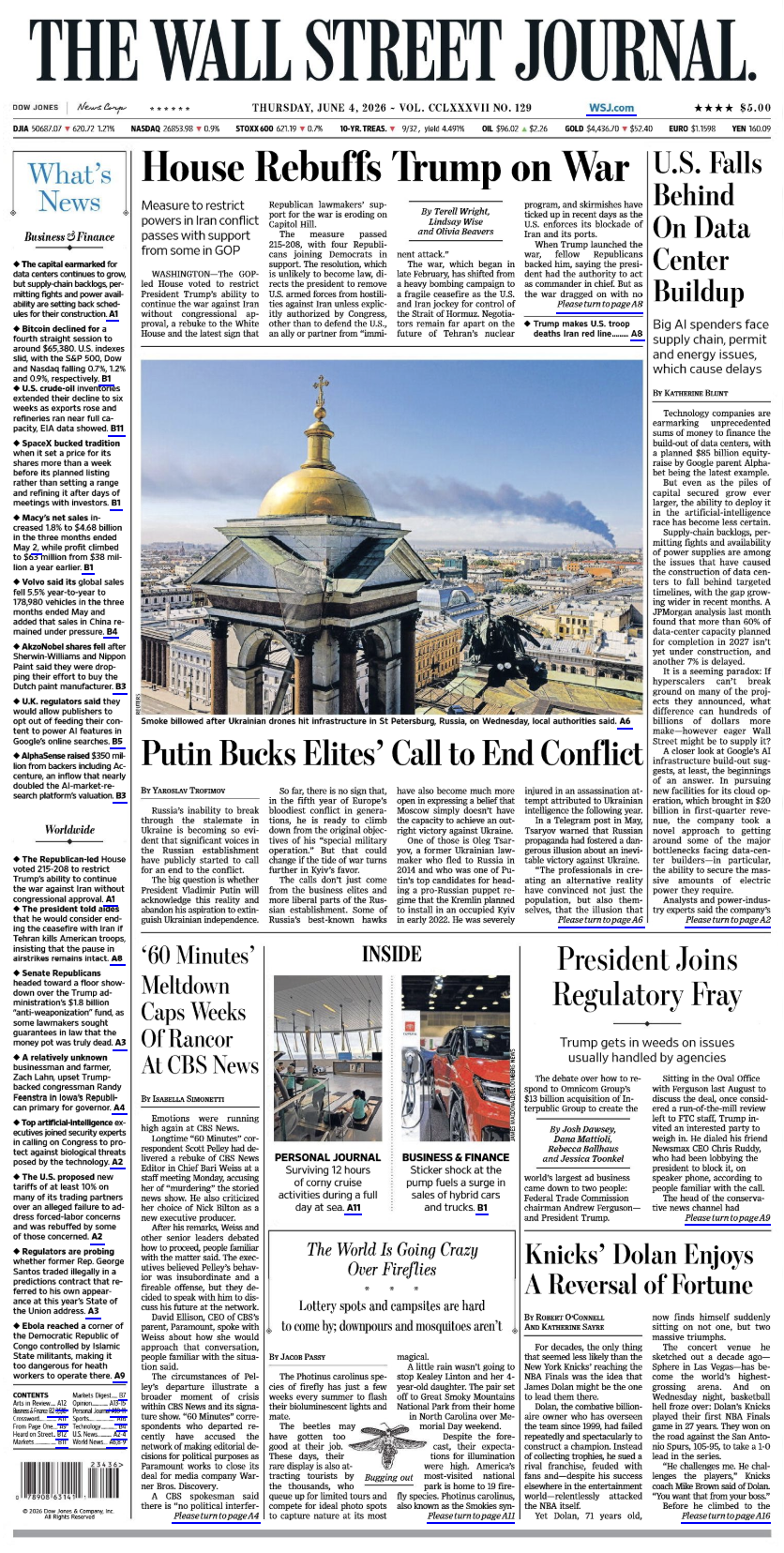
    “Tehran hits Kuwait in drone attack,” The New York Times says on Thursday’s front page. “Ukraine strikes again deep inside Russia’s borders,” The Washington Post says. “Putin bucks elites’ calls to end conflict,” The Wall Street Journal says. In California races, “Hilton, Becerra take sizable lead” as “Wiener, Chan step closer to Pelosi’s seat,” says the San Francisco Chronicle. “Uncounted ballots are expected to swing blue,” the Los Angeles Times says. “Justices clear redistricting in Alabama,” The Minnesota Star Tribune says. “Alabama can keep using disputed vote map” with “lines that favor GOP, cut majority Black districts,” says USA Today.

    ► See the newspaper front pages


    Tall tale

    Hel on wheels

    In Poland, bus route 666 is once again whisking passengers from Krakow to Hel. The “Highway to Hel” route number was changed from 666 to 669 three years ago, following complaints from Christian groups angry over the number’s “satanic associations,” said CNN. But new operator Flixbus brought back 666 as a way to boost tourism and “increase the route’s visibility,” a spokesperson told TVN24. Hel is a popular seaside destination, with an average summer temperature of 72 degrees Fahrenheit.


    Morning Report was written and edited by Nadia Croes, Catherine Garcia, Scott Hocker, Anya Jaremko-Greenwold, Justin Klawans, Chas Newkey-Burden, Rafi Schwartz, Peter Weber and Kari Wilkin, with illustrations by Stephen Kelly and Julia Wytrazek.

    Image credits, from top: Win McNamee / Getty Images; Stringer / NurPhoto / Getty Images; Jay Janner / Austin American-Statesman via Getty Images; Illustration by Julia Wytrazek / Getty Images
     

    Recent editions

    • Evening Review

      A conspicuously missing congressman

    • Morning Report

      Midterms take shape after key primaries

    • Evening Review

      UAE’s role in Sudan’s crisis

    VIEW ALL
    TheWeek
    • About Us
    • Contact Future's experts
    • Terms and Conditions
    • Privacy Policy
    • Cookie Policy
    • Advertise With Us
    • FAQ
    Add as a preferred source on Google Add as a preferred source on Google

    The Week is part of Future US Inc, an international media group and leading digital publisher. Visit our corporate site.

    © Future US, Inc. Full 7th Floor, 130 West 42nd Street, New York, NY 10036.