The Week The Week
flag of US
US
flag of UK
UK
https://cdn.mos.cms.futurecdn.net/flexiimages/jacafc5zvs1692883516.jpg

SUBSCRIBE & SAVE

Less than $3 per week

Sign in
  • View Profile
  • Sign out
  • The Explainer
  • The Week Recommends
  • Newsletters
  • Cartoons
  • From the Magazine
  • The Week Junior
  • Student Offers
  • More
    • Politics
    • World News
    • Business
    • Health
    • Science
    • Food & Drink
    • Travel
    • Culture
    • History
    • Personal Finance
    • Puzzles
    • Photos
    • The Blend
    • All Categories
  • Newsletter sign up Newsletter
  • Brand Logo
    Medicare drug prices, Japan’s devastating earthquake, and an x.AI lawsuit

     
    TODAY’S healthcare story

    Trump administration ends key Medicare drug subsidies

    What happened
    The Centers for Medicare and Medicaid Services said yesterday it will end a Medicare subsidy program aimed at lowering prescription costs for some seniors at the end of 2026, one year ahead of schedule. The Medicare prescription drug benefit, which is expected to cost the government some $3.6 billion in subsidies this year, was introduced by former President Joe Biden in 2024. It shields some 25 million people with “Part D” Medicare plans from steep insurance premium hikes.

    Who said what
    Characterizing the government subsidies as a “bailout” that “gave BILLIONS of taxpayer money DIRECTLY to Big Insurance Companies,” CMS Administrator Mehmet Oz said on social media that the administration is “stabilizing the market.” All but a quarter of Part D enrollees are likely to see their premiums rise next year as a result of the change, some by $20 a month, an anonymous Trump administration official told The Wall Street Journal. 

    The change could “inflame the debate” about healthcare costs at a time when “voters’ concerns about the cost of living are a top campaign issue,” Bloomberg said. Republicans could find this “politically damaging” ahead of the November midterm elections, The New York Times said. 

    What next?
    CMS will release the new monthly Part D premiums in September, which means Medicare users could be in for some “sticker shock while shopping for next year’s drug plan,” the Times said.


    TODAY’S international story

    ‘Race against time’ to find Japan earthquake survivors

    What happened
    Search teams have rescued eight people from the ruins of a shopping center (pictured above) after a powerful earthquake struck the southern Japanese island of Kyushu yesterday. Recovery operations continued overnight at the Aeon Mall in Kumamoto Prefecture after part of the building collapsed and an explosion followed the initial quake.

    The earthquake was initially measured at magnitude 7.1 before being revised to 6.8. It was followed by more than 60 aftershocks and, together, they sparked fires, damaged roads and cut power to thousands of homes. At least 13 people are known to have died, and the death toll is expected to rise.

    Who said what
    “Although more than 20 hours have passed since the earthquake, there are those still in need of help,” Japanese Prime Minister Sanae Takaichi said during a press conference. “This is truly a race against time.”

    The earthquake has “rattled a region still marked by one of the country’s deadliest recent disasters,” CNN said. In 2016, a series of massive earthquakes killed 275 people, injured thousands more and caused widespread devastation, with more than 200,000 homes damaged. 

    What next?
    Emergency workers continue to look for people who are trapped or missing, as engineers assess the damaged infrastructure. The Japan Meteorological Agency has warned of landslides and further aftershocks over the coming week because the quake is still “triggering seismic activity in the area,” said The Guardian.


    TODAY’S AI Story

    Musk’s x.AI sues Minnesota over ‘nudification’ ban

    What happened
    Former trillionaire Elon Musk’s artificial intelligence company x.AI has filed a lawsuit against Minnesota’s “first-in-the-nation law” banning programs and applications that “create and post deepfake videos or images of people naked without their consent,” said MPR News. Those found in violation of Minnesota’s anti-nudification rule risk fines of “$500,000 for each unlawful access, download or use,” per the law’s text. 

    Who said what
    X.AI did not dispute that the state has “valid interests” in barring the “dissemination of artificially generated nude images of people without their consent,” said Bloomberg Law. Rather, it argued that Minnesota’s rule goes “far beyond that goal” and exposes a “wide array of protected speech to civil liability and government sanctions.”

    What next?
    Musk’s suit holds that Minnesota’s law is “unconstitutional” and should either be “placed on hold while the case proceeds” or “struck down entirely,” said MPR News. The provision is set to go into effect on August 1. If and when it does, x.AI has threatened to “limit services for users in the state.”


    It’s not all bad

    One year after being translocated to Mozambique, a South African cheetah named Kazi has given birth to three cubs. She was one of 12 cheetahs who traveled 1,000 miles to their new sanctuary on 494,000 acres of unfenced land. Translocations can be risky because of a higher mortality rate, but experts say they are “essential to maximizing the genetic diversity” needed for species survival, said National Geographic. There are fewer than 7,100 cheetahs in the wild and captivity, making Kazi’s growing family something to celebrate.


    Under the radar

    Burner phones could soon be illegal in the US

    An anonymous phone call — along with prepaid cellphones and burner phones — may soon be a thing of the past. The Federal Communications Commission (FCC) has proposed requiring a host of personal information in order to enable someone’s phone service. While the new rules are an effort to stomp out pesky robocalls, they may cause more harm than peace.

    The FCC 26-27 proposal, adopted on April 30, was deemed a “know-your-customer” standard with the intention of “stopping illegal calls before they enter the phone network, requiring providers to block unwanted or illegal calls and giving consumers more information about the calls they receive,” said the FCC in a news release. The proposal is “misguided and counterproductive,” Sydney Saubestre, a senior policy analyst on the Privacy and Data Project at the Center for Democracy and Technology, said to Fortune. 

    A lack of access to private telecommunications can cause “especially acute harm and danger for survivors of domestic violence, sexual assault, technology-facilitated abuse and stalking,” the Kansas Coalition Against Sexual & Domestic Violence said in a letter to the FCC. Also, requiring government-issued IDs is a barrier for many to obtain a phone.

    Many also have concerns about how phone providers will handle user data. “Every other year, there’s a new data breach in which 70 million, 100 million U.S. consumers have their data exposed,” Chao Jun Liu, a senior legislative associate at the nonprofit Electronic Frontier Foundation, said to CNET. Those in favor of the proposal, like banking industry groups, said Fortune, have cited “fraud and scam losses that totaled nearly $200 billion in 2024.”


    On this day

    July 29, 1958

    President Dwight D. Eisenhower signed legislation establishing the National Aeronautics and Space Administration (NASA) to compete with the Soviets in the Space Race. Exactly 47 years later, on July 29, 2005, another space breakthrough occurred with the discovery of the dwarf planet Eris in the outer solar system.


    TODAY’S newspaperS

    ‘Graham honored’

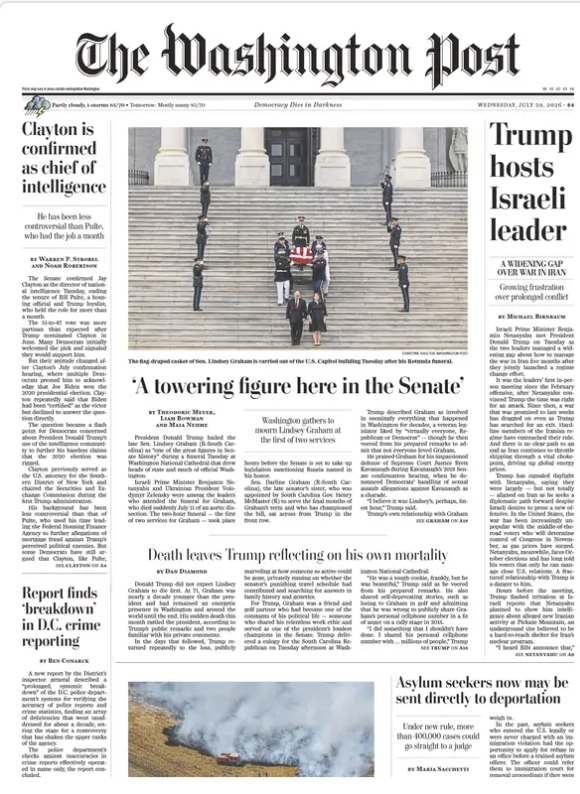
    “World leaders” paid “respects” as Lindsey “Graham honored” in Washington D.C. funeral, says USA Today on Wednesday’s front page. Senator’s “death leaves Trump reflecting on his own mortality,” The Washington Post says. Iran sees “no need to rush for a cease-fire,” says The New York Times. “A mooooving” butter cow exhibit revealed at Ohio State Fair, says The Columbus Dispatch.

    ► See the newspaper front pages


    Tall tale

    Windbreaker windfall

    The $3 jacket Quinn Brown bought at a Goodwill in Oregon sold for $89,600 last week at auction. Brown stumbled upon the Los Angeles Lakers warm-up jacket while browsing and had a feeling it was an important garment. Sotheby’s auction house determined it once belonged to NBA legend Wilt Chamberlain, after finding photos of him wearing it during the 1972 NBA finals. “I got very, very lucky,” Brown said to NBC News.


    Morning Report was written and edited by Nadia Croes, Catherine Garcia, Scott Hocker, Anya Jaremko-Greenwold, Justin Klawans, Rafi Schwartz, Jessica Hullinger and Helen Brown, with illustrations by Julia Wytrazek.

    Image credits, from top: George Frey / Bloomberg / Getty Images; Tomohiro Ohsumi / Getty Images; Jeanne Accorsini / Sipa / Shutterstock; Illustration by Julia Wytrazek / Getty Images
     

    Recent editions

    • Evening Review

      Democrats’ ‘war room’ preparations

    • Morning Report

      Trump escalates mail-in voting battle

    • Evening Review

      Trump’s Australian inspiration

    VIEW ALL
    TheWeek
    • About Us
    • Contact Future's experts
    • Terms and Conditions
    • Privacy Policy
    • Cookie Policy
    • Advertise With Us
    • FAQ
    Add as a preferred source on Google Add as a preferred source on Google

    The Week is part of Future US Inc, an international media group and leading digital publisher. Visit our corporate site.

    © Future US, Inc. Full 7th Floor, 130 West 42nd Street, New York, NY 10036.