Sign up to get Today’s Best Articles in your inbox
Join 350,000+ subscribers and keep yourself informed with a selection of
The Week’s most interesting, enlightening and entertaining stories - plus daily puzzles.
You are now subscribed
Your newsletter sign-up was successful
Want to add more newsletters?
An account already exists for this email address, please log in.
Why the Bangladesh election is one to watch
Opposition party has claimed the void left by Sheikh Hasina’s Awami League but Islamist party could yet have a say
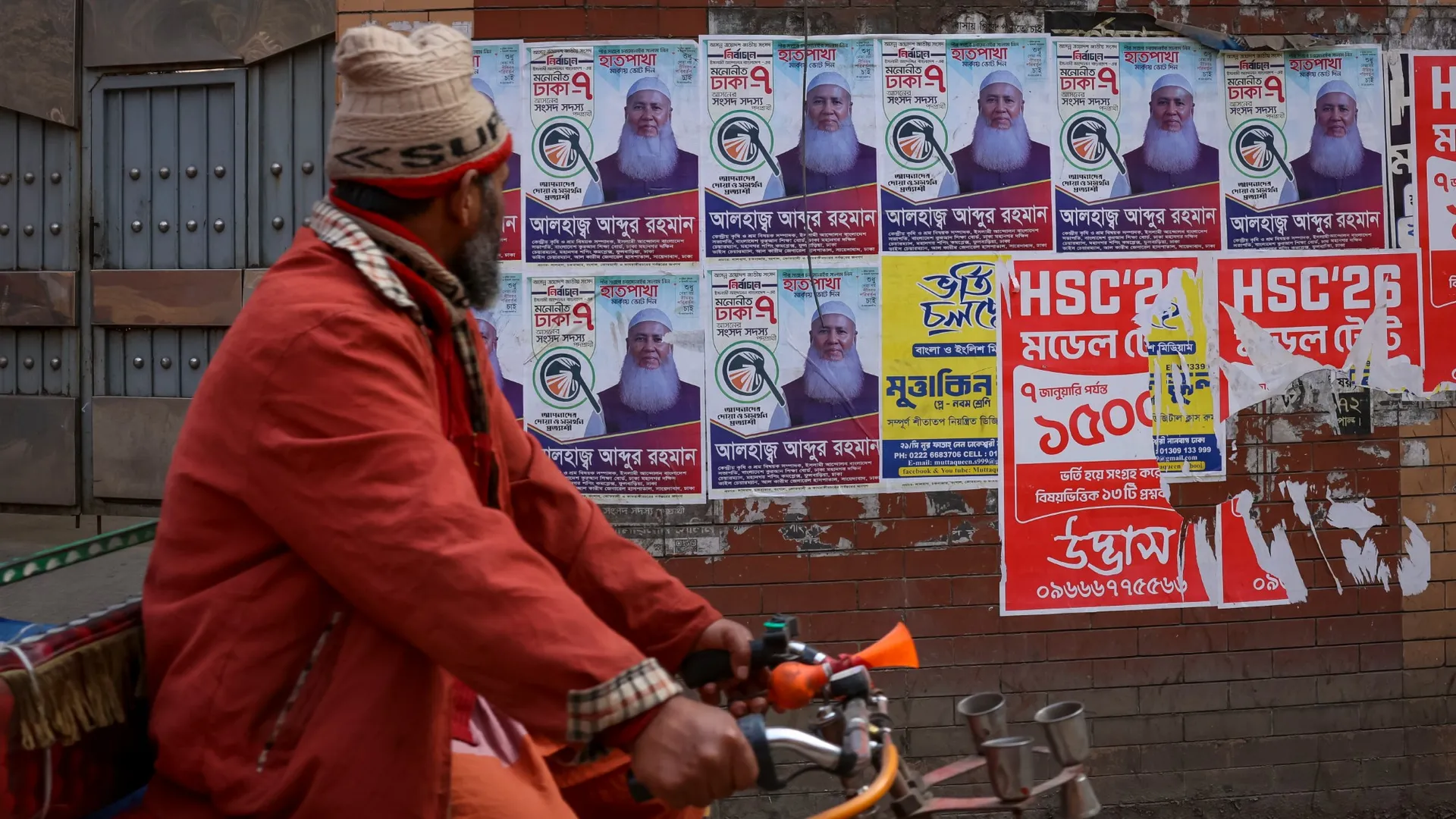
Bangladesh goes to the polls this week in its first general election since former prime minister Sheikh Hasina was deposed by youth-led protests in 2024.
Thursday’s poll will be seen as a verdict on the student uprising and as a weathervane signalling the political direction of the subcontinent more broadly. With more than 127 million registered voters, it “will be the biggest democratic process of 2026, anywhere”, said the EU delegation to Bangladesh on X. “Described by many as the first free and fair election in more than a decade,” said CNN, “on the streets of Dhaka, the prevailing mood is one of anticipation”.
Who is in the running?
Of the 59 registered political parties in Bangladesh, 51 are taking part, with 1,981 candidates standing, including 249 independents. Hasina’s party, the Awami League, has been banned.
The Week
Escape your echo chamber. Get the facts behind the news, plus analysis from multiple perspectives.
Join more than 350,000 subscribers and keep yourself informed with a selection of The Week’s most interesting, enlightening and entertaining stories - plus daily puzzles.
Join more than 350,000 subscribers and keep yourself informed with a selection of The Week’s most interesting, enlightening and entertaining stories - plus daily puzzles.
The contest is expected to be a battle between two rival coalitions. The first is headed by the centre-right Bangladesh Nationalist Party (BNP), led by Tarique Rahman, the son of former prime minister Khaleda Zia and a representative of the entrenched political elite. The other coalition is led by Islamist party Jamaat-e-Islami and includes the National Citizen Party, formed by student leaders of the 2024 uprising.
The NCP has become “badly fractured” since the protests and is widely regarded as “too inexperienced” for power, said the BBC. To counter that perception, it has formed an alliance with Jamaat-e-Islami, which says it “would govern under the country’s secular constitution on a reform agenda” if elected, said Al Jazeera. At a pre-election rally, Jamaat leader Shafiqur Rahman said the election was an opportunity “to bury the rotten politics of the past”.
What’s at stake?
The vote will reflect deep-seated concerns on issues including high inflation (which reached 8.58% in January, said The Daily Star), economic stagnation, law and order, and endemic corruption.
Nearly half of those registered to vote are aged between 18 and 37, and youth unemployment and the lack of opportunities for young Bangladeshis have been key campaign issues. For many, the question of national identity is also at stake, as religious and secular forces vie for power.
Sign up to get Today’s Best Articles in your inbox
A free daily email with the day’s biggest news and analysis – and the best features from TheWeek.com
As well as voting for representatives in the national parliament, Bangladeshis will also cast their ballot in a referendum on reforms to restructure state institutions and limit executive power. “Everyone agreed that there must be reform in the system so that no one can become a dictator in the future,” Salman Al-Azami, from Liverpool Hope University, told Anadolu Agency.
Why are these elections so significant?
For many Bangladeshis, this election is a test of whether a free and fair democratic process can finally take root. The suspension of the Awami League, the dominant party for over a decade, will radically reshape the party dynamic in the country.
The polling will also be seen as a verdict on the success of the student uprising. As many as 1,400 people died in the protests, the majority of them killed in the security crackdown ordered by Hasina. After the election, “students will learn whether their revolution, and the bloodshed, were worth it”, said the BBC.
More broadly, the vote will be the “linchpin” in South Asia’s “election season”, said Rudabeh Shahid on the Atlantic Council. Nepal will follow Bangladesh to the polls in March, and there are also state-level elections taking place in neighbouring India in the months that follow.
Both countries share Bangladesh’s struggle with “deepening social polarisation, rising religious extremism, and a faltering economy”, so they will be observing the outcome of Thursday’s poll closely. A surge for Jamaat would “reinforce regional concerns” about the rise of Islamist politics, while a strong showing for the NCP may signal that “anti-establishment, generational politics may be moving from street protests to an electoral force”.
Chas Newkey-Burden has been part of The Week Digital team for more than a decade and a journalist for 25 years, starting out on the irreverent football weekly 90 Minutes, before moving to lifestyle magazines Loaded and Attitude. He was a columnist for The Big Issue and landed a world exclusive with David Beckham that became the weekly magazine’s bestselling issue. He now writes regularly for The Guardian, The Telegraph, The Independent, Metro, FourFourTwo and the i news site. He is also the author of a number of non-fiction books.