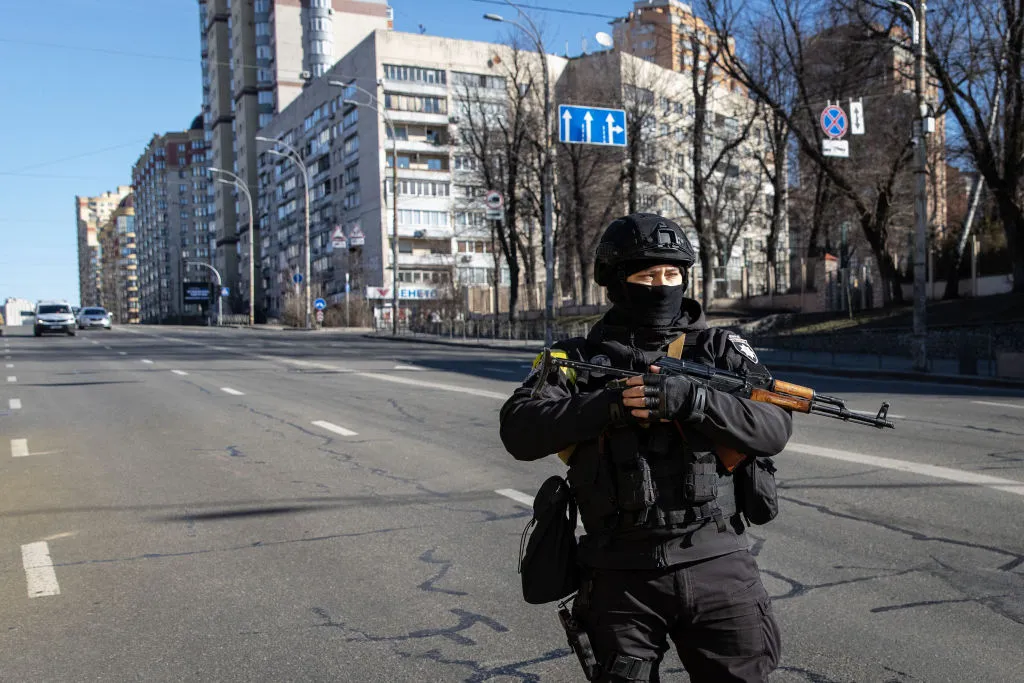
17-mile-long Russian convoy reaches outskirts of Kyiv
A free daily email with the biggest news stories of the day – and the best features from TheWeek.com
You are now subscribed
Your newsletter sign-up was successful
A 17-mile-long convoy comprising hundreds of Russian military vehicles reached the outskirts of Kyiv on Monday, CNN reported.
Per CNN, the convoy was originally identified on Sunday in satellite imagery provided by Maxar Technologies. At the time, it was approximately 40 miles from Kyiv. By around 11:00 a.m. on Monday, the convoy was positioned near Antonov air base, about 17 miles from the city center of Kyiv.
Russian forces captured the air base on Friday after heavy fighting, BBC reported.
The Week
Escape your echo chamber. Get the facts behind the news, plus analysis from multiple perspectives.
Sign up for The Week's Free Newsletters
From our morning news briefing to a weekly Good News Newsletter, get the best of The Week delivered directly to your inbox.
A source described as a "western official" told CNN on Monday that Russia is "well behind the schedule it set" for the invasion. Kyiv has already outlasted the worst-case scenario U.S. Chairman of the Joint Chiefs of Staff Gen. Mark Milley outlined before the invasion when he said the Ukrainian capital could fall within 72 hours.
According to Ukrainian military sources, Russian reconnaissance forces made several attempts to push into Kyiv on Friday night but were repelled after vicious street fighting. Russian troops have also fired missiles into the Ukrainian capital.
The main body of Russian troops pushing south from Belarus has not yet attacked the city, but the large number of tanks, artillery pieces, and other vehicles in the convoy could signal that a major assault is imminent.
A free daily email with the biggest news stories of the day – and the best features from TheWeek.com
Grayson Quay was the weekend editor at TheWeek.com. His writing has also been published in National Review, the Pittsburgh Post-Gazette, Modern Age, The American Conservative, The Spectator World, and other outlets. Grayson earned his M.A. from Georgetown University in 2019.
-
Switzerland could vote to cap its populationUnder the Radar Swiss People’s Party proposes referendum on radical anti-immigration measure to limit residents to 10 million
-
Political cartoons for February 15Cartoons Sunday's political cartoons include political ventriloquism, Europe in the middle, and more
-
The broken water companies failing England and WalesExplainer With rising bills, deteriorating river health and a lack of investment, regulators face an uphill battle to stabilise the industry
-
What is ‘Arctic Sentry’ and will it deter Russia and China?Today’s Big Question Nato considers joint operation and intelligence sharing in Arctic region, in face of Trump’s threats to seize Greenland for ‘protection’
-
What would a UK deployment to Ukraine look like?Today's Big Question Security agreement commits British and French forces in event of ceasefire
-
Would Europe defend Greenland from US aggression?Today’s Big Question ‘Mildness’ of EU pushback against Trump provocation ‘illustrates the bind Europe finds itself in’
-
Did Trump just end the US-Europe alliance?Today's Big Question New US national security policy drops ‘grenade’ on Europe and should serve as ‘the mother of all wake-up calls’
-
Is conscription the answer to Europe’s security woes?Today's Big Question How best to boost troop numbers to deal with Russian threat is ‘prompting fierce and soul-searching debates’
-
Trump peace deal: an offer Zelenskyy can’t refuse?Today’s Big Question ‘Unpalatable’ US plan may strengthen embattled Ukrainian president at home
-
Vladimir Putin’s ‘nuclear tsunami’ missileThe Explainer Russian president has boasted that there is no way to intercept the new weapon
-
The Baltic ‘bog belt’ plan to protect Europe from RussiaUnder the Radar Reviving lost wetland on Nato’s eastern flank would fuse ‘two European priorities that increasingly compete for attention and funding: defence and climate’