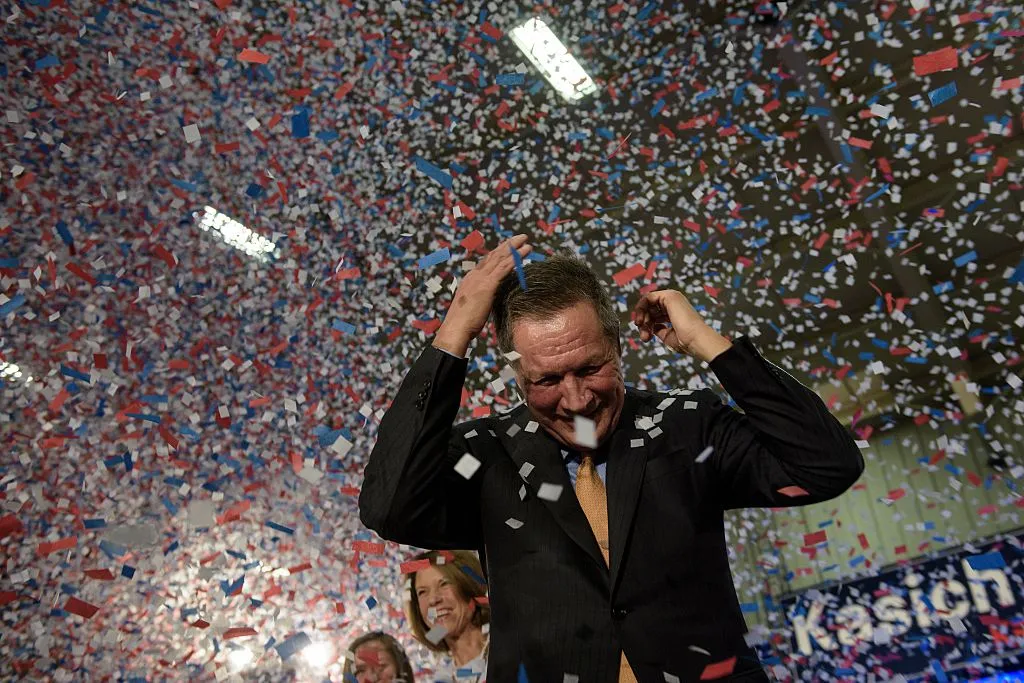
John Kasich celebrates win in Ohio, promises he won't 'take the low road' to White House
A free daily email with the biggest news stories of the day – and the best features from TheWeek.com
You are now subscribed
Your newsletter sign-up was successful
Gov. John Kasich's victory speech in his home state, Ohio, started with a protest. He did not yell at or threaten the protesters, making his first contrast with likely Republican nominee Donald Trump. "When you went to college in the 1970s, you appreciate a good peaceful protest every once in a while," he joked. Later in the speech, he made the contrast more specific: Without mentioning Trump by name, Kasich said he wanted to remind people "that I will not take the low road to the highest office in the land." Kasich did mention Marco Rubio, though, asking his supporters to applaud the "great, talented United States senator" who dropped out of the race after losing his own home state, Florida.
Kasich spent most of his speech talking about how he has been overlooked and ignored by the media for most of the campaign — I "labored in obscurity for so long," as he put it — and touting his record in Ohio, where he said he pursued a conservative agenda "and we are leaving no one behind." Despite the fact that this was Kasich's first win and he's trailing Trump and Sen. Ted Cruz pretty badly in delegates, he still predicted that he is "going to go all the way to Cleveland and secure the Republican nomination," presumably in a brokered convention.
A free daily email with the biggest news stories of the day – and the best features from TheWeek.com
The Week
Escape your echo chamber. Get the facts behind the news, plus analysis from multiple perspectives.
Sign up for The Week's Free Newsletters
From our morning news briefing to a weekly Good News Newsletter, get the best of The Week delivered directly to your inbox.
Peter has worked as a news and culture writer and editor at The Week since the site's launch in 2008. He covers politics, world affairs, religion and cultural currents. His journalism career began as a copy editor at a financial newswire and has included editorial positions at The New York Times Magazine, Facts on File, and Oregon State University.
-
The 8 best TV shows of the 1960sThe standout shows of this decade take viewers from outer space to the Wild West
-
Microdramas are boomingUnder the radar Scroll to watch a whole movie
-
The Olympic timekeepers keeping the Games on trackUnder the Radar Swiss watchmaking giant Omega has been at the finish line of every Olympic Games for nearly 100 years
-
Judge orders Washington slavery exhibit restoredSpeed Read The Trump administration took down displays about slavery at the President’s House Site in Philadelphia
-
Hyatt chair joins growing list of Epstein files losersSpeed Read Thomas Pritzker stepped down as executive chair of the Hyatt Hotels Corporation over his ties with Jeffrey Epstein and Ghislaine Maxwell
-
Judge blocks Hegseth from punishing Kelly over videoSpeed Read Defense Secretary Pete Hegseth pushed for the senator to be demoted over a video in which he reminds military officials they should refuse illegal orders
-
Trump’s EPA kills legal basis for federal climate policySpeed Read The government’s authority to regulate several planet-warming pollutants has been repealed
-
House votes to end Trump’s Canada tariffsSpeed Read Six Republicans joined with Democrats to repeal the president’s tariffs
-
Bondi, Democrats clash over Epstein in hearingSpeed Read Attorney General Pam Bondi ignored survivors of convicted sex offender Jeffrey Epstein and demanded that Democrats apologize to Trump
-
El Paso airspace closure tied to FAA-Pentagon standoffSpeed Read The closure in the Texas border city stemmed from disagreements between the Federal Aviation Administration and Pentagon officials over drone-related tests
-
Judge blocks Trump suit for Michigan voter rollsSpeed Read A Trump-appointed federal judge rejected the administration’s demand for voters’ personal data