The Week The Week
flag of US
US
flag of UK
UK
https://cdn.mos.cms.futurecdn.net/skoGBi9qKFoUtnNWkovjJQ.jpg

SUBSCRIBE

Try 6 Free Issues

Sign in
  • View Profile
  • Sign out
  • The Explainer
  • Talking Points
  • The Week Recommends
  • Podcasts
  • Newsletters
  • From the Magazine
  • The Week Junior
  • More
    • Politics
    • World News
    • Business
    • Health
    • Science
    • Food & Drink
    • Travel
    • Culture
    • History
    • Personal Finance
    • Puzzles
    • Photos
    • The Blend
    • All Categories
  • Newsletter sign up Newsletter
  • Brand Logo
    Venezuela smash-and-grab, Iranian protests and Critics Choice crown

     
    TODAY’S AMERICAS story

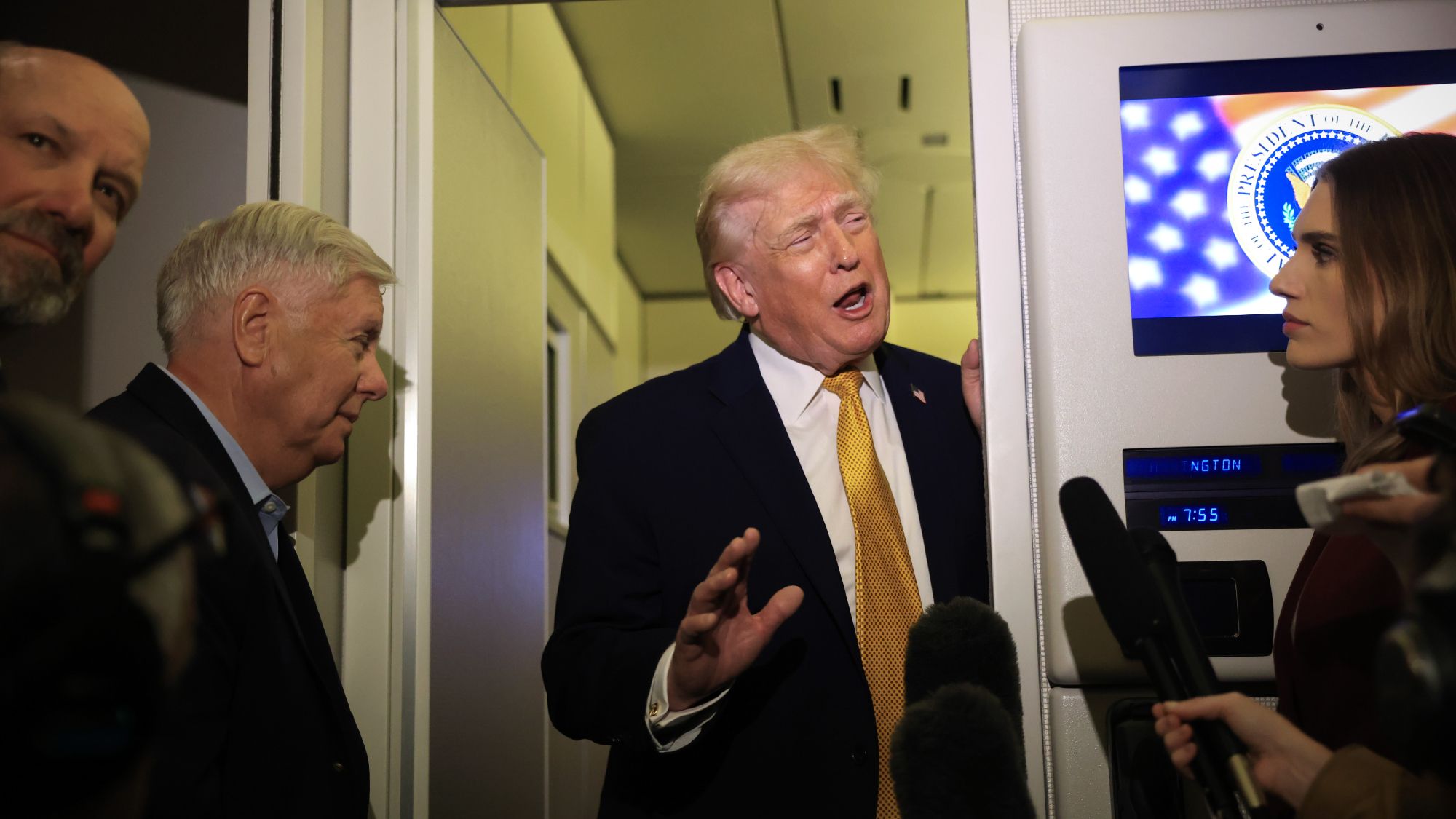
    Trump says US ‘in charge’ of Venezuela after Maduro grab

    What happened
    President Donald Trump last night told reporters that the U.S. is “in charge” of Venezuela after the U.S. military seized its president, Nicolás Maduro, and his wife in a raid on Caracas early Saturday. Trump on Saturday said the U.S. would “run the country” and its oil wealth for an unspecified period of time, and he was “not afraid of boots on the ground.” But Secretary of State Marco Rubio earlier yesterday said the U.S. is “running policy” in Venezuela through coercion and duress, not direct rule.

    Maduro’s vice president, Delcy Rodríguez, assumed the role of interim president yesterday and is being sworn in today. At least 80 people were killed during the U.S. raid, including 32 Cuban security officers, and several U.S. soldiers were injured, The New York Times said, citing officials in the three countries.

    Who said what
    Rodríguez initially denounced the U.S. incursion as an “atrocity that violates international law,” but said on social media last night she hoped to build “respectful relations” with Trump and was willing to “collaborate” on “shared development within the framework of international law.” Trump had told The Atlantic earlier yesterday that if Rodríguez “doesn’t do what’s right, she is going to pay a very big price, probably bigger than Maduro.” Asked last night what he needs from her, Trump said “total access” to “the oil and to other things in the country.” The “very controversial” answer to “who’s in charge” in Venezuela is “we’re in charge,” he told reporters. 

    Democrats and many legal experts called Trump’s actions blatantly illegal, especially since he did not seek authorization from Congress to invade another country, or even inform key lawmakers beforehand. “Most Republicans lined up behind the president,” The Associated Press said, but “there were signs of unease across the spectrum within the party,” especially the “America First” wing. “This is the same Washington playbook that we are so sick and tired of that doesn’t serve the American people, but actually serves the big corporations, the banks and the oil executives,” Rep. Marjorie Taylor Greene (R-Ga.) said yesterday on NBC’s “Meet the Press.” 

    What next?
    Maduro and his wife, Cilia Flores, are scheduled to be arraigned in federal court in Manhattan today on newly unsealed charges of drug trafficking and other alleged crimes. The United Nations Security Council is holding an emergency session today focused on the legality of the U.S. raid.


    TODAY’S INTERNATIONAL story

    Iran’s government rocked by protests

    What happened
    Protests sparked by the collapse of Iran’s currency have spread to 26 of the country’s 31 provinces, and the death toll has reached at least 19, the Human Rights Activists News Agency reported today. The protests have “convulsed Iran for a week,” The New York Times said, and while not yet as large as the “last two major uprisings — one in 2022 led by women and another in 2019 set off by gasoline prices — they have rattled senior officials.” 

    Who said what
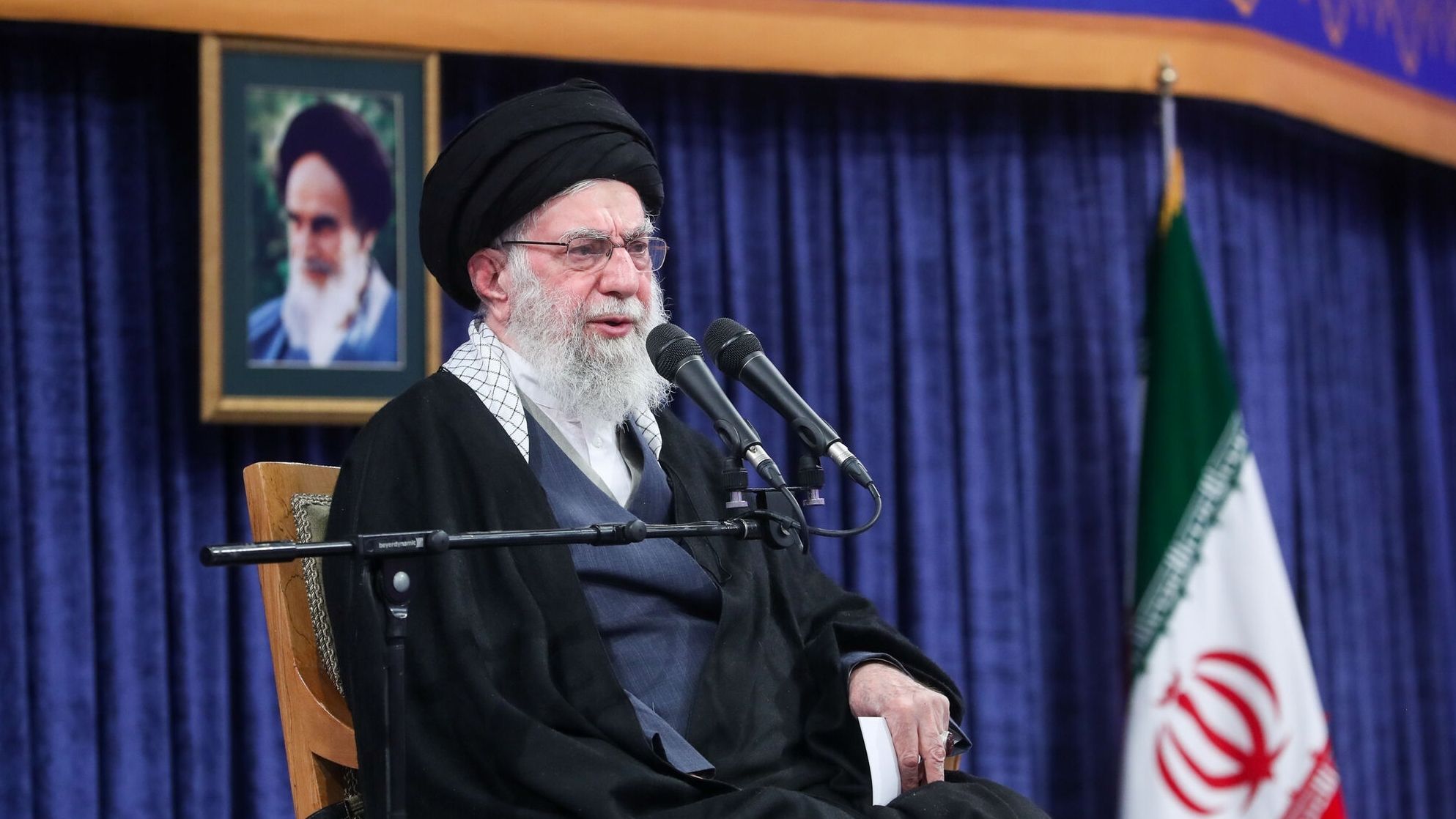
    The protests “began first with merchants in Tehran before spreading” and becoming increasingly political, The Associated Press said. And the demonstrations “do not appear to be stopping, even after Supreme Leader Ayatollah Ali Khamenei on Saturday said ‘rioters must be put in their place.’” President Masoud Pezeshkian took a more conciliatory tone than Khamenei (pictured above), saying  that “we must listen to the people” and any “unjust” policy is “doomed to fail.” 

    Iran’s theocratic government is facing “growing domestic unrest combined with an external military threat,” the Times said, and it “appears at a dead end in addressing both.” President Donald Trump said Friday that if Tehran “violently kills peaceful protesters,” the U.S. is “locked and loaded and ready” to “come to their rescue.” He reiterated his warning last night. Trump’s threat “has taken on new meaning after American troops captured Venezuelan President Nicolás Maduro, a longtime ally of Tehran,” the AP said.

    What next?
    Iran’s protests “could still spread and turn more violent,” the Times said, and officials “appear to have few tools at their disposal to deal with either the pressing challenges of a tanking economy” or the “threat of further conflict with Israel and the United States.”


    TODAY’S CULTURE Story

    ‘One Battle After Another’ wins Critics Choice honors

    What happened
    “One Battle After Another” won best picture at the 31st Critics Choice Awards yesterday, becoming only the fourth film to win the “Big Four” critics’ awards, after earning top honors from the New York Film Critics Circle, National Board of Review and Los Angeles Film Critics Association. Director Paul Thomas Anderson (pictured above) also won best director and best adapted screenplay awards for the film. Timothée Chalamet won best actor for “Marty Supreme” and Jessie Buckley was awarded best actress for “Hamnet.” 

    Who said what
    The Critics Choice Awards, “presented by a group of more than 500 broadcast critics and journalists in Santa Monica, Calif., usually follow the Golden Globes and often rubber-stamp the same set of winners,” The New York Times says. But with the Golden Globes going second this year, “pundits were curious to see which direction the Critics Choice voters would take.” 

    Each of the early pre-Oscars awards “has its own identity, influence and taste profile,” Variety said, but the Critics Choice Awards “tend to reflect broader industry consensus,” and they boosted “Anora” to its triumph at last year’s Academy Awards. “This is the best time I ever had making a movie, and I feel like it shows,” Anderson said at last night’s ceremony. 

    What next?
    Of the three other movies to sweep all four early critics’ awards — “Schindler’s List” (1993), “L.A. Confidential” (1997) and “The Social Network” (2010) — only “Schindler’s List” went on to win the Oscar for best picture. The Golden Globes are on Sunday


    It’s not all bad

    Becky and Lynn Miner purchased 100 acres of mismanaged forest in Chewelah, Washington, in 1992 and have since planted 11,000 ponderosa pines and western larch trees and installed 700 nest boxes, attracting 80 species of birds. They are donating what’s now a healthy tree farm to Washington State University Extension Forestry for teaching forest management. It’s a “really special gift,” WSU forester Andy Perleberg told Spokane Public Radio.


    Under the radar

    The mysterious origin of a lemon-shaped exoplanet

    Scientists have unearthed a new exoplanet, PSR J2322-2650b, through NASA’s James Webb telescope. Its properties are in “stark contrast to every known exoplanet orbiting a main-sequence star,” said a study published in The Astrophysical Journal Letters. “How the planet came to be is a mystery,” NASA said in a press release.

    The exoplanet is about the mass of Jupiter and is “known to orbit a pulsar, a rapidly spinning neutron star,” said NASA. This star is “completely bizarre — the mass of the sun, but the size of a city,” said Michael Zhang, a postdoctoral researcher at the University of Chicago and a co-author of the study.

    PSR J2322-2650b is extraordinarily close to its star at just 1 million miles away, compared to the Earth’s distance from the sun, which is about 100 million miles. As PSR J2322-2650b is “big enough and close enough to its pulsar host,” the star’s gravity is “pulling the planet into a lemon shape,” said Scientific American.

    What has interested scientists most is the planet’s atmosphere, which “nobody has ever seen before,” said Zhang. “Instead of finding the normal molecules we expect to see on an exoplanet, like water, methane and carbon dioxide, we saw molecular carbon, specifically C3 and C2.”

    All these cosmic anomalies raise questions as to how PSR J2322-2650b formed in the first place. While designated as an exoplanet, some theorize that the planet is the “stripped remains of a former star” because of its strange composition, said Scientific American. 


    On this day

    January 5, 1925

    Nellie Tayloe Ross was sworn in as the governor of Wyoming, becoming the first woman to lead a U.S. state. Serving for two years, she is Wyoming’s only woman governor and one of 51 women who have governed a U.S. state, including 12 currently serving.


    TODAY’S newspaperS

    ‘The oil is ours’

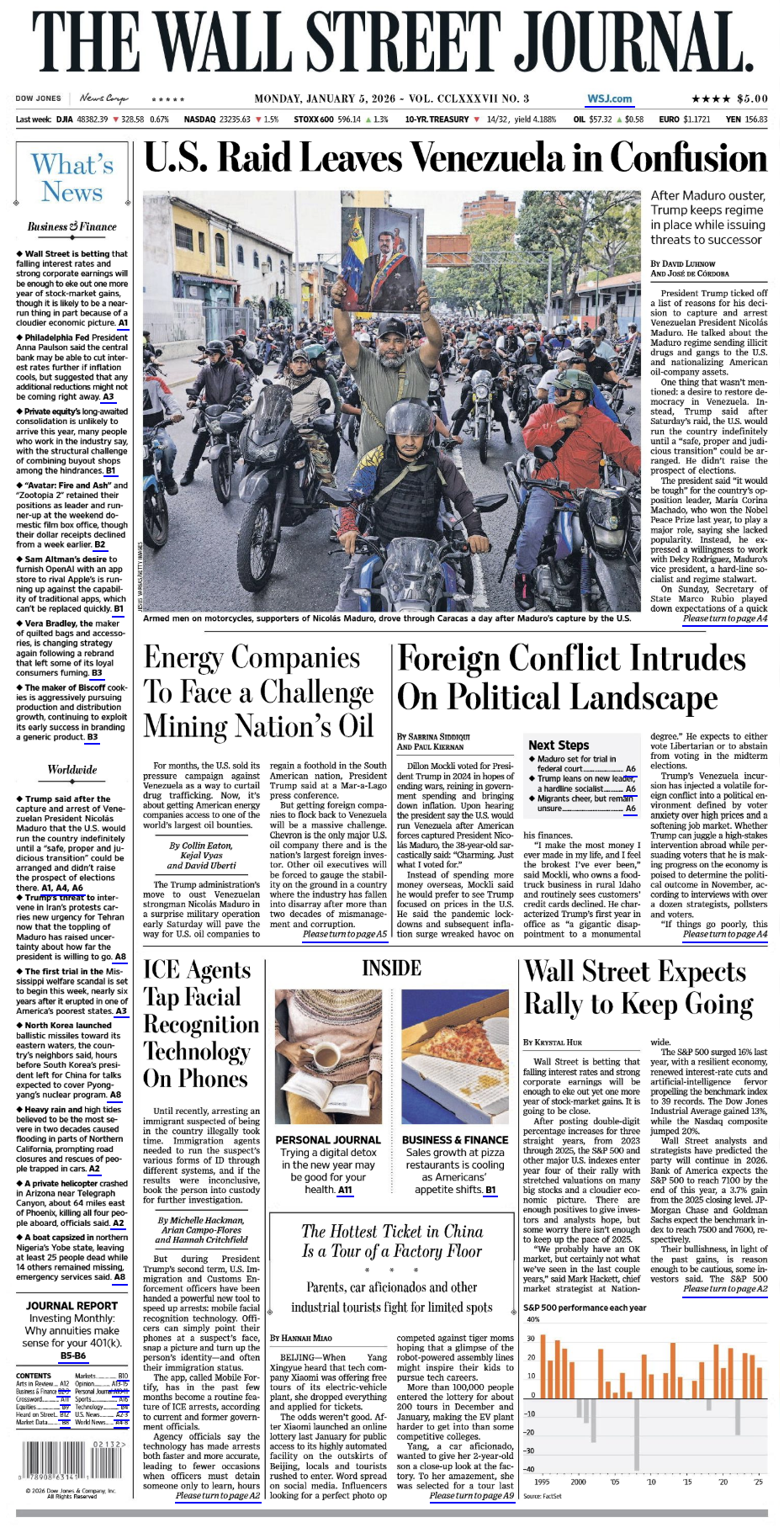
    “U.S. raid leaves Venezuela in confusion,” The Wall Street Journal says on Monday’s front page. “Implications of Maduro raid grow,” USA Today says. “After Maduro, a common refrain: The oil is ours,” says the Los Angeles Times. Trump’s “gamble on Chavismo” could “stabilize Venezuela,” the Miami Herald says.  “America enters a risky new era of control,” but “is there a way for lawmakers to push back? Is there a will?” The New York Times says. “Protesters decry U.S. military strike,” says the Austin American-Statesman. “House win a possibility for Democrats, a wave less likely,” The Washington Post says. “‘Affordability’ is the political buzzword of 2026,” says The Atlanta Journal-Constitution.

    ► See the newspaper front pages


    Tall tale

    UBDENIED

    Illinois rejected 550 of last year’s 56,000 applications for vanity plates, including one for “IBPOOPN,” Illinois Secretary of State Alexi Giannoulias revealed in a YouTube video. The plates were thrown out for being “inflammatory, profane, offensive or too difficult to read,” Giannoulias explained. Other rejects include “BLUBALN,” “PRIUSSY” and “BBL,” a term that “apparently stands for ‘Brazilian butt lift,’” he said, “which had to be explained to me.”


    Morning Report was written and edited by Nadia Croes, Catherine Garcia, Scott Hocker, Anya Jaremko-Greenwold, Justin Klawans, Rafi Schwartz, Peter Weber and Kari Wilkin, with illustrations by Stephen Kelly and Julia Wytrazek.

    Image credits, from top: Joe Raedle / Getty Images; Iranian Leader Press Office / Anadolu via Getty Images; JC Olivera / Variety via Getty Images; Illustration by Julia Wytrazek / Getty Images
     

    Recent editions

    • Evening Review

      Would Europe defend Greenland?

    • Morning Report

      Maduro’s ‘humbling moment’

    • Evening Review

      Greenland, Colombia or Cuba: where next for Trump?

    VIEW ALL
    TheWeek
    • About Us
    • Contact Future's experts
    • Terms and Conditions
    • Privacy Policy
    • Cookie Policy
    • Advertise With Us
    • FAQ
    Add as a preferred source on Google

    The Week UK is part of Future plc, an international media group and leading digital publisher. Visit our corporate site.

    © Future Publishing Limited Quay House, The Ambury, Bath BA1 1UA. All rights reserved. England and Wales company registration number 2008885.