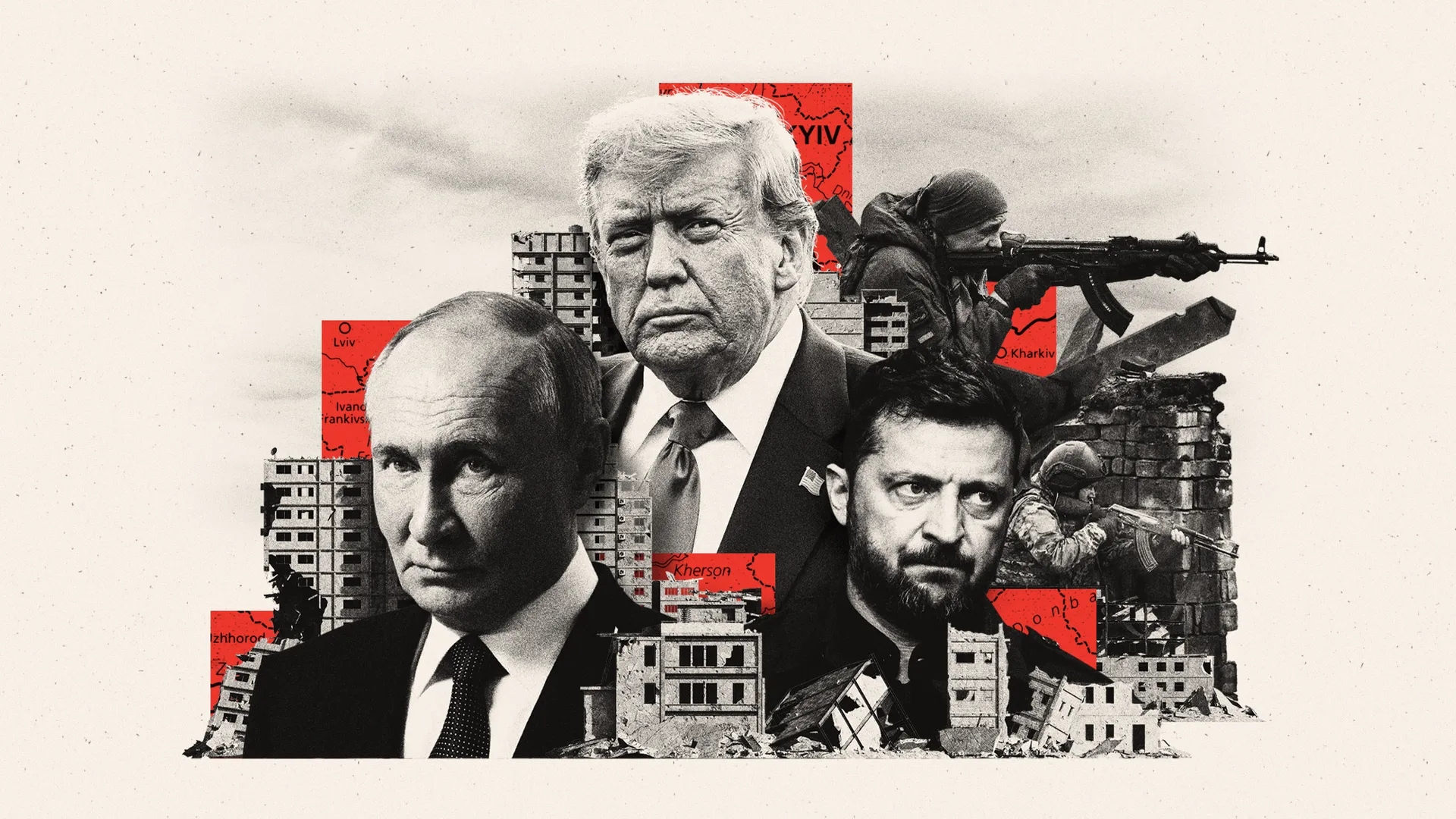
“If a war can be stopped in one region, then surely other wars can be stopped as well – including the Russian war,” said Ukraine’s President Volodymyr Zelenskyy.
Following Donald Trump’s 20-point peace plan for Gaza, Zelenskyy is pushing for “stronger military capabilities” to enhance the prospect of counter-attacks against Russia, said the BBC.
Zelenskyy and Trump spoke on the telephone on Saturday, an indication of a “warming of relations” between the two leaders, said The Guardian. The conversation centred on the proposed US provision of Tomahawk cruise missiles, whose 1,500-mile range could pose a significant threat to Moscow.
The Week
Escape your echo chamber. Get the facts behind the news, plus analysis from multiple perspectives.
SUBSCRIBE & SAVE
Sign up for The Week's Free Newsletters
Join more than 350,000 subscribers and keep yourself informed with a selection of The Week’s most interesting, enlightening and entertaining stories - plus daily puzzles.
Join more than 350,000 subscribers and keep yourself informed with a selection of The Week’s most interesting, enlightening and entertaining stories - plus daily puzzles.
Latest Videos FromThe Week US
Russia’s President Vladimir Putin could be an “unlikely casualty” of the conflict in Gaza between Israel and Hamas, said UnHerd. Trump’s main takeaway from the Middle East negotiations has been that “pressure and arm-twisting succeed while friendly overtures do not garner results”: a conclusion that undermines Trump’s red-carpet attitude towards Putin so far.
With “next year’s Nobel Peace Prize to win”, the prospect of another conflict to resolve could reinforce the strategy of “pushing” rather than “luring” Putin to the negotiating table.
But there’s no guarantee that Trump’s attention will now turn to Eastern Europe, said RFE/RL. The US President looks to have “achieved headway” and celebrated the “pomp and circumstance” of his 20-point peace deal, but talks with the Russians have “appeared to lose steam” in recent months.
Achieving resolutions to each conflict are two very different undertakings. Israel is “diplomatically isolated” to such an extent that it “depends” on US support, and as it is the “largest recipient of US aid in the world”, American leverage is substantial. Russia, on the other hand, presents a separate challenge as it “enjoys” economic backing from China and military endorsement from North Korea.
Obtaining US Tomahawk missiles could prove decisive, as Ukraine’s strategy involves an “increasing number of long-range strikes into Russian territory that have expanded and remade the battlefield”, said Atlantic Council. The war has become more of a “technology race than a battle for territory”. Ukrainian engineers are “rushing to innovate” more quickly than Russia, due to their inferior size and their refusal to deliberately target civilians; Putin, meanwhile, “prioritises” attacks on Ukraine’s population.
Russia’s position might not be as strong as we have been led to believe, as it continually “bleeds troops for microscopic frontline gains”, said Politico. Russia lost more than 280,000 soldiers in Ukraine between January and August, Ukrainian intelligence services claim, with around a third of those killed, and the rest either missing, wounded or captured.
What next?
Russia “warned” in September that if the US agreed to the use of Tomahawks in Ukraine, it could mean they were “directly involved in the war”, said The Times.
The conflict in Ukraine may be the “most difficult international conflict in the world to resolve”, said RFE/RL. “Influential” Republican Senator Lindsey Graham has also called for “massive secondary tariffs to cripple Russia’s revenues from fossil fuels” to further turn the screw on Russia.
Though the introduction of Tomahawks into the conversation is a “step in the right direction”, said UnHerd, “if recent success has taught the US president anything”, it is that “he will need to apply even more pressure” on Putin and Russia.