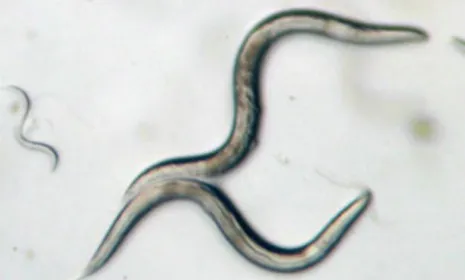
The fate of mankind's future in space may hinge on microscopic worms. The tiny creatures, known as Caenorhabditis elegans, were recently blasted into space on the shuttle Discovery and studied aboard the International Space Station by British scientists. The results of the research were published this week in the Royal Society journal, and yield clues about humans' ability to colonize other planets. Here's what you should know:
What do we need these worms for?
They'll be guinea pigs, essentially. Regular space travel is "no easy amble," says Jennifer Carpenter at BBC News. "Humans must first learn to cheaply and safely propel themselves into space," where the body is subjected to high levels of radiation and anti-gravity. "Without the gravitational pull of Earth," important muscles — including the heart — can deteriorate. Enter the space worms.
The Week
Escape your echo chamber. Get the facts behind the news, plus analysis from multiple perspectives.
SUBSCRIBE & SAVE
Sign up for The Week's Free Newsletters
Join more than 350,000 subscribers and keep yourself informed with a selection of The Week’s most interesting, enlightening and entertaining stories - plus daily puzzles.
Join more than 350,000 subscribers and keep yourself informed with a selection of The Week’s most interesting, enlightening and entertaining stories - plus daily puzzles.
Latest Videos FromThe Week
How were these worms studied?
C. elegan shares half of its genes with humans, says Jennifer Viegas at Discovery, making the worms ideal test subjects. In this study, 4,000 of the worms were left alone for six months in space, "with no one even touching the organisms." Even though life aboard the space station has one tenth the gravity of Earth and receives 10 times the radiation exposure, the worms were able to do "just fine," spawning 12 generations of offspring.
What does this mean for us?
Scientists want to send worm colonies into deep space for long periods of time, beaming data back to Earth to determine if a region is potentially habitable by humans. "We would love to send worms to places like Mars and/or other planets," says the study's co-author, Nathaniel Szewczyk. "The key challenge, and a major goal of this publication, is to convince governments and/or funding agencies that this can and should be done."
Sources: BBC News, Discovery, PBS News