Sign up to get Today’s Best Articles in your inbox
Join 350,000+ subscribers and keep yourself informed with a selection of
The Week’s most interesting, enlightening and entertaining stories - plus daily puzzles.
You are now subscribed
Your newsletter sign-up was successful
Want to add more newsletters?
An account already exists for this email address, please log in.
3 reasons Marco Rubio isn't going to be the GOP nominee in 2016
Although he fills an obvious gap for his party, the odds are stacked against him
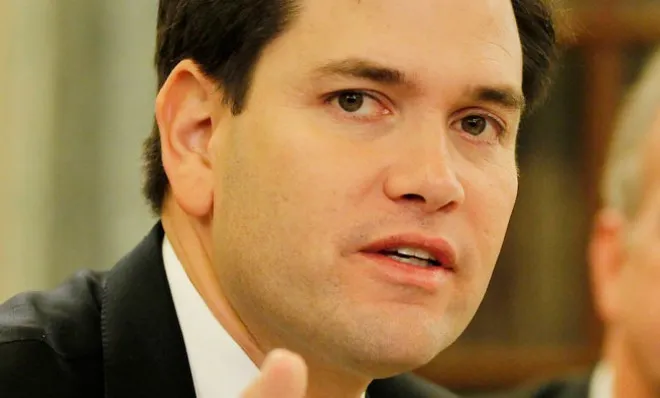
With Sen. Marco Rubio (R-Fla.) giving the Republican response to President Obama's State of the Union address, many are asking if he's the answer to his party's electoral woes.
Time magazine even put him on the cover and asked if he's the Republican savior.
But there are three big reasons why it's unlikely the Florida senator is on a fast track to the presidency in 2016.
The Week
Escape your echo chamber. Get the facts behind the news, plus analysis from multiple perspectives.
Join more than 350,000 subscribers and keep yourself informed with a selection of The Week’s most interesting, enlightening and entertaining stories - plus daily puzzles.
Join more than 350,000 subscribers and keep yourself informed with a selection of The Week’s most interesting, enlightening and entertaining stories - plus daily puzzles.
1. Republicans almost always pick the next guy in line.
Ever since the untested Sen. Barry Goldwater (R-Ariz.) lost in a historic landslide in 1964, the Republican Party has nearly always picked a nominee who has previously run for national office. The one exception is George W. Bush — and he was the son of a former president.
2. Rubio would face a very tough field.
The 2012 Republican primaries included many candidates who had no shot at ever winning the nomination. The 2016 field is likely to be packed with plausible candidates. Seasoned politicians like Chris Christie, Bobby Jindal, Rick Perry, and Paul Ryan are already lined up and mulling possible bids.
Sign up to get Today’s Best Articles in your inbox
A free daily email with the day’s biggest news and analysis – and the best features from TheWeek.com
3. Rubio is still largely unknown.
The national spotlight usually uncovers something unflattering in a first-time presidential candidate's past. In last year's GOP primary race, we quickly found out that Newt Gingrich had been a lobbyist for Freddie Mac, Rick Perry couldn't debate, and Herman Cain had issues with women who were not his wife.
Harry Enten adds a couple more marks against Rubio — that he's not liked by the GOP establishment and that he's too conservative — and concludes, "Given the hurdles a Rubio candidacy would face, I honestly wouldn't be surprised if he never runs at all.”
Taegan D. Goddard is the founder of Political Wire, one of the earliest and most influential political websites. He also runs Wonk Wire and the Political Dictionary. Goddard spent more than a decade as managing director and COO of a prominent investment firm in New York City. Previously, he was a policy adviser to a U.S. senator and governor. Goddard is also co-author of You Won — Now What? (Scribner, 1998), a political management book hailed by prominent journalists and politicians from both parties. Goddard's essays on politics and public policy have appeared in dozens of newspapers across the country, including The Washington Post, USA Today, Boston Globe, San Francisco Chronicle, Chicago Tribune, Philadelphia Inquirer, and Christian Science Monitor. Goddard earned degrees from Vassar College and Harvard University. He lives in New York with his wife and three sons.