Sign up to get Today’s Best Articles in your inbox
Join 350,000+ subscribers and keep yourself informed with a selection of
The Week’s most interesting, enlightening and entertaining stories - plus daily puzzles.
You are now subscribed
Your newsletter sign-up was successful
Want to add more newsletters?
An account already exists for this email address, please log in.
Why some say South Korea's new President Yoon Suk-yeol is 'like Trump'
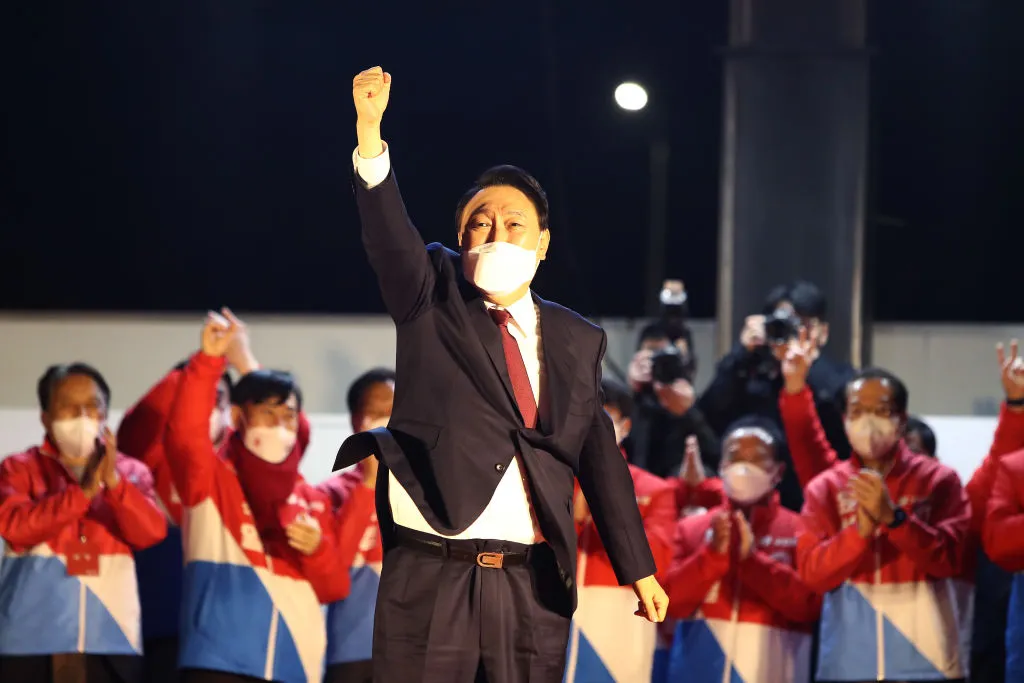
South Koreans on Wednesday elected former top prosecutor and conservative People Power Party candidate Yoon Suk-yeol to be their nation's next leader, in what was "the most contested presidential election in the country's democratic history," The Washington Post reports.
Yoon — a political newcomer who helped convict presidents before becoming one — edged to victory by less than a 1 percent margin, "ushering in an era of conservative party rule that would significantly shift the country's policies in the face of North Korea's nuclear ambitions and China's rise," the Post writes.
"Up until recently, I had never imagined entering politics," Yoon said in a recent campaign speech, per The New York Times. "But the people put me in the position I am in now, on a mission to remove the incompetent and corrupt Democratic Party from power."
The Week
Escape your echo chamber. Get the facts behind the news, plus analysis from multiple perspectives.
Join more than 350,000 subscribers and keep yourself informed with a selection of The Week’s most interesting, enlightening and entertaining stories - plus daily puzzles.
Join more than 350,000 subscribers and keep yourself informed with a selection of The Week’s most interesting, enlightening and entertaining stories - plus daily puzzles.
In some ways, given Yoon's political novelty, the anger conservatives felt toward his Democratic predecessor, and the lack of confidence voters have in current People Power Party leadership, "Yoon is like [former U.S. President Donald] Trump," Kim Hyung-joon, a political scientist in Seoul, told the Times. "He is an outsider running to shake up the establishment."
Yoon also cultivated a particularly strong contingent of support from men in their 20s and 30s by both criticizing his predecessor's progressive gender policies and taking issue with feminism, adds the Sydney Morning Herald.
Assistant Professor Jae Jok Park of the Hankuk University of Foreign Studies described Yoon's maneuvering as a "Trump-style campaign to get young voters," per the Sydney Morning Herald.
And, according to the Korea Herald, both Trump and Yoon "have made remarks that would be offensive to other countries, praised heavily controversial political figures, gone after foreigners, and shown a poor understanding of feminism."
Sign up to get Today’s Best Articles in your inbox
A free daily email with the day’s biggest news and analysis – and the best features from TheWeek.com
Brigid Kennedy worked at The Week from 2021 to 2023 as a staff writer, junior editor and then story editor, with an interest in U.S. politics, the economy and the music industry.