The Week The Week
flag of US
US
flag of UK
UK
https://cdn.mos.cms.futurecdn.net/flexiimages/jacafc5zvs1692883516.jpg

SUBSCRIBE & SAVE

Less than $3 per week

Sign in
  • View Profile
  • Sign out
  • The Explainer
  • The Week Recommends
  • Newsletters
  • Cartoons
  • From the Magazine
  • The Week Junior
  • Student Offers
  • More
    • Politics
    • World News
    • Business
    • Health
    • Science
    • Food & Drink
    • Travel
    • Culture
    • History
    • Personal Finance
    • Puzzles
    • Photos
    • The Blend
    • All Categories
  • Newsletter sign up Newsletter
  • The Week Evening Review
    The Trump bump, North Korea’s economic growth, and prebuilt housing’s boom

     
    talking points

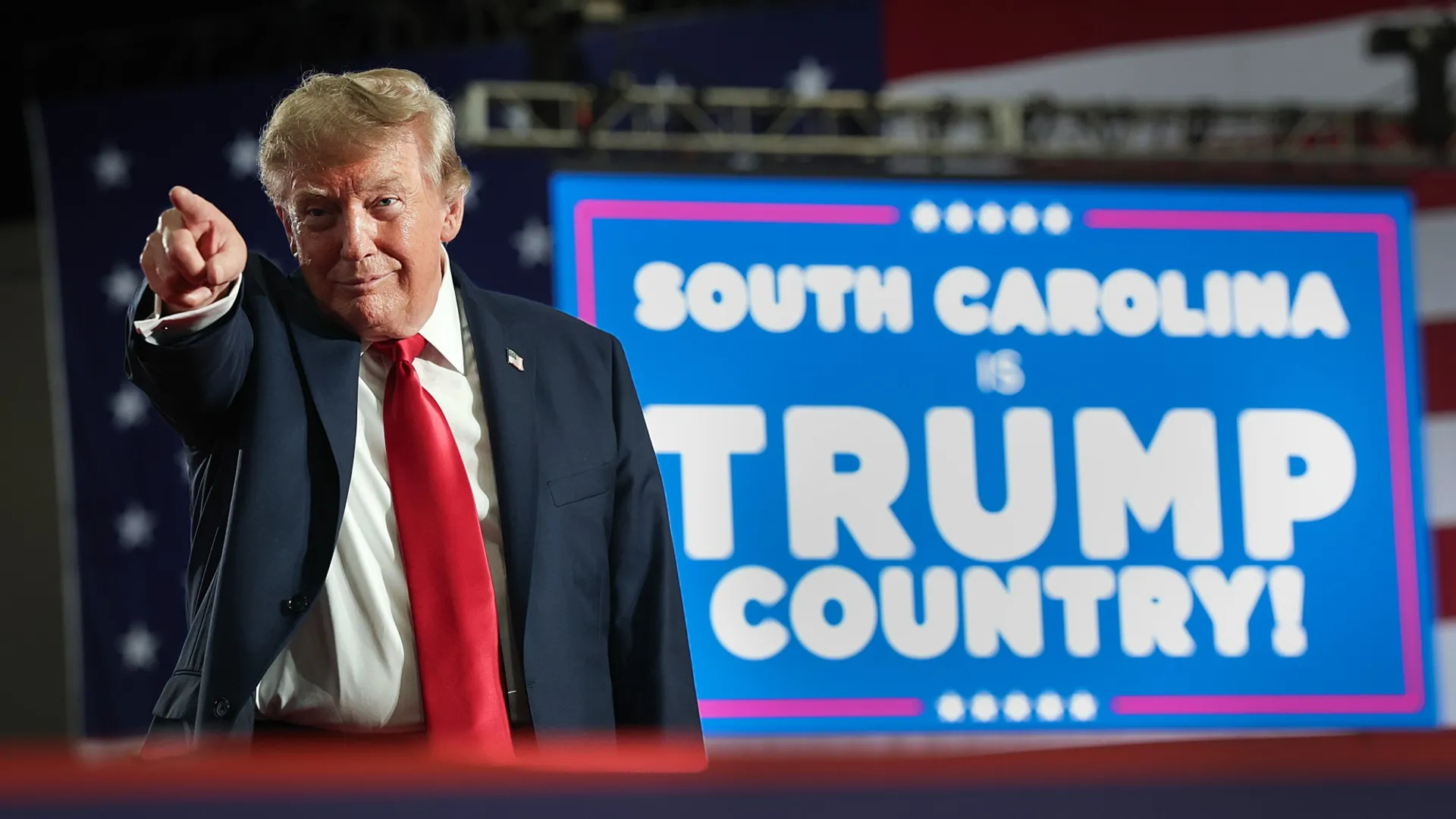
    Trump’s South Carolina playbook has the GOP on edge

    The president did not have his name on the ballot in South Carolina, but Senator Darline Graham’s narrow win over Rep. Ralph Norman in that state’s GOP Senate primary last week was a major victory for Trump. By pulling Graham over the electoral line, he reestablished himself as an electoral force to reckon with, even as his personal unpopularity threatens the GOP’s midterm prospects. 

    ‘Defied electoral expectations’
    Trump “stuck his neck out” on Graham’s behalf in a state that “twice in the last six months has rejected his preferences,” said The New York Times. Not only did the president visit Myrtle Beach to “rally supporters,” he “personally called high-level state officials” to “compel them to endorse” his candidate of choice. 

    The MAGA Inc. super PAC associated with the president’s inner circle, which was “notoriously wary to spend on races this cycle,” spent “nearly $800,000 on phone calls” for the Graham campaign, said the Times. The president’s pitch to voters was essentially to “treat Graham as an extension of himself,” said Politico.

    As he has “done often” since first being elected president, Trump “defied electoral expectations,” said the Times. South Carolina voters have “signaled that the party’s political identity and perhaps its fortunes remain tightly intertwined” with Trump, even as the GOP “begins to imagine what it might look like” after his presidency.

    ‘Darline treatment’
    While Trump may have carried Graham over the line, he “lost a lot of support in South Carolina” in the process, said The New Republic. Attendees “booed and jeered at mentions of the president’s name” during Norman’s concession speech to Graham in a sign of “palpable aggravation” over Trump’s “unwanted involvement in the contentious Senate runoff.”

    Adding to some Republicans’ frustrations is the fact that Trump has not yet “campaigned as hard” for other conservative candidates “looking to stem their party’s expected losses in the midterms,” said WPDE. After seeing how Trump carried Graham over the finish line, it’s “now or never,” said one GOP consultant to Politico regarding other campaigns seeking the “Darline treatment.” But with just months to go before polls close, it “doesn’t seem like there’s any sense of urgency.”


    QUOTE OF THE DAY

    ‘The FCC has no authority to punish journalists this administration doesn’t like. These threats to press freedom are dangerous. They undermine the foundation of our democracy.’

    Anna Gomez, the lone Democrat on the Federal Communications Commission, responding to Trump’s social media post claiming that NBC’s “Meet the Press” moderator Kristen Welker will be “reported to the FCC for rebuke or punishment” over a TV segment he didn’t like


    the explainer

    Is North Korea’s economic miracle sustainable?

    North Korea is the “world’s most surprising economic success story,” said The Wall Street Journal. Despite being tightly controlled, technologically backward and subject to crippling Western trade embargoes, the country has recorded year-over-year GDP growth of more than 3%, far exceeding many advanced economies.

    What has changed?
    Five years after making a rare admission that the nation’s economic policies were falling short, North Korean leader Kim Jong Un told the Workers’ Party Congress in a February speech that “everything has fundamentally changed.” But while he may have taken the credit, he “has Russia and China to thank” for the boom, said Forbes.

    North Korea has earned an estimated $14 billion providing military support to the Kremlin during the Ukraine war and hundreds of millions in trade and foreign aid from China. North Korea’s “emergence as a modern-day pirate state on the back of its lucrative cryptocurrency theft operations” has also helped, said Shreyas Reddy, of the analysis firm Korea Risk Group, to the Financial Times.

    What does it mean for North Korea?
    The Hermit Kingdom has used some of this windfall to modernise Pyongyang, building high-rise apartment blocks and brightly lit shopping districts filled with luxury and high-tech goods. Cars, once a rarity, are increasingly common and frequently electric and can now be hailed with ride-sharing apps.

    Outside the capital, the regime’s ambitious “20x10” regional development initiative aims to build new factories, housing and public infrastructure in 20 counties every year over 10 years. All of this is an “incredible accomplishment for a country that’s this poor,” said regional expert Stephan Haggard to the Wall Street Journal.

    Can it last?
    About 17 million of North Korea’s 27 million citizens are still believed to live in extreme poverty, The U.N. estimates that more than 40% of the country’s people are undernourished. 

    And analysts are sceptical that Kim can turn the short-term gains from the war in Ukraine into sustainable long-term growth. The country is in the throes of a “Russian sugar high,” said Peter Ward, of the Sejong Institute in Seoul, to the FT. It’s fueling a slew of “shovel-ready, exciting-looking projects that will catch the eye of the leader but aren’t necessarily sustainable.”


    Statistic of the day

    $10 million: The amount that a secret grand-jury report has found Republican Florida Gov. Ron DeSantis and his administration misappropriated. Of the $67 million settlement with a healthcare company “owed to Florida taxpayers,” $10 million was diverted to the nonprofit Hope Florida Foundation as “part of a sophisticated scheme to fund political activities,” according to the jurors, per CBS.


    in the spotlight

    New housing law could open the door to prebuilt homes

    The U.S. is plagued by a housing crisis. One possible solution is manufactured housing, which can be produced quickly and relatively cheaply. A new federal housing law could supercharge the sector’s expansion. But to succeed, manufactured housing must overcome the stigmas against mobile homes and trailer parks.

    Federal law, local codes
    Manufactured homes are quietly “filling the suburbs,” said The Washington Post. The dwellings were long looked down upon as “low-quality, less-safe housing” that was mostly “limited to trailer parks and rural properties” for decades, but higher-quality models are starting to spring up. Cost is a big factor, as the average price of a manufactured home is just $90,700.

    Prebuilt housing is the “most efficient, effective way to allow homeownership” in the U.S., said Joel Farkas of Fruition Communities, which is planning an 8,000-unit neighborhood in the Denver suburbs, to the Post. The median single-family home price now runs more than $400,000, and elevated mortgage rates are “suppressing housing turnover, constricting supply and inflating prices,” said the progressive think tank Groundwork Collaborative. 

    Sears prebuilt home kits in the early 20th century made housing widely available and relatively inexpensive for generations of Americans. A proposed program to “deliver 500,000 high-quality, factory-built homes” across the country would create a “permanently affordable” source of housing that harkens back to those Sears homes, said the Groundwork Collaborative. 

    The new federal housing law does not go as far as Groundwork’s proposal. But the legislation “aims to slash some of the red tape” that has hindered construction of manufactured housing, said The Wall Street Journal. 

    ‘More support’ needed
    One obstacle is that the feds “can only do so much” in a country where housing policies are largely set at the state and local levels, said the Journal. And manufactured housing still has its own “affordability problem” even with the red tape stripped out, said Politico. 

    Loans to buy such housing are different from regular mortgages and often feature interest rates “near double digits” that can “lock out many prospective buyers,” said the outlet. Now, some members of Congress want “more federal government support” to make factory-built home loans cheaper.


    Good day ✈️

    … for cooler skies. A U.K. government trial called Operation Blue Skies could provide a plane-diverting solution to the condensation trails, or contrails, caused by aircraft engine emissions that warm the planet. Scientists will use AI to predict the areas where contrails are most likely to form, and air-traffic controllers will then direct pilots to avoid them. 


    Bad day 🎾

    … for tennis greats. Novak Djokovic is out after a grueling first-round match against Argentina’s Mariano Navone at New York’s U.S. Open. The Serbian hadn’t lost in a first round in more than 20 years. And Venus Williams is out after falling in straight sets of the first round — possibly her final Grand Slam singles match — to fellow American Sofia Kenin.


    Picture of the day

    Raging waters

    People wait near the Silver Bridge amid flash flooding in Arizona’s Grand Canyon National Park. At least two people are dead and more than 15 others are unaccounted for after significant floods destroyed footbridges, “forcing evacuations and prompting officials to ask the public for help locating hikers,” said KTLA.
    Wieke De Boer / Reuters


    Puzzles

    Daily sudoku

    Challenge yourself with The Week’s daily sudoku, part of our puzzles section, which also includes guess the number

    Play here


    The Week recommends

    The best chef memoirs to put on the front burner

    Based on Anthony Bourdain’s first and most beloved memoir, “Kitchen Confidential” (2000), this summer’s “coming-of-age” film “Tony” is set during a summer restaurant job that “helped shape the beloved late chef and TV host into the icon he ultimately became,” said Deadline. Bourdain (pictured above with chef Eric Ripert) is considered “one of the best food memoirists of all time,” said Izzy Titherington at The i Paper. And these chef-writers follow in Bourdain’s tell-all food-steps.

    ‘Accidentally on Purpose’ 
    Kristen Kish “interlaces kitchen anecdotes, the rigors of culinary school and restaurant life with deeper reckonings about identity, belonging and love,” said Saskia Kemsley at The Standard. She writes “candidly” about coming out, the “pressures and pleasures of professional kitchens” and how “comfort can take shape in both food and relationships.” 

    ‘The Devil in the Kitchen’
    Marco Pierre White gives us an insight into the “obsession and sacrifice” behind his journey as the “youngest-ever chef in the U.K. (and the youngest anywhere at the time) to earn three Michelin stars and then the first to give them all back,” said Titherington. “The Devil in the Kitchen: Sex, Pain, Madness and the Making of a Great Chef” follows him through his working-class upbringing in Leeds and his subsequent “rise as one of the culinary world’s original rock-star chefs.”

    ‘Salt, Sweat & Steam’
    In Brigid Washington’s “fast-moving coming-of-age” memoir, there are “injuries, flirtations, squabbles, name-drops and dishes gone awry,” said Bettina Makalintal at Eater. “Salt, Sweat & Steam: The Fiery Education of an Accidental Chef” has been described as “‘The Devil Wears Prada’ for the ‘yes chef’ generation,” as Washington explores her “grueling” days at the Culinary Institute of America. 

    Read more


    Poll watch

    About seven in 10 Americans (72%) think it’s “extremely” or “very” important that doctors and other providers tell them if they are using artificial intelligence in their healthcare, according to a Pew Research Center survey of 3,488 U.S. adults. More than half (53%) believe they have not much or no say about whether a provider uses AI. 


    INSTANT OPINION

    Today’s best commentary

    ‘Uzbekistan’s startups could give the US an edge in Central Asia’
    Bruno S. Sergi at Newsweek
    A “few years ago, the idea of a billion-dollar Uzbek tech company would have sounded far-fetched,” but “today, investors are searching for the next Uzum, Uzbekistan’s largest digital ecosystem,” says Bruno S. Sergi. This is “exactly why Uzbekistan matters.” If the U.S. “wants Central Asia in its orbit and not locked into Russian surveillance tech, Chinese AI models and processing of its critical minerals, it needs a success story that’s not built on sanctions or pressure but on commerce.”

    ‘Tanzania’s dam is a massive moment for African self-finance’
    Mihir Sharma at Bloomberg
    Tanzania’s new hydroelectric dam has “doubled domestic generation capacity,” and that’s the “sort of energy abundance even developed countries dream of,” says Mihir Sharma. The country has “achieved this almost entirely on its own dime.” Given the “many pitfalls associated with big dams, it’s remarkable that Tanzania has pulled this off.” Western investors have “turned away from big projects in the emerging world and from hydropower in particular,” but countries are “discovering they can do it for themselves.”

    ‘Why we love watching robots fail’
    Kyle MacNeill at Time
    Robotic “tumbling records will likely be, in the pop cultural consciousness, eclipsed by something far more entertaining: tumbling robots,” says Kyle MacNeill. Along with the “epic wins, there have been some seriously old-school, epic fails,” and these “slapstick scenes are deliciously satisfying.” This robot “schadenfreude is fueled by a fear of the future,” as “pointing out their flaws makes humanity’s finish line feel further away, even if that’s a highly unintelligent thing to think.”


    WORD OF THE DAY

    paralarval

    The first life-cycle stage of a cephalopod. Scientists have released 130,000 octopus paralarvae into the Adriatic Sea in a creative attempt to address growing numbers of invasive fish-gobbling blue crabs in Italian waters. When fully grown, the octopuses could eat up to four crabs per day.


    Evening Review was written and edited by Will Barker, Nadia Croes, Scott Hocker, Anya Jaremko-Greenwold, Justin Klawans, Joel Mathis and Rafi Schwartz.

    Image credits, from top: Win McNamee / Getty Images; KCNA via KNS / AFP / Getty Images; Glen Martin / The Denver Post / Getty Images; Owen Hoffmann / Patrick McMullan / Getty Images
     

    Recent editions

    • Morning Report

      Iran war veers back into dueling strikes

    • Sunday Shortlist

      Wile E. Coyote takes Acme to court

    • Saturday Wrap

      Natalie Harp’s outsized influence

    VIEW ALL
    TheWeek
    • About Us
    • Contact Future's experts
    • Terms and Conditions
    • Privacy Policy
    • Cookie Policy
    • Advertise With Us
    • FAQ
    Add as a preferred source on Google Add as a preferred source on Google

    The Week is part of Future US Inc, an international media group and leading digital publisher. Visit our corporate site.

    © Future US, Inc. Full 7th Floor, 130 West 42nd Street, New York, NY 10036.