The Week US
flag of US
US
flag of UK
UK
https://cdn.mos.cms.futurecdn.net/flexiimages/jacafc5zvs1692883516.jpg

SUBSCRIBE & SAVE

Less than $3 per week

Sign in
  • View Profile
  • Sign out
  • The Explainer
  • The Week Recommends
  • Newsletters
  • Cartoons
  • From the Magazine
  • The Week Junior
  • More
    • Politics
    • World News
    • Business
    • Health
    • Science
    • Food & Drink
    • Travel
    • Culture
    • History
    • Personal Finance
    • Puzzles
    • Photos
    • The Blend
    • All Categories
  • Newsletter sign up Newsletter
  • The Week Evening Review
    The VP’s war critique, Trump’s Russian deference, and Catholics’ war theory

     
    in the spotlight

    Vance makes his post-midterms move

    Just 24 hours after his party’s midterm drubbing, Vice President JD Vance offered a pointed diagnosis of why MAGA lost: frustration over the Iran war. Despite couching his critique with brief genuflections toward President Donald Trump, Vance’s lengthy missive on X yesterday about why Republicans lost has been taken by some as a deliberate schism point between himself and the administration he ostensibly helps lead. With two years left of the Trump White House and a presumptive presidential run of his own after that, Vance seems set on not allowing this week’s losses to limit his political future.

    ‘Astonishing, if implicit, rebuke’
    Vance’s statement represents a “striking acknowledgment” from a sitting vice president that his own administration’s “handling” of the Iran war has “become a political liability for Republicans,” said Politico. The “blunt assessment” comes as “speculation mounts over his own political future,” said Fox News. His remarks signify a “shift in his public assessment of the war’s consequences” after “previously defending aspects of the administration’s military campaign.”

    While the vice president “expressed some reluctance” in the early days of Trump’s Iran war plans, he ultimately embraced the “spineless sycophantism we have come to expect,” said The New Republic. After the Democrats’ seismic midterm performance, however, Vance “promptly threw the president under the bus.” The veep’s “astonishing, if implicit, rebuke” of a president he has backed “consistently and unequivocally for years” suggests the GOP is entering an era of “competing factions” that “more openly jockey for influence,” said HuffPost.

    ‘Better late than never’
    Trump detractors have “delighted in watching the in-fighting,” said Mediaite. Some Republicans have already embraced Vance’s pivot, including outgoing Rep. Thomas Massie (R-Ky.), a frequent critic of Trump’s foreign policy. “Better late than never,” said Massie, asserting he had been “right about everything” in response to Vance’s social media post.

    When asked about whether the Iran war should be blamed for Republicans’ loss in the midterms, Trump “essentially agreed with Vance,” said HuffPost. Vance’s critique is “largely true” because the war “drove the gasoline up a little,” said the president to reporters. However, he added, “if I had to do it again, I’d have to do it again.”


    QUOTE OF THE DAY

    ‘This is [as] close to an extinction-level event for Republicans in many parts of the country as we have seen probably in the last 100 years.’

    Florida Gov. Ron DeSantis (R) at a press conference on GOP midterm losses. The massive Republican defeat is a “worst-case scenario” that can “reverberate for the next decade or more,” added DeSantis, whose term as governor ends in January. 


    today’s big question

    Will Trump lose congressional Republicans over Russia?

    The Democratic victors in Tuesday’s races do not take office until January, and President Donald Trump wants lame-duck legislators to pass his proposed $1.5 trillion defense budget in the remaining weeks his party still has leverage on Capitol Hill. But some of his GOP allies, grumpy about the election results and Trump’s overtures to Russia, may not play along.

    What did the commentators say?
    A “handful of defections” by Republican defense hawks could “jeopardize Trump’s entire defense agenda,” said Politico. Some members of the president’s party are unhappy with his choice to allow Russian fuel sales and waive sanctions on Russian President Vladimir Putin’s regime, and they still want answers about the recent throttling of Starlink access to Ukraine. Trump “can’t even see Russia as our adversary,” said outgoing Rep. Don Bacon (R-Neb.) to the outlet. “Why do I want to fund his agenda?”

    The “growing pushback” even extends to Trump’s staunchest allies, said Reuters. Putin “cannot be trusted,” and there could be “unintended consequences” from sanctions relief, said House Speaker Mike Johnson to Fox News before the midterm election. 

    Several House and Senate Republicans signed letters last month objecting to the diesel and sanctions decisions. Their frustration could “pose new hurdles” for the president’s defense and spending bills during the lame-duck session, said Reuters.

    Outgoing Sen. Mitch McConnell (R-Ky.), an occasional Trump antagonist, might be the most notable opponent. Passing the defense bill will require the support of Republicans who “know the difference between the good guys and the bad guys,” said McConnell at The Wall Street Journal. Trump should “plan accordingly” and end the “obeisance” to Putin.

    What next?
    Trump’s lame-duck agenda will “run into a brick wall” if defeated GOP incumbents decide to play hooky during their final weeks in office, said The Hill. These candidates often “lose their appetite to stick around Washington” during the last weeks of their term. Some of them will also “blame Trump on election results,” said Bacon to the outlet, and that will “factor in.”


    Statistic of the day

    350,000: The estimated number of trees felled by Google at two sites in Finland to make way for data centers, according to the Finnish Association for Nature Conservation. More than 93,000 Finns have signed a petition for data center regulation and compensation for environmental damage. 


    talking points

    Is the Catholic Church’s just-war theory obsolete?

    For more than 1,000 years, the Catholic Church has used its just-war theory to create moral guardrails for when nations choose to fight and how their armies conduct themselves in combat. But now, under the guidance of Pope Leo, it’s having second thoughts.

    Just cause, just means?
    There’s “no such thing as a holy war; only peace is holy,” Leo (pictured above) said last month at a religious conference, per Christopher Hale at Letters from Leo. The pope sparked the ire of President Donald Trump earlier this year by criticizing the U.S. war against Iran, and his continued anti-war messaging shows “he means it,” said Hale. The Church is now reviewing its “outdated” just-war doctrines in a reaction against “every leader who has tried to draft heaven into a bombing campaign.”

    The theory says a war is justified only if waged for a “just cause” and with “just means,” said Luis Parrales at The Atlantic. This guidance has influenced instruction at military academies and the development of human rights laws. 

    But there’s a sense that the doctrine is “prone to abuse” by national leaders who have twisted and bent its tenets to dubiously assert their chosen conflicts’ morality, said Parrales. So the Church’s current task is to create a “successor theory that better addresses the many moral challenges that modern-day wars pose.”

    ‘Necessary and therefore just’
    Just-war theory “fails to adequately train peacemakers,” said Eli McCarthy at the outlet U.S. Catholic. Leaders must “cultivate strategic nonviolent practices” and build institutions that make “sustainable peace” possible. Existing doctrine only makes wars “more likely to continue.”

    Critics suggest that abandoning just-war principles would risk “dangerous passivity in the face of aggression,” said the National Catholic Register. “All wars are bad,” said John Rist, a church historian and philosopher, to the outlet. But sometimes it’s “necessary and therefore just” to fight. This “unhappy truth” must be acknowledged. Because “appeasing the wicked and supposing one needs only to ‘accompany’ them or ‘dialogue’ with them is itself irresponsible.”


    Good day 👖

    … for elevated-fashion fans. The newly announced Met Gala theme, “extraORDINARY: Fashion and the Poetics of the Everyday,” will celebrate the transformation of standard clothing items like jeans into high-fashion pieces. It will explore how designers “rework familiar garments, everyday objects and commonplace materials,” said New York’s Metropolitan Museum of Art in a statement.


    Bad day ⚽

    … for Portuguese soccer fans. Cristiano Ronaldo has announced he’s retiring from Portugal’s international team. The 41-year-old, who currently plays for Saudi club Al-Nassr, made the decision after a falling out with coach Jorge Jesus for being named a substitute in this summer’s World Cup.


    Picture of the day

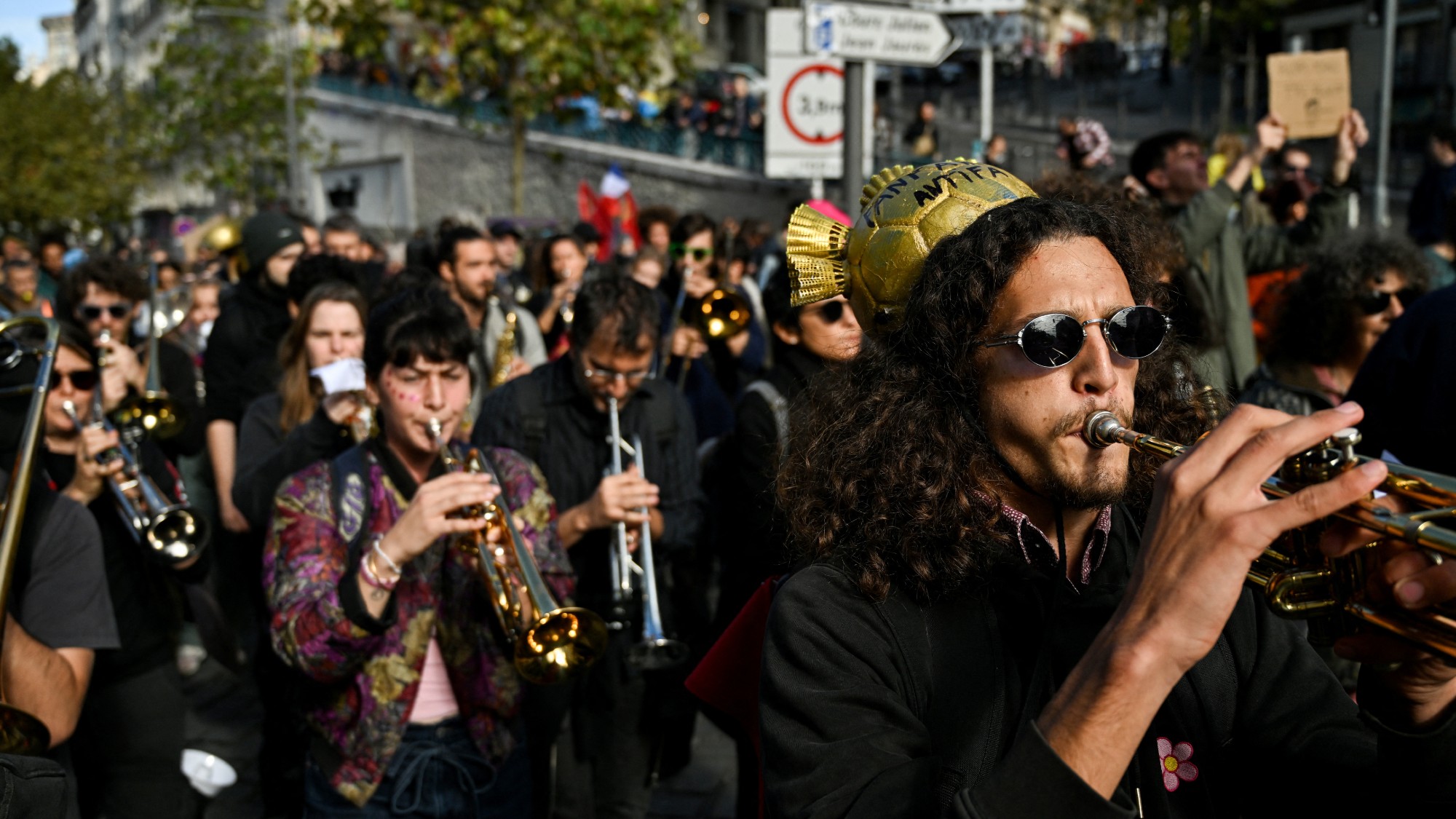
    Notes of discord

    A band plays at a demonstration in Marseille, France. Hundreds of thousands of workers across the country are on strike today, as student-led rallies against educational failings continue to expand into wider protests about the cost of living.
    Justine Meddah / AFP / Getty Images


    Puzzles

    Daily sudoku

    Challenge yourself with The Week’s daily sudoku, part of our puzzles section, which also includes guess the number

    Play here


    The Week recommends

    The most thrilling of thriller books

    Thrillers come in many styles, from mind-numbingly psychological to high-octane crime. These are the most gripping novels of all time.

    ‘Strangers on a Train’ (1950)
    Patricia Highsmith is better known for “The Talented Mr. Ripley,” but “Strangers on a Train” might be her “greatest book, reeling us in from the very beginning,” said Collider. The author’s “genius lies in” shifting the focus “away from the murders themselves” and toward the “psychological burden that follows.” ($17, W. W. Norton & Company)

    ‘Mystic River’ (2001)
    The consequences of an incident between three boyhood friends in 1970s Boston ripple for decades. When one of the trio’s teen daughters is murdered 25 years later, the book becomes an “enthralling study” in “remorse, revenge and the long tail of emotional trauma” told in Dennis Lehane’s “inimitably tender and profane style,” said The New York Times. ($20, HarperCollins)

    ‘In the Woods’ (2007)
    Tana French has established herself as one of the greats in the thriller genre, and her debut novel, “In The Woods,” remains one of her finest. Detective Rob Ryan is called to investigate a murder in the same woods where his childhood friends disappeared. It’s a “stone-cold stunner” of a book,” said Electric Lit. ($19, Penguin Books, Amazon)

    ‘The Girl with the Dragon Tattoo’ (2008)
    Swedish writer Stieg Larsson’s “Millennium juggernaut” began with this book (translated into English by Reg Keeland), said The New York Times. It introduces goth-punk Swedish computer hacker Lisbeth Salander, whose “technical brilliance is matched only by her antisocial tendencies.” ($19, Vintage Crime / Black Lizard)


    Poll watch

    Almost half of Americans (46%) don’t want AI to have “anything to do” with making health insurance claim decisions, according to a Pew Research Center survey of 3,488 adults. And only 5% are open to AI making these decisions without any human oversight. 


    INSTANT OPINION

    Today’s best commentary

    ‘Now it’s clear who could save the Democratic brand’
    Oliver Libby at The Washington Post
    Democrats saw two “seemingly contradictory” things happen on Tuesday, says Oliver Libby. Some safe blue seats became more progressive, and “more interestingly, almost every toss-up victory was won by a centrist Democrat.” This “powerful new generation” of “radical moderates” won by “painting a vision” of an America that “has people’s backs, without holding them back.” If successful, they will “define the party’s vision” for generations, “rehabilitating a brand that’s nearly as unpopular as the president’s.”

    ‘Elon Musk’s very bad night’
    Michelle Goldberg at The New York Times
    The election was an “epic repudiation of the president,” but it was also a “democratic rebuke of Silicon Valley,” says Michelle Goldberg. After Trump, there was “no bigger loser” than Elon Musk, who “spent over $400 million backing Republicans.” Shares in SpaceX and Tesla “plunged even as the broader stock market soared” yesterday, while Congress is preparing investigations into the “tech overlords” who spent the past two years “sucking up” to the president.

    ‘Now that Democrats won, let’s make the GOP’s fears come true’ 
    Rex Huppke at USA Today
    After a “historic” election that showed Trump he’s “less popular than scabies,” wokeness is “officially back,” says Rex Huppke. That means “we are doing all the things that terrify Republicans.” The “grand Republican experiment” of “beating down progressivism” and “cruelly pretending diversity isn’t a thing” ended “with a thud,” as Americans got a look at “widespread right-wing jerk-ism” and “democratically” responded with “oh, hell no.” Buckle up, “Fox News viewers.” The “libs are comin’ for ya.”


    WORD OF THE DAY

    nanovaccine

    A vaccine that uses nanoparticles — microscopic particles that measure less than 100 nanometers — to deliver antigens to the body. MIT scientists have developed a unique cancer nanovaccine using a fiber that can be “coated with cancer antigens,” said the university in a release. This could allow for “personalized” vaccines to “treat individual patients’ tumors.”


    Evening Review was written and edited by Theara Coleman, Nadia Croes, Scott Hocker, Anya Jaremko-Greenwold, Justin Klawans, Joel Mathis and Rafi Schwartz, with illustrations by Stephen Kelly and Julia Wytrazek.

    Image credits, from top: Illustration by Julia Wytrazek / Getty Images; Illustration by Stephen P. Kelly / Getty Images; Christopher Furlong / Getty Images; W. W. Norton & Company / William Morrow / Penguin / Knopf
     

    Recent editions

    • Morning Report

      Hegseth in the political crosshairs after GOP rout

    • Evening Review

      Singing the blues

    • Morning Report

      Blue tsunami

    VIEW ALL
    TheWeek
    • About Us
    • Contact Future's experts
    • Terms and Conditions
    • Privacy Policy
    • Cookie Policy
    • Advertise With Us
    • FAQ
    Add as a preferred source on Google Add as a preferred source on Google

    The Week US is part of Future US Inc, an international media group and leading digital publisher. Visit our corporate site.

    © Future US, Inc. Full 7th Floor, 130 West 42nd Street, New York, NY 10036.