Sign up to get Today’s Best Articles in your inbox
Join 350,000+ subscribers and keep yourself informed with a selection of
The Week’s most interesting, enlightening and entertaining stories - plus daily puzzles.
You are now subscribed
Your newsletter sign-up was successful
Want to add more newsletters?
An account already exists for this email address, please log in.
Swedish elections on a knife-edge
A ‘razor-thin’ victory for the centre-left is forecast but not certain, in a result that tests the temperature of European politics
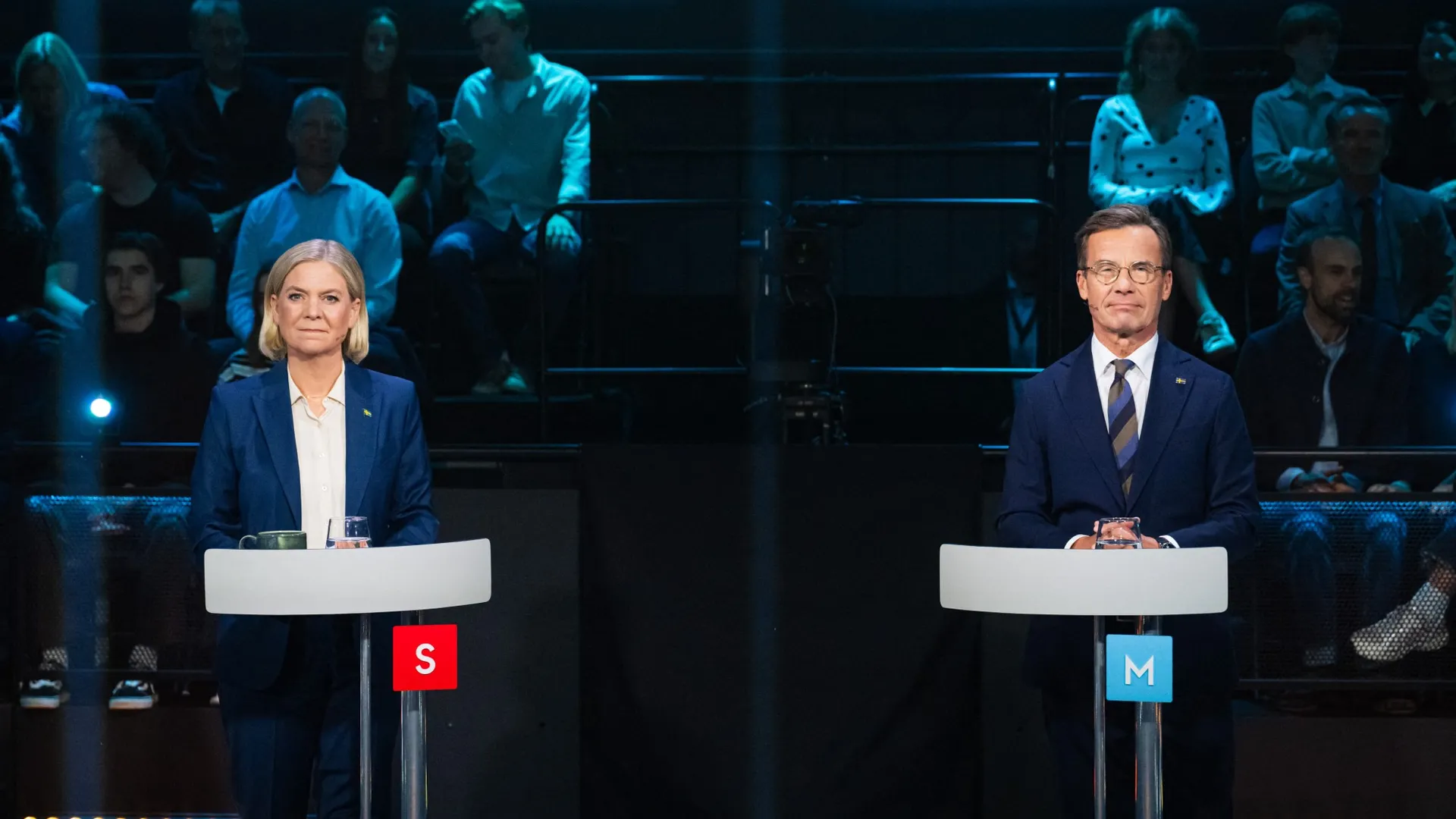
Magdalena Andersson of the centre-left Social Democrats seems to have a narrow lead over centre-right Moderate and current prime minister Ulf Kristersson
(Image credit: Jonathan Nackstrand / AFP / Getty Images)
Preliminary results from Sweden’s general election suggest a narrow three-seat lead for the centre-left opposition over the right-wing ruling bloc that had promised ministerial seats to the far-right.
The election is being fought on multiple fronts. Current prime minister and leader of the centre-right Moderate party, Ulf Kristersson, has been fighting for re-election on a platform of cutting asylum numbers and reducing gang shootings, while Magdalena Andersson, leader of the centre-left Social Democrats, has been focusing on the economy, the welfare state and suppressing the country’s growing far-right faction.
Like many nations across Europe, Sweden “has been subject to increased fragmentation” in its politics, said the Financial Times. The closeness of the votes so far herald “weeks of uncertainty” and protracted coalition talks. And the final result, and the fate of the far-right, will be closely watched elsewhere in Europe, where similar nationalist movements are gaining ground.
The Week
Escape your echo chamber. Get the facts behind the news, plus analysis from multiple perspectives.
Join more than 350,000 subscribers and keep yourself informed with a selection of The Week’s most interesting, enlightening and entertaining stories - plus daily puzzles.
Join more than 350,000 subscribers and keep yourself informed with a selection of The Week’s most interesting, enlightening and entertaining stories - plus daily puzzles.
There are currently eight political parties in Sweden, and they are fighting this election in two major blocs: the Moderates, the Sweden Democrats, the Christian Democrats and the Liberals on the right, and the Social Democrats, the Left Party, the Centre Party, and the Green Party on the left.
Sweden uses a “mandate distribution” voting system, a type of proportional representation. To get “mandates”, or seats, in the Riksdag, the Swedish parliament, a party must pass the minimum threshold of 4% of the vote. After that, roughly speaking, a party that gets, say, 20% of the vote will get 20% of the seats.
This means that “coalitions are the norm”, said Politico. And in those coalition-building efforts, “Sweden’s smaller parties often have outsized influence”. With the “razor-thin victory margin” currently projected for the left, “that will be true again this time”.
Why has this election been so tight?
Party campaigns this year were “unusually heated and polarised”, said The Guardian. There have been months of “personal attacks between leaders, accusations of misinformation and Maga-inspired ads”.
Sign up to get Today’s Best Articles in your inbox
A free daily email with the day’s biggest news and analysis – and the best features from TheWeek.com
The friction between the two main blocs has been growing since the right-wing coalition “broke a long-standing taboo” by partnering with the Sweden Democrats, an anti-immigration party with “neo-Nazi roots”. Kristersson has promised members of the party cabinet positions, should the right-wing bloc be re-elected.
With a campaign slogan of “Make Sweden Sweden again” – clearly aligning itself with Donald Trump’s Maga movement – the Sweden Democrats’ policies include banning headscarves and expanding a “repatriation grant” worth SKr350,000 (£27,000) to immigrants who have already become Swedish citizens. They have run bus advertisements, saying “Do you miss Mogadishu? The repatriation grant will help you get home”. One of their MPs “recently called for Muslims to simply ‘stop being Muslims’”, said The Economist, and their leader, Jimmie Åkesson, casting his vote in an immigrant neighbourhood in northern Stockholm announced that “Sweden shouldn’t look like this”.
Why does it matter?
The shifts in the balance of power triggered by this election will not only affect government decisions on taxation, welfare, health, education and crime but also “shape decisions affecting communities with limited influence over Stockholm politics” said The European Times. These include disputes over industrial development on Indigenous land, most prominently near Kiruna, which could impact the remaining Sámi reindeer-migration corridor.
This election has broader implications across the continent, too. If European centrists were hoping to take lessons from Sweden on how to beat the populist right, these “confusing” results make things “far from clear”, said The Economist. Although Sweden Democrats have suffered their first decline in support since their founding, they won’t be “too unhappy”. The party that was previously ostracised has now “attained mainstream acceptance that was once unthinkable”.
What will happen next?
It’s unlikely a final election result will be announced until Wednesday or Thursday. “Hundreds of thousands of overseas votes and late ballots” are still to be counted, said the Financial Times. Overseas votes in particular “typically skew conservative, so the final result is still considered too close to call” by some experts.
Once all the votes are in, “there is likely to be intense wooing of the smaller parties in the middle of the political spectrum”. And these talks are “likely to be protracted”. Both Kristersson and Andersson have “hinted that they might try to form centrist coalitions”.
Will Barker joined The Week team as a staff writer in 2025, covering UK and global news and politics. He previously worked at the Financial Times and The Sun, contributing to the arts and world news desks, respectively. Before that, he achieved a gold-standard NCTJ Diploma at News Associates in Twickenham, with specialisms in media law and data journalism. While studying for his diploma, he also wrote for the South West Londoner, and channelled his passion for sport by reporting for The Cricket Paper. As an undergraduate of Merton College, University of Oxford, Will read English and French, and he also has an M.Phil in literary translation from Trinity College Dublin.