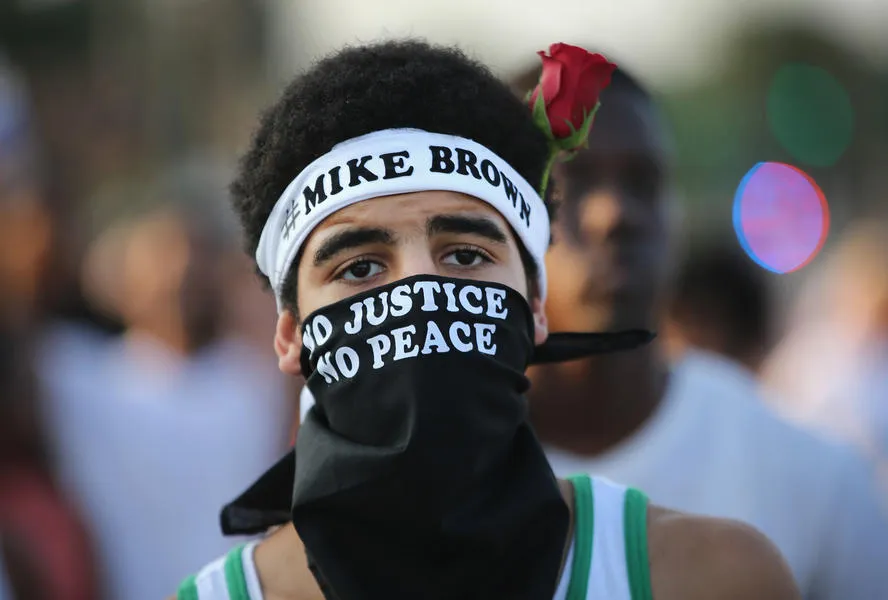
Police in Ferguson call Tuesday night's lower-key protests 'a turning point'
There were sporadic clashes on Tuesday night and Wednesday morning in Ferguson, Missouri, but the protests were mostly peaceful, smaller than before, and Missouri State Highway Patrol Capt. Ron Johnson called the night "a turning point" in the 10 days of protests sparked by the police shooting of Michael Brown.
This is Johnson's definition of "turning point," delivered at a press conference early Wednesday: "We had to respond to fewer incidents than the night before. There were no Molotov cocktails tonight. There were no shootings." There were 47 arrests, however, and police seized three loaded handguns during the protests. "Criminals and agitators" threw glass and plastic bottles, some filled with urine, at police, Johnson added. And police sometimes responded with blasts of pepper spray.
Police and state officials blame the violence during the protests largely on agitators from other cities and states, mostly young men — one guy booked Monday is from Austin, and this was his third arrest of the protest, Johnson noted — but arrest records show that most of the people detained during the protests are from Ferguson and elsewhere in St. Louis County, the St. Louis Post-Dispatch reports.
The Week
Escape your echo chamber. Get the facts behind the news, plus analysis from multiple perspectives.
Sign up for The Week's Free Newsletters
From our morning news briefing to a weekly Good News Newsletter, get the best of The Week delivered directly to your inbox.
A free daily email with the biggest news stories of the day – and the best features from TheWeek.com
Peter has worked as a news and culture writer and editor at The Week since the site's launch in 2008. He covers politics, world affairs, religion and cultural currents. His journalism career began as a copy editor at a financial newswire and has included editorial positions at The New York Times Magazine, Facts on File, and Oregon State University.
-
Is Europe finally taking the war to Russia?Today's Big Question As Moscow’s drone buzzes and cyberattacks increase, European leaders are taking a more openly aggressive stance
-
How coupling up became cringeTalking Point For some younger women, going out with a man – or worse, marrying one – is distinctly uncool
-
The rapid-fire brilliance of Tom StoppardIn the Spotlight The 88-year-old was a playwright of dazzling wit and complex ideas
-
GOP wins tight House race in red Tennessee districtSpeed Read Republicans maintained their advantage in the House
-
Trump targets ‘garbage’ Somalis ahead of ICE raidsSpeed Read The Department of Homeland Security will launch an immigration operation targeting Somali immigrants in the Minneapolis-St. Paul area
-
Hegseth blames ‘fog of war’ for potential war crimespeed read ‘I did not personally see survivors,’ Hegseth said at a Cabinet meeting
-
Canada joins EU’s $170B SAFE defense fundspeed read This makes it the first non-European Union country in the Security Action for Europe (SAFE) initiative
-
Appeals court disqualifies US Attorney Alina HabbaSpeed Read The former personal attorney to President Donald Trump has been unlawfully serving as US attorney for New Jersey, the ruling says
-
White House says admiral ordered potential war crimeSpeed Read The Trump administration claims Navy Vice Adm. Frank ‘Mitch’ Bradley ordered a follow-up strike on an alleged drug-smuggling boat, not Pete Hegseth
-
Honduras votes amid Trump push, pardon vowspeed read President Trump said he will pardon former Honduran president Juan Orlando Hernández, who is serving 45 years for drug trafficking
-
Congress seeks answers in ‘kill everybody’ strike reportSpeed Read Lawmakers suggest the Trump administration’s follow-up boat strike may be a war crime