-
President Trump is reportedly terrified of stairs
January 30, 2017 -
Here's what Trump can and can't do with the $200 million he raised on election fraud claims
December 19, 2020 -
Trump reportedly considered appointing controversial lawyer Sidney Powell to lead election fraud investigation
December 19, 2020 -
Trump again shows 'reluctance' to criticize Russia after suggesting China may have been behind cyberattack
December 19, 2020 -
Moderna's COVID-19 vaccine has reached distribution centers
December 19, 2020 -
Marco Rubio latest lawmaker to receive COVID-19 vaccine
December 19, 2020 -
Stanford's vaccine distribution woes could be 'harbinger' of broader issue, left-out doctors say
December 19, 2020 -
Pompeo explains why it's 'wiser' for Trump to keep quiet about suspected Russia hack
December 19, 2020
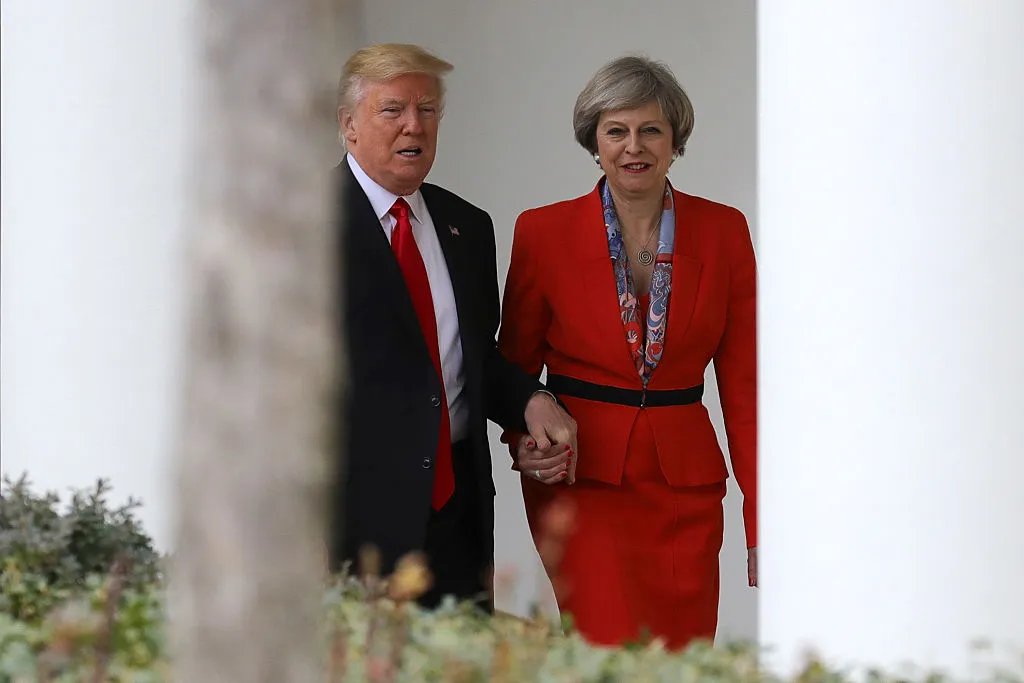
President Donald Trump and U.K. Prime Minister Theresa May were spotted holding hands last week, but it was more than just a sweet display of friendship, The Times of London reports. "Downing Street officials claimed the president's phobia of stairs and slopes led him to grab the prime minister's hand as they walked down a ramp at the White House," the Times writes.
In a deep-dive into Trump's potential stairs phobia, Jezebel rediscovered a September report by The Washington Post in which a waiter at Trump's D.C. hotel said that Trump, "for security reasons … didn't venture higher [than the first floor] out of concern that someone might push him."
There is also this:
The way President Obama runs down the stairs of Air Force 1, hopping & bobbing all the way, is so inelegant and unpresidential. Do not fall!
— Donald J. Trump (@realDonaldTrump) April 23, 2014
There are eight staircases in the White House. Trump, luckily, can stick to one of the three elevators. Jeva Lange
"I can think of no other president who has set up a leadership PAC immediately after losing an election and begun fundraising for it furiously. This is entirely, entirely unique," Brendan Fischer, a campaign finance specialist at the Campaign Legal Center, told The Guardian in reference to President Trump, who has reeled in around $200 million after asking donors to back his fight to overturn the presidential election.
Trump won't win that fight, especially after the Supreme Court got involved and the Electoral College sealed President-elect Joe Biden's victory, but the money is "basically going to be the vehicle for Trump's post-White House political operation," Fischer predicts.
There are certain things he legally cannot do with the funds — for starters, the money can't be used to resolve any legal or financial problems he may face after leaving office, and it also can't support a potential 2024 presidential run. It can, however, lay the groundwork for that campaign, Fischer said. But the money would likely be most useful if it went to another candidate who would perhaps act as a successor of sorts. "It can potentially pay for rallies in support of another candidate," Fischer said. "It can be used to pay for ads that are run ostensibly independently of the candidate that he's supporting."
Of course, that would mean Trump has to be interested in more than his own personal success. "Is he savvy enough as a political operator to use that money to essentially build a broad coalition in which he is the center and the doler-out of the money that could strengthen his political position?," asked Jennifer Victor, an associate professor of political science at George Mason University. "It's hard to say because his political movement so far has been so centered around himself." Read more at The Guardian. Tim O'Donnell
The Trump campaign may have distanced itself from attorney Sidney Powell in its longshot fight to overturn the presidential election results, but President Trump has another job in mind for the controversial lawyer, The New York Times reports.
During a Friday meeting at the White House, Trump discussed making Powell a special counsel investigating voter fraud, two people briefed on the discussion told the Times. The president's advisers were reportedly not fond of the idea — Powell has largely fallen out of favor even among Trump's most ardent loyalists because she's pushed baseless conspiracy theories that Trump's loss stemmed from a Venezuelan plot involving corrupted voting machines.
Powell was at the White House for the meeting, which reportedly became "raucous" at times, and accused Trump's advisers of being quitters, the Times' sources said. Trump's personal lawyer Rudy Giuliani and White House counsel Pat Cipollone were reportedly two of the people who rejected the idea.
Per the Times, the meeting also involved a discussion about an executive order to take control of voting machines to examine them. Giuliani has reportedly made separate but similar calls for the Department of Homeland Security to seize the machines, only to be told the department does not have the authority to do so. Read more at The New York Times. Tim O'Donnell
Secretary of State Mike Pompeo on Friday said the "wiser" course for President Trump would be to refrain from commenting on the alleged Russian cyberattack which targeted several U.S. federal agencies and companies. But the president didn't completely follow that advice Saturday, when he expressed his views on the matter over Twitter.
Trump broke with the consensus by suggesting that China, not Russia, may have been the perpetrator, and that the urge to blame Russia stems from the media's fixation on Moscow as an antagonist. He didn't outright accuse Beijing or dismiss the possibility of the Kremlin's involvement, but the ambiguity of his comments is a departure from U.S. intelligence agencies and Pompeo himself, who said Russia was "pretty clearly" behind the incident.
The president also worked in another unfounded allegation of voter fraud, hinting that the cyberattack could have led to a hit on U.S. voting machines, costing him the election. There is no evidence to support any of those claims.
....discussing the possibility that it may be China (it may!). There could also have been a hit on our ridiculous voting machines during the election, which is now obvious that I won big, making it an even more corrupted embarrassment for the USA. @DNI_Ratcliffe @SecPompeo
— Donald J. Trump (@realDonaldTrump) December 19, 2020
The comments were viewed by some as one more example of Trump's reluctance to potentially anger Russian President Vladimir Putin, a frequent criticism hurled at him throughout his time in the White House. Tim O'Donnell
Trump's first remark on a giant hack that went undetected for months, whose severity isn't fully known and which his own secretary of state says was done by Russia is to suggest it wasn't, showing how his reluctance to criticize Russia has persisted throughout his presidency.
— Kaitlan Collins (@kaitlancollins) December 19, 2020
Distribution of Moderna's COVID-19 vaccine has "already begun," Army Gen. Gustave Perna, the logistics chief of the United States' vaccination effort, said Saturday.
The vaccine, which the Food and Drug Administration authorized for emergency use Friday night, isn't quite out on the road yet, but the overall process is off and running, and doses have been moved from manufacturing sites to the central distributor, McKesson, Perna said. Boxes are being packed and loaded at McKesson centers, he added, and will go out on UPS and FedEx trucks Sunday morning.
“Distribution of Moderna vaccine has already begun."#OperationWarpSpeed’s Gen. Gustave Perna says of the latest Covid-19 vaccine to be granted emergency use authorization in the U.S. pic.twitter.com/VVf0BcgLoN
— Bloomberg Quicktake (@Quicktake) December 19, 2020
"We have absolute confidence" McKesson and the two delivery companies "will deliver vaccines to the American people in a safe and timely manner," Perna said. Over the next week, 5.9 million doses of the Moderna vaccine will be shipped out, he said, along with another 2 million doses of the Pfizer-BioNTech vaccine, which has already been rolled out.
While Perna was optimistic about the next stage, he also took responsibility for shortcomings involving the Pfizer-BioNTech rollout. Several states said the federal government has cut their anticipated vaccine allotments for next week by about 40 percent without explanation. Perna gave them one when he briefed the press Saturday, apologizing to the affected governors and stating that "nobody else failed" but him. He clarified there is no problem with the Pfizer-BioNTech vaccine or the distribution process, chalking it up instead to a planning error that overestimated the amount of vaccine available. Tim O'Donnell
Sen. Marco Rubio (R-Fla.) is the latest U.S. lawmaker to receive the first dose of the Pfizer-BioNTech COVID-19 vaccine.
Rubio tweeted a photograph of the inoculation Saturday morning. He poked fun of himself for looking away from the needle, but expressed great confidence in the vaccine.
I know I looked away from the needle
And yes, I know I need a tan
But I am so confident that the #Covid19 vaccine is safe & effective that I decided to take it myself pic.twitter.com/TQbog6fu7i
— Marco Rubio (@marcorubio) December 19, 2020
The senator joins several other prominent U.S. political leaders in getting vaccinated, including Vice President Mike Pence and his wife, Karen, as well as House Speaker Nancy Pelosi (D-Calif.), Senate Majority Leader Mitch McConnell (R-Ky.), and Surgeon General Jerome Adams, all of whom got their shots Friday. While health care workers have priority access to the vaccine in the initial roll out, Rubio and the others are jumping the line to help instill public confidence in the process. Tim O'Donnell
Only seven of Stanford Medicine's 1,300 residents, many of whom have regularly been on the frontlines treating COVID-19 patients, made the cut to receive the medical center's first set of coronavirus vaccine doses, some of which instead went to health care workers who don't attend to coronavirus patients and medical faculty who have been working from home. Stanford acknowledged the mistake and "profusely" apologized Friday, citing an algorithmic error, and some of the doctors have since been inoculated, but the mishap has raised concerns about vaccine distribution around the country.
James Dickerson, a 28-year-old internal medicine resident at Stanford, predicted similar controversies around the country, telling The Washington Post that the "devil is in the details." Another internal medicine resident, Christine Santiago, explained that residents "fall in this vague, unclear position" because "we're not fully employees of the workforce," suggesting that what happened at Stanford could be part of a broader issue. She tweeted that the "disparities in distribution" at Stanford may be "a harbinger" of what's to come for "underserved communities" across the U.S. Read more at The Washington Post. Tim O'Donnell
Disparities in distribution of the vaccine can be seen at a micro level at Stanford today. I worry that the situation we see at stanford is a harbinger of population level inequities of vaccine distribution for our underserved communities. https://t.co/YdCR9cuUlD
— Christine Santiago (@cksantiago_MD) December 18, 2020
Secretary of State Mike Pompeo said Friday night during an appearance on the Mark Levin Show that "we can say pretty clearly that it was the Russians that engaged" in a recently discovered cyberattack that breached dozens of federal agencies and companies. He added that while "we're still unpacking precisely" what happened, "this was a very significant effort," marking a slight change in tone for the secretary who had previously suggested the hack may not have been out of the ordinary.
The New York Times notes that Pompeo is the first member of the Trump administration to suggest the Kremlin was behind the attack, even after intelligence agencies have told Congress they suspect Russia's own elite intelligence agency, the S.V.R, was behind it. Russia has denied involvement.
President Trump has yet to address the issue, and Pompeo told Levin that he may keep quiet during the investigation. "I saw this in my time running the world's premier espionage service at the CIA," he said. "There are many things that you'd very much love to say, 'Boy, I'm going to call that out,' but a wiser course of action to protect the American people is to calmly go about your business and defend freedom." Read more at NBC News and The New York Times. Tim O'Donnell