-
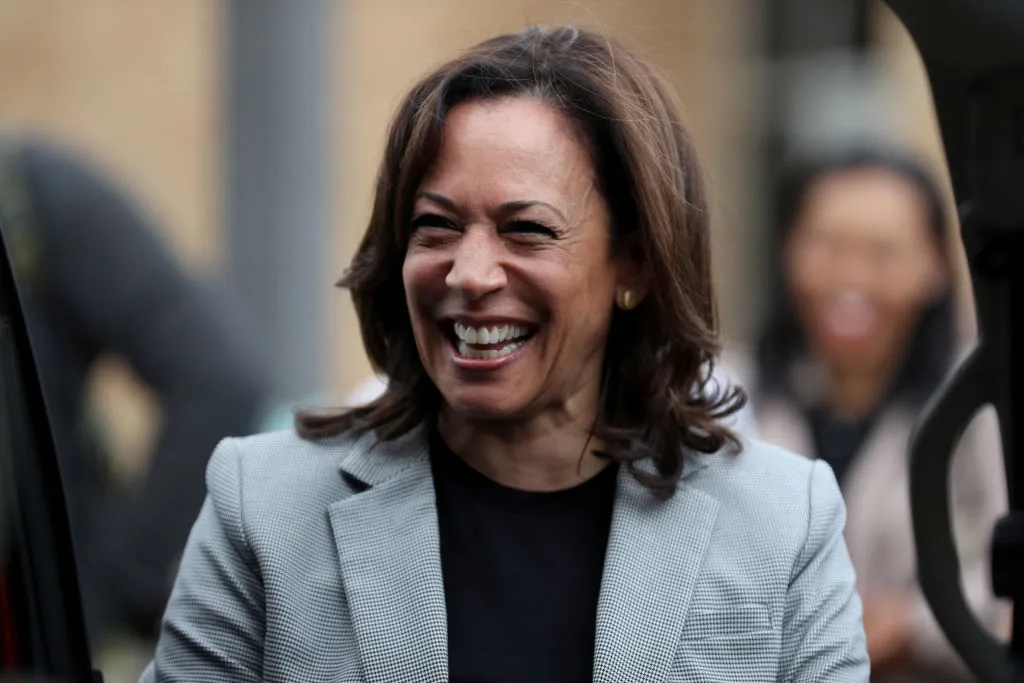
New poll shows Kamala Harris has plunged 12 points since the 1st debate
August 20, 2019 -
Sony still wants a deal to keep Spider-Man in the Marvel Cinematic Universe, but Disney is reportedly finished negotiating
7:59 a.m. -
Top federal scientists warned about an opioid crisis in 2006. It's not clear why nothing came of it.
7:39 a.m. -
Australian appellate court upholds Cardinal George Pell's sex abuse conviction
6:02 a.m. -
Trump to limit protections for migrant children, taking aim at the Flores settlement
5:01 a.m. -
Coincidentally, Obama is visiting Denmark in late September
2:50 a.m. -
Dog rescued from Phoenix shelter is about to become a Hollywood star
2:10 a.m. -
Trump evidently chose NRA chief Wayne LaPierre over Ivanka Trump on universal background checks
1:41 a.m.
The narrative of the 2020 Democratic primary shifted following a strong performance by Sen. Kamala Harris (D-Calif.) in the first debate in June. But two months later, a new poll puts us roughly back where we started.
While Harris experienced a major polling bump following her break-out first debate, during which she confronted former Vice President Joe Biden on busing, she's been slipping ever since the second debate in July. In the latest poll from CNN and SSRS released on Tuesday, she's down to 5 percent support, a 12-point drop from a post-debate June poll that had her at 17 percent support.
This poll brings Harris down to 10 points behind Sen. Bernie Sanders (I-Vt.) and 9 points behind Sen. Elizabeth Warren (D-Mass.), as well as 24 points behind Biden; she had been just five points away from the former vice president in June. CNN notes that this 5 percent support for Harris is about where she was before the first presidential debate.
Biden went up seven points in the CNN/SSRS poll compared to the one conducted in June, putting him at 29 percentage points, 14 points ahead of his closest rival, Sanders.
After a performance in the second Democratic debate that clearly did not make as much of an impression on voters as her first, Harris will next have a chance during the third debate in September, which will now have at least 10 candidates. With this CNN poll, former Secretary of Housing and Urban Development Julián Castro has met the qualification requirements. Should just one more candidate qualify, the debate will be split into two nights again, meaning Harris may or may not get another rematch with Biden.
CNN's poll was conducted by speaking to 1,001 adults nationally over the phone from Aug. 15-18. The margin of error is 6.1 percentage points. Read the full results at CNN. Brendan Morrow
Is there still a chance that Spider-Man could swing back home into the Marvel Cinematic Universe? Potentially, although it's not looking good.
Reports emerged on Tuesday that Disney and Sony failed to reach an agreement that would allow them to continue sharing ownership of the Spider-Man character, with Marvel Studios President Kevin Feige no longer set to be involved in the upcoming sequels starring Tom Holland.
This would likely mean that Spider-Man would exit the Marvel Cinematic Universe completely, no longer being able to interact with any of the Avengers in future films. Considering Spider-Man was just recently set up as a crucial component to the rest of the Marvel franchise, and effectively the next Iron Man, this would be a radical shift.
Sony in a statement now says that "we are disappointed but respect Disney's decision." The point of contention, according to Deadline's Tuesday report, was Disney wanting a 50-50 co-financing arrangement on future Spider-Man films. This was reportedly far too high for Sony, which made counteroffers that Disney turned down. The current deal sees Marvel get five percent of the first-dollar gross.
In its response, though, Sony suggests the issue is actually that Feige does not have "time" to work on a movie series not owned by Disney due to his "many new responsibilities," but Deadline writes that this "seems like spin."
Sony also says that "we hope this might change in the future," leaving the door open for a deal to still happen. Indeed, Variety cites a source as saying a deal remains possible, although talks are not currently ongoing. But The Wrap reports that Disney "considers the matter closed," even as Sony believes that "negotiations are ongoing."
If director James Gunn can be re-hired nearly eight months after his public firing, anything's possible when it comes to Marvel. But should nothing change, don't expect Spider-Man to do whatever an Avenger can. Brendan Morrow
Top federal scientists warned about an opioid crisis in 2006. It's not clear why nothing came of it.
The heads of the National Institute of Drug Abuse (NIDA) and National Institutes of Health (NIH) correctly identified the nascent opioid abuse epidemic in March 2006 and nearly convinced then-Surgeon General Richard Carmona to issue an official call to action, the most potent tool the surgeon general has to alert the public, Politico reported Wednesday. But for reasons that aren't fully clear, "the effort didn't lead to any real action, and the toll of death and addiction climbed."
"Why it then didn’t happen is still a mystery to me," Geoffrey Laredo, a former senior NIDA adviser who worked closely on the call to action, tells Politico. "We were facing what we believed was a public health crisis that needed to be addressed and we had what we thought was an agreement with the surgeon general to do a thing. We produced that thing ... and then it never saw the light of day."
Carmona told Politico he held a number of meetings about the call to action with Health and Human Services Department officials and the George W. Bush White House Domestic Policy Council, but his office was dealing with other big crises, like obesity and bioterrorism. "The [opioid] crisis was in its infancy," he said. "It wasn't like we dropped the ball." His term ended a few months after NIDA Director Nora Volkow pressed him for urgent action, and when an acting surgeon general took over, "what little momentum had built for a public warning evaporated," Politico says.
"Had the call to action succeeded it would have been the first major attempt by the federal government to counteract the aggressive marketing of pharmaceutical companies that had led doctors to liberally — too liberally, in retrospect — prescribe the painkillers," Politico reports. Instead, "more than 133,000 people have died from prescription opioids since then — and hundreds of thousands more from street drugs including heroin and illicit fentanyl." Read more about the failed warnings at Politico. Peter Weber
An Australian appellate court Wednesday upheld the 2018 conviction of Cardinal George Pell on charges of sexually molesting two 13-year-old boys in 1996 and 1997. The 2-to-1 verdict in Victoria's Court of Appeals sends Pell back to prison, where he is serving a six-year sentence. Pell's lawyer said the 78-year-old prelate will likely appeal the decision to Australia's High Court, though there's no guarantee the nation's final arbiter would agree to hear his appeal. Pell, the former Vatican finance minister and archbishop of Melbourne, is the senior-most Catholic prelate convicted of sexual abuse. He maintains that he is innocent.
Chief Justice Anne Ferguson said she and Justice Chris Maxwell "decided that it was open to the jury to be satisfied beyond reasonable doubt that Cardinal Pell was guilty," adding that dissenting Justice Mark Weinberg "could not exclude as a reasonable possibility that some of what the complainant said was concocted."
Advocates for sexual abuse victims cheered the verdict, the Australian Catholic Bishops' Conference said it respectfully accepted the verdict, and the Vatican, which is conducting its own investigation of Pell, confirmed "its closeness to the victims of sexual abuse and its commitment to pursue, through the competent ecclesiastical authorities, those members of the clergy who commit such abuse." Peter Weber
As soon as Wednesday, the Trump administration is expected to publish sweeping new rules for detaining minors who cross the U.S.-Mexico border, seeking to sidestep or terminate the Flores Settlement Agreement that has determined how the U.S. treats migrant children since 1997, ABC News and The New York Times report. The new rules, a version of which were proposed in September 2018 but never enacted, could allow the government to detain migrant children for longer than 20 days, revise the minimum standards of care children are afforded, and end some of all of the other protections set out in the Flores agreement. Once published, the rules will likely be challenged in court.
Administration officials told the Times that the new rules will maintain the underlying purpose of the Flores settlement and that all children will be "treated with dignity, respect, and special concern for their particular vulnerability as minors," as required under Flores. Migrant advocates disagree. "The proposed regulations do not implement the settlement," Peter Schey, who filed the original 1985 lawsuit with colleague Carlos Holguin, tells the Times. "They abrogate key terms of the settlement."
In the version of the rules proposed last year, the administration argued it can "terminate" Flores protections if it establishes its own replacement regulations. Trump and other Republicans say the Flores settlement encourages migrant parents to flee Central America with their children so they won't be locked up indefinitely. The Obama administration tried and failed to get out from under the Flores restrictions.
Schey and Holguin have returned to court again and again to enforce the settlement, and they've enlisted lawyers and law students to visit detention facilities, like the one in Clint, Texas. "It's like we are playing whack-a-mole," Holguin told the Times. "If someone had told me in 1985 that our work to protect children would continue into 2019," he added, "there is no way I would have believed it." Read more about this history of the Flores settlement at The New York Times. Peter Weber
President Trump surprised, amused, and left lots of people aghast when he abruptly announced Tuesday evening that, because Denmark isn't willing to discuss selling Greenland, he is no longer visiting the country, its leaders, and its queen in the beginning of September. Maggie Haberman at The New York Times, for one, isn't buying Trump's stated reason for scrapping the visit — which, to be fair, is pretty unbelievable.
Unanswered question: What's the real reason Trump didn't want to go to Denmark that he's blaming on the Greenland thing?
— Maggie Haberman (@maggieNYT) August 21, 2019
Could be and sometimes is, but it isn't here. https://t.co/UPdHzZ3dUi
— Maggie Haberman (@maggieNYT) August 21, 2019
Haberman doesn't offer her own explanation. But in the wake of Trump's announcement, Twitter discovered a local Danish news report from last week: Coincidentally, former President Barack Obama is visiting Denmark again at the end of September. And some unkind wags drew their own conclusions.
.@maggieNYT very shrewd. This isn't about Greenland. Obama scheduled to visit Denmark 9/28. Trump was scared of the likely contrast to his state visit on 9/2-3. https://t.co/BsRvpMQ8Xj
— David Frum (@davidfrum) August 21, 2019
In his self-loathing heart, Trump knows Obama is bigger than he is, around the world as well as in the United States. That knowledge tortures Trump, never allows him a minute's respite
— David Frum (@davidfrum) August 21, 2019
It's clearly a coincidence that Trump called off his visit to Denmark a week after Obama's trip was announced — geopolitics isn't quite that petty. And yet...
Trump can’t hold public events in most major US cities for fear of protests
in 2018 Pew survey of 22 countries, proportion w/confidence in US President had plummeted from 70% under Obama to 28% under Trump
imagine what Denmark’s leader would face for even entertaining this idea— John Harwood (@JohnJHarwood) August 21, 2019
Obama will speak and take questions from business leaders and students at Aalborg University in northern Denmark, The Local reports. Rich Henningsen, the moderator of the event, told local media that "President Obama is one of the people I look up to most in the in the world," while Aalborg's mayor, Thomas Kastrup-Larsen, gushed awkwardly: "I do not doubt for a moment that this will be a new climax for Aalborg and the whole of northern Jutland."
Meanwhile, a month before Trump's visit, thousands of people had "already signed up for a demonstration against him," the Copenhagen Post reported last week. "So it looks like the Danes prefer Obama over Trump after all. ..." Apropos of nothing. Peter Weber
Once they saw Monte, they knew they had met their leading man.
Animal trainers scouting for dogs to appear in Disney's live-action Lady and the Tramp came to the HALO Animal Rescue in Phoenix, hoping to find a few animals that would be a good fit. Monte, a two-year-old terrier mix, immediately stood out, as he's not only handsome, but he also knows how to sit, is good on a leash, and loves attention.
The stars of Lady and the Tramp are all former rescue dogs, and Monte will be voiced by actor Justin Theroux. All of the dogs have found loving families, Disney said. The movie will premiere on Nov. 12 on Disney's new streaming service. Catherine Garcia
President Trump spoke by phone with National Rifle Association CEO Wayne LaPierre for at least 30 minutes on Tuesday, and according to at least three accounts of their conversation, Trump assured LaPierre that expanding background checks — supported by 90 percent of Americans in multiple polls conducted after the back-to-back mass shootings in El Paso, Texas, and Dayton, Ohio — is off the table.
In the call, Trump assured LaPierre that "he was not interested in legislation establishing universal background checks and that his focus would be on the mental health of the gunmen, not their guns," The New York Times reports. Trump said as much after the phone call, telling reporters "we have very, very strong background checks right now," and "mental problems" are the "sort of missing areas and areas that don't complete the whole circle." He added: "A lot of the people that put me where I am are strong believers in the Second Amendment, and I am also."
This wasn't Trump's first aborted post-shooting lurch toward gun control, nor his first conversation with LaPierre after the El Paso and Dayton mass murders. Three days after the shootings, daughter and senior adviser Ivanka Trump "had proposed the idea of a televised Rose Garden appearance as a way to nudge her father toward supporting universal background checks," promising a made-for-TV occasion "where Trump could sign a document and call it 'historic' and 'unprecedented' — and receive positive media attention," The Atlantic reports.
Trump "loved it. He was all spun up about it," a former senior White House official told The Atlantic, but when he enthusiastically pitched the idea to LaPierre on an Aug. 7 call, LaPierre shot it down, and, as an NRA official put it, "the Rose Garden fantasy" was dead. The NRA, despite scandal and shrinking support, has kept up the lobbying onslaught unabated, to a receptive White House. Ivanka Trump assured GOP donors in Wyoming on Monday night that the White House is still focused on background checks, The Atlantic notes, but "less than 24 hours later, her father reportedly assured LaPierre of the opposite." Peter Weber