Sign up to get Today’s Best Articles in your inbox
Join 350,000+ subscribers and keep yourself informed with a selection of
The Week’s most interesting, enlightening and entertaining stories - plus daily puzzles.
You are now subscribed
Your newsletter sign-up was successful
Want to add more newsletters?
An account already exists for this email address, please log in.
Trump officially nominates Amy Coney Barrett for Supreme Court
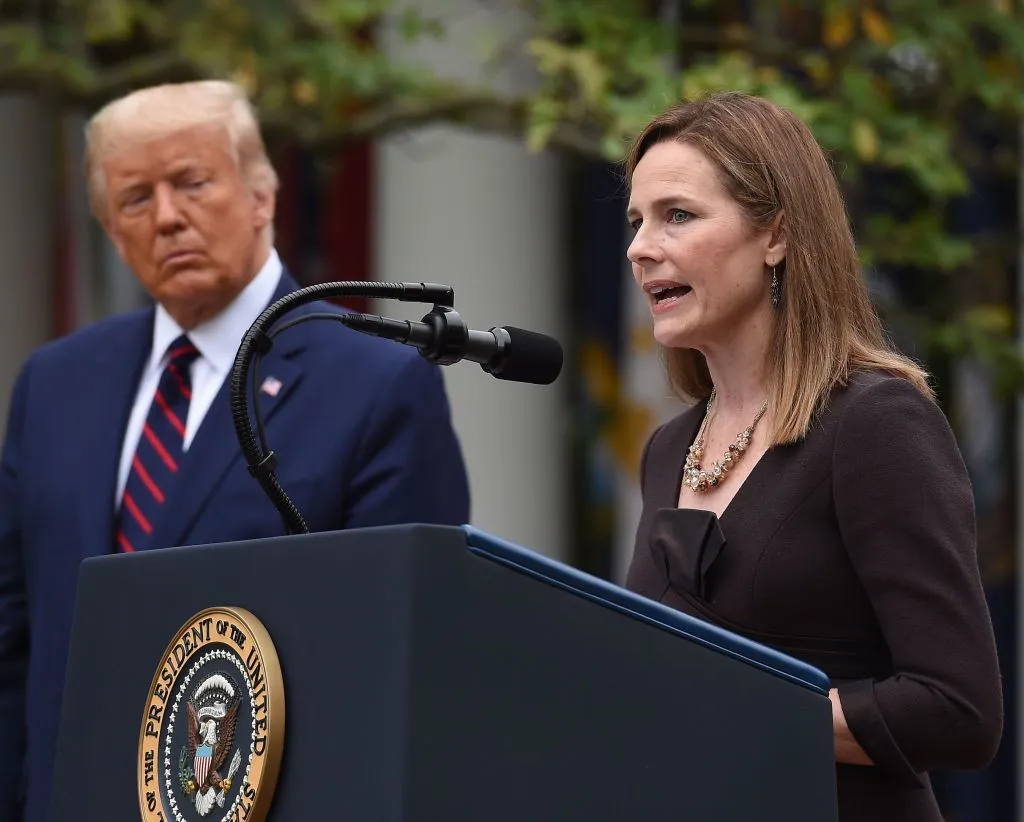
As expected, President Trump on Saturday officially nominated Amy Coney Barrett, a judge for the U.S. Court of Appeals for the Seventh Circuit, for the Supreme Court following the death of Justice Ruth Bader Ginsburg last week.
Speaking at the White House, Trump described the 48-year-old Barrett, who traveled to Washington, D.C., from her home in South Bend, Indiana, for the nomination, as "one of our nation's most gifted and brilliant legal minds" and a "woman of unparalleled achievement, towering intellect, sterling credentials, and unyielding loyalty to the Constitution."
During her own remarks, Barrett first paid tribute to Ginsburg, who she said "smashed" glass ceilings in the legal profession. She also paid homage to the late Justice Antonin Scalia — and his famed friendship with Ginsburg despite their fierce legal disagreements — whom she clerked for in the late '90s. Barrett, who is well-respected in conservative circles, said she shares the judicial philosophy of her mentor. Judges, she said, "must apply the law as written" while "setting aside any policy views they might hold."
The Week
Escape your echo chamber. Get the facts behind the news, plus analysis from multiple perspectives.
Join more than 350,000 subscribers and keep yourself informed with a selection of The Week’s most interesting, enlightening and entertaining stories - plus daily puzzles.
Join more than 350,000 subscribers and keep yourself informed with a selection of The Week’s most interesting, enlightening and entertaining stories - plus daily puzzles.
Barrett must now be confirmed by the Senate in what is expected to be a contentious process. While Barrett's legal opinions likely won't appeal to several Democratic lawmakers, the circumstances surrounding her nomination are what make this a particularly controversial nomination. In 2016, the Republican-led Senate blocked then-President Barack Obama's Supreme Court nominee, Merrick Garland, on the grounds that it was too close to that year's presidential election. There's actually an even smaller window between nomination and election this time around, but the GOP is ready to go through with the confirmation process, arguing the current situation differs from 2016 because the Senate majority and president hail from the same party.
Sign up to get Today’s Best Articles in your inbox
A free daily email with the day’s biggest news and analysis – and the best features from TheWeek.com
Tim is a staff writer at The Week and has contributed to Bedford and Bowery and The New York Transatlantic. He is a graduate of Occidental College and NYU's journalism school. Tim enjoys writing about baseball, Europe, and extinct megafauna. He lives in New York City.