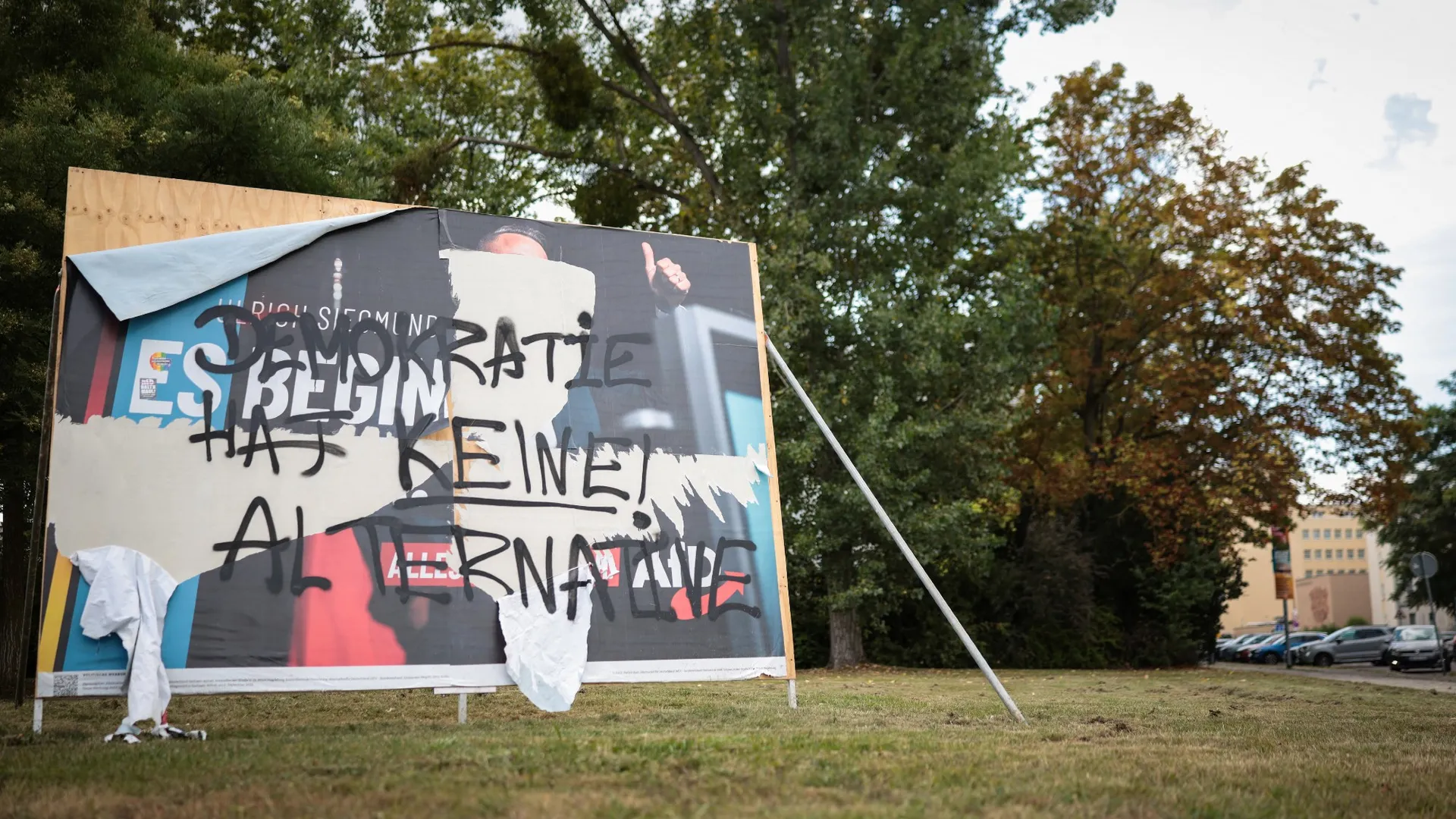
The far-right Alternative fur Deutschland Party is on course to take control of a German state for the first time, blasting through a postwar consensus designed to keep extremists out of power. With polls suggesting the AfD will win 40% of the vote in Saxony-Anhalt in next week’s state election, it’s now “completely undemocratic to permanently exclude” the former fringe movement, said left-wing party leader Sahra Wagenknecht. “The firewall has failed.”
What did the commentators say?
Germany’s political firewall, the Brandmauer, is an agreement between mainstream parties to refuse to cooperate or work with extremists. It has succeeded in keeping the AfD out of power at state and federal level until now but has done nothing to harm the party’s popularity. If anything, being excluded has contributed to the AfD’s rise in national polls, where it now has a clear lead over its mainstream rivals.
Maintaining the firewall has created a “hollowed-out center,” said Alexander Gorlach, a politics professor at New York University, at Jacobin magazine. Building majorities that exclude the far-right has “led to uncomfortable compromises”: Parties on the left and center-right have made coalitions “born of necessity rather than conviction.” Not only has this alienated some voters and even driven them toward extremist alternatives, but it has also blurred the distinctions between mainstream parties, reinforcing the AfD’s line that they are carbon-copy “cartel parties.”
The Brandmauer also means the AfD has “no incentive” to moderate its policies to gain power, as some other populists in Europe have done, said The Economist. Behind the firewall, the party is protected from the “disappointment that accountability in a democracy implies,” said Christian Stecker, a political scientist at German university TU Darmstadt, to the outlet.
What next?
If current polling proves accurate, the AfD could secure an absolute majority in the Saxony-Anhalt election on Sept. 6 — a rarity under Germany’s proportional-voting system. The consequences of this “would be far-reaching,” said the Center for Strategic and International Studies think tank in Washingon, D.C. It would not only “create a shock to the ideological spectrum” but also, for the first time, enable a far-right party in Germany to “put some of its agenda into practice.” |