Sign up to get Today’s Best Articles in your inbox
Join 350,000+ subscribers and keep yourself informed with a selection of
The Week’s most interesting, enlightening and entertaining stories - plus daily puzzles.
You are now subscribed
Your newsletter sign-up was successful
Want to add more newsletters?
An account already exists for this email address, please log in.
Tim Scott, the next White House hopeful
The Republican South Carolina senator has jumped into the presidential race
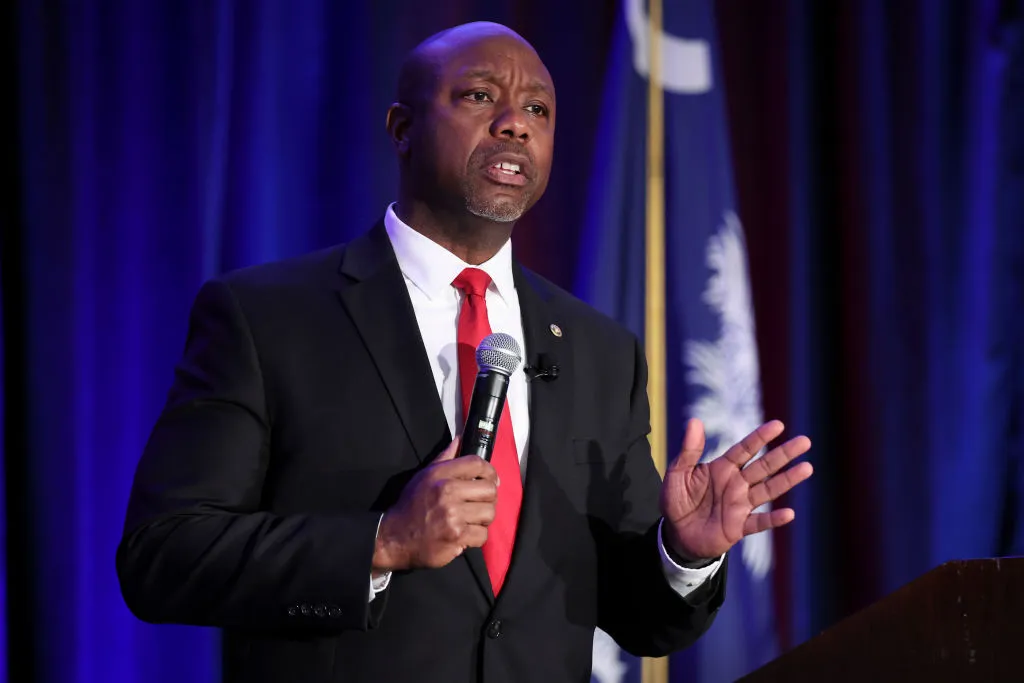
An already crowded field of presidential hopefuls has increased: South Carolina Sen. Tim Scott has officially launched his bid for the White House, becoming the sixth Republican to enter the race. Scott will look to unseat former President Donald Trump as the party's 2024 frontrunner, and begins his campaign having raised $22 million, according to The New York Times.
Scott, 57, has become one of the most well-known Republican faces on Capitol Hill, described by the Times as "a rising star in the GOP." He already has one key backing: Sen. John Thune (R-S.D.), the number two Republican in the Senate, has endorsed Scott for president, and introduced him at his campaign announcement in Charleston, South Carolina. During his remarks, Scott said the nation was "standing at a time for choosing: victimhood or victory? Grievance or greatness? I choose freedom and hope and opportunity."
While polling from Harvard/Harris shows Trump beating Scott 79% to 21% in a hypothetical matchup, Scott campaign officials told Newsweek it was too early in the race for these figures to be meaningful.
The Week
Escape your echo chamber. Get the facts behind the news, plus analysis from multiple perspectives.
Join more than 350,000 subscribers and keep yourself informed with a selection of The Week’s most interesting, enlightening and entertaining stories - plus daily puzzles.
Join more than 350,000 subscribers and keep yourself informed with a selection of The Week’s most interesting, enlightening and entertaining stories - plus daily puzzles.
Not only is Scott the lone Black GOP senator, but he is also South Carolina's first Black senator of either party. He will now look to one-up this accomplishment by becoming the Republican Party's first Black president — but where did he come from, and how good are his odds?
Scott's beginnings
Tim Scott was born in North Charleston, South Carolina, in a "poor, single-parent household" where he "grew accustomed to moving every few years, as well as the long hours his mom worked to keep a roof over their heads," according to his official Senate biography.
He graduated from Charleston Southern University, a private Baptist college in his hometown, and was eventually elected to the South Carolina House of Representatives. From there, he was elected to the U.S. House of Representatives in 2010. Upon his election, Scott and Florida's Allen West became the first Black Republicans in Congress in seven years, NPR reported at the time.
Scott eventually garnered committee assignments and began raising his profile in Washington, D.C, transitioning from the House to the Senate in 2013. He was not elected to his first Senate term, but rather appointed by the South Carolina governor to replace a retiring senator. Ironically, the governor who appointed him was Nikki Haley, now competing against Scott in a Republican presidential campaign of her own.
Sign up to get Today’s Best Articles in your inbox
A free daily email with the day’s biggest news and analysis – and the best features from TheWeek.com
The newly minted senator was re-elected to a full term in 2016, then again in 2022. In 2019, he told Charleston newspaper The Post and Courier that his 2022 Senate campaign would be his last political outing, though from his presidential ambitions, it seems he may have been talking about his senatorial career.
Scott's controversies and future
The senator is a uniquely successful Southern Black politician, Politico reported, calling him "a victim of racism in stores, on roads, online and even in the U.S. Capitol itself, who doesn't see the country as racist and doesn't see himself as a victim."
Indeed, Scott has often campaigned on the assertion that the U.S. is not inherently racist. During a 2021 speech, he generated controversy by saying, "America is not a racist country. It's backward to fight discrimination with different types of discrimination." He later elaborated on this stance following a slew of backlash, saying he acknowledged there was "a lingering effect after a couple of centuries of racism and discrimination in this nation." He has also generated anger amongst some liberals for his support of "pulling yourself up by your own bootstraps," categorized by some as a racist trope.
Despite these controversies, Scott's website states he is a supporter of "traditional conservative values." Will these values help him win? Some in the party seem to believe so, with GOP pollster Frank Luntz describing Scott as "the exact opposite of Donald Trump, and that's why he is so intriguing. He is as nice and kind-hearted as Trump is tough and critical."
For now, though, Scott, like the rest of the GOP candidates, remains far behind Trump, and only time will tell if his "traditional conservative values" will be enough to carry him to the White House.
Justin Klawans has worked as a staff writer at The Week since 2022. He began his career covering local news before joining Newsweek as a breaking news reporter, where he wrote about politics, national and global affairs, business, crime, sports, film, television and other news. Justin has also freelanced for outlets including Collider and United Press International.