Sign up to get Today’s Best Articles in your inbox
Join 350,000+ subscribers and keep yourself informed with a selection of
The Week’s most interesting, enlightening and entertaining stories - plus daily puzzles.
You are now subscribed
Your newsletter sign-up was successful
Want to add more newsletters?
An account already exists for this email address, please log in.
The school protests in France that have seen more than 5,000 arrests
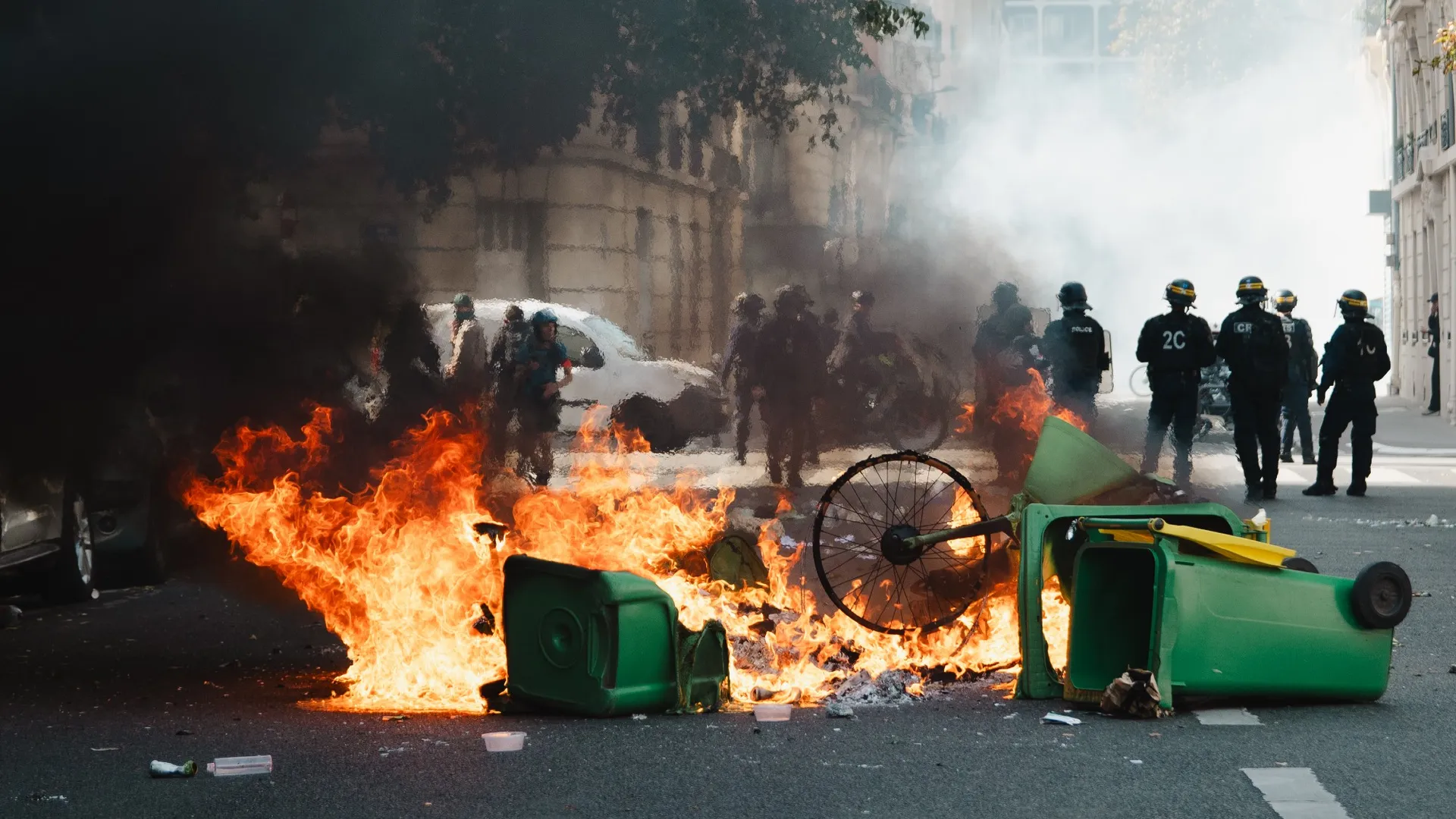
Continued riots have closed 500 schools across the country, with further action planned for the coming days
“Authorities seek to drive us out of our places of study through budget cuts, the closure of places, dilapidated buildings, selection, or repression, let’s not let them: let’s block and retake the universities and high schools!”, wrote the Student Union and the High School Trade Union in a statement last week.
What started as a “spontaneous blockade” of a high school in a Paris suburb in mid-September, has now led to the closure of up to 500 schools across the country, said Le Monde. Since protests began, more than 5,000 people have been arrested, “85% of them minors”, said the same paper, with the education minister confirming that 24 schools had either been “burned or ransacked”, and millions of euros of damage caused.
Ever since the student demonstrations of May 1968 and, more recently, the gilets jaunes protests in 2018, “every government has run scared of angry French youth”, said Paris correspondent Hugh Schofield on the BBC. With no sign of slowing down, and presidential elections coming up, the protests will “send shivers” down the French government’s spine.
The Week
Escape your echo chamber. Get the facts behind the news, plus analysis from multiple perspectives.
Join more than 350,000 subscribers and keep yourself informed with a selection of The Week’s most interesting, enlightening and entertaining stories - plus daily puzzles.
Join more than 350,000 subscribers and keep yourself informed with a selection of The Week’s most interesting, enlightening and entertaining stories - plus daily puzzles.
A major cause of the protest has been a lack of central government funding for the education system. On Thursday, French Prime Minister Sébastien Lecornu outlined a modest 1.7% rise in education spending to €65.53 billion (£55.7 billion) in a draft of the 2027 budget, said The Telegraph. However, this is below the rate of inflation, and excludes teacher pensions. Traditionally, education has been the “largest item in the French budget”, but this year, debt-servicing costs are expected to reach €74.5 billion (£63.1 billion), according to the draft.
Another “main complaint” is a shortage of teachers and support staff in schools, said Time Magazine. In the year 2024/25, nearly 10% of teaching hours in public secondary education went untaught, according to data from the education ministry. The majority of that (7.5%) was due to a failure to find substitute teachers, and 2.3% because of complete school closures.
Students have had to navigate “overcrowded classes of up to 40 children in crumbling buildings”, said The Guardian. “Ceilings partially collapsing during class, leaks, cockroaches and buildings in disrepair” are fairly common experiences.
Many have also found the online system designed for university applications – “Parcoursup”, the equivalent of UCAS – “opaque and difficult”, and in urgent need of reform. Discontent this year has also been exacerbated by “unbearable temperatures in classrooms during heatwaves in May and June”.
Sign up to get Today’s Best Articles in your inbox
A free daily email with the day’s biggest news and analysis – and the best features from TheWeek.com
How has the government responded?
The government has “strongly condemned the violence and responded forcefully”, said The New York Times. On Friday, France’s justice minister Gérald Darmanin said on X that he would pursue a “firm” criminal response, and hold parents of minors civilly liable “wherever possible”.
But the government has also tried to “placate” the rapidly spreading protests, and has “acknowledged some of the students’ grievances”, said the NYT. Education minister Édouard Geffray announced on Thursday that the government would scrap plans to increase some higher education registration fees, an idea floated just hours before in the proposed 2027 budget. Ahead of meeting unions for talks on Friday, Geffray said he would introduce a new platform, where students could voice their thoughts for education reform, which would then be included in a “national report”, said Time.
Geffray also told broadcaster France 2 on Thursday evening that the protests, which were “legitimate at the outset”, had been “taken hostage by ultra-left groups”, said Le Monde. Lecornu’s team had directly blamed La France Insoumise (France Unbowed, or LFI) and “its ultra-left proxies” for the violence. LFI, led by presidential candidate Jean-Luc Mélenchon, has strongly denied the claim, though supported the students’ right to protest. However, party member and mayor of Paris suburb Saint-Denis, Bally Bagayoko, had said that “violence can sometimes be legitimate”.
What could be the effect of the protests?
Talks between student representatives and Geffray “failed to produce the concrete measures they were seeking”, said The Wall Street Journal. Student unions have called for a third day of nationwide protest on Tuesday, joined by several teachers’ unions. The General Confederation of Labour, one of France’s largest unions, also “threw its support behind the demonstrations, raising the prospect of the unrest broadening beyond schools and universities”.
We cannot forget that French presidential elections are “only months away”, said the BBC. These protests, like many youth movements, are “unpredictable and shapeless”, and have “no clear structure” that would allow for negotiation. Because of this, they will have Emmanuel Macron in “cold sweats”.
One person who stands to gain is Mélenchon, who “stands a good chance of making it to the second round of the presidential elections”. Polls show he has “massive” support – around 40% – among 18- to 24-year-olds. He still lies behind Marine Le Pen in popularity, but given the current unrest, France is in “unstable territory”, and the “young people’s protests of recent days will indeed have been a harbinger” for the election’s results.
Will Barker joined The Week team as a staff writer in 2025, covering UK and global news and politics. He previously worked at the Financial Times and The Sun, contributing to the arts and world news desks, respectively. Before that, he achieved a gold-standard NCTJ Diploma at News Associates in Twickenham, with specialisms in media law and data journalism. While studying for his diploma, he also wrote for the South West Londoner, and channelled his passion for sport by reporting for The Cricket Paper. As an undergraduate of Merton College, University of Oxford, Will read English and French, and he also has an M.Phil in literary translation from Trinity College Dublin.