×
FOLLOW THE WEEK ON FACEBOOK
February 25, 2015
Wikimedia Commons

No, it’s not a drunk text. It's just the latest all-inclusive acronym, brought to you courtesy of Wesleyan University's Office of Residential Life.

The long string of letters stands for: lesbian, gay, bisexual, transgender, transsexual, queer, questioning, flexual, asexual, genderf--k, polyamourous, bondage/discipline, dominance/submission, and sadism/masochism.

The abbreviation appears on the university's program housing website with an advertisement for ''a safe space for [LBTTQQFAGPBDSM] communities and for people of sexually or gender dissident communities.''

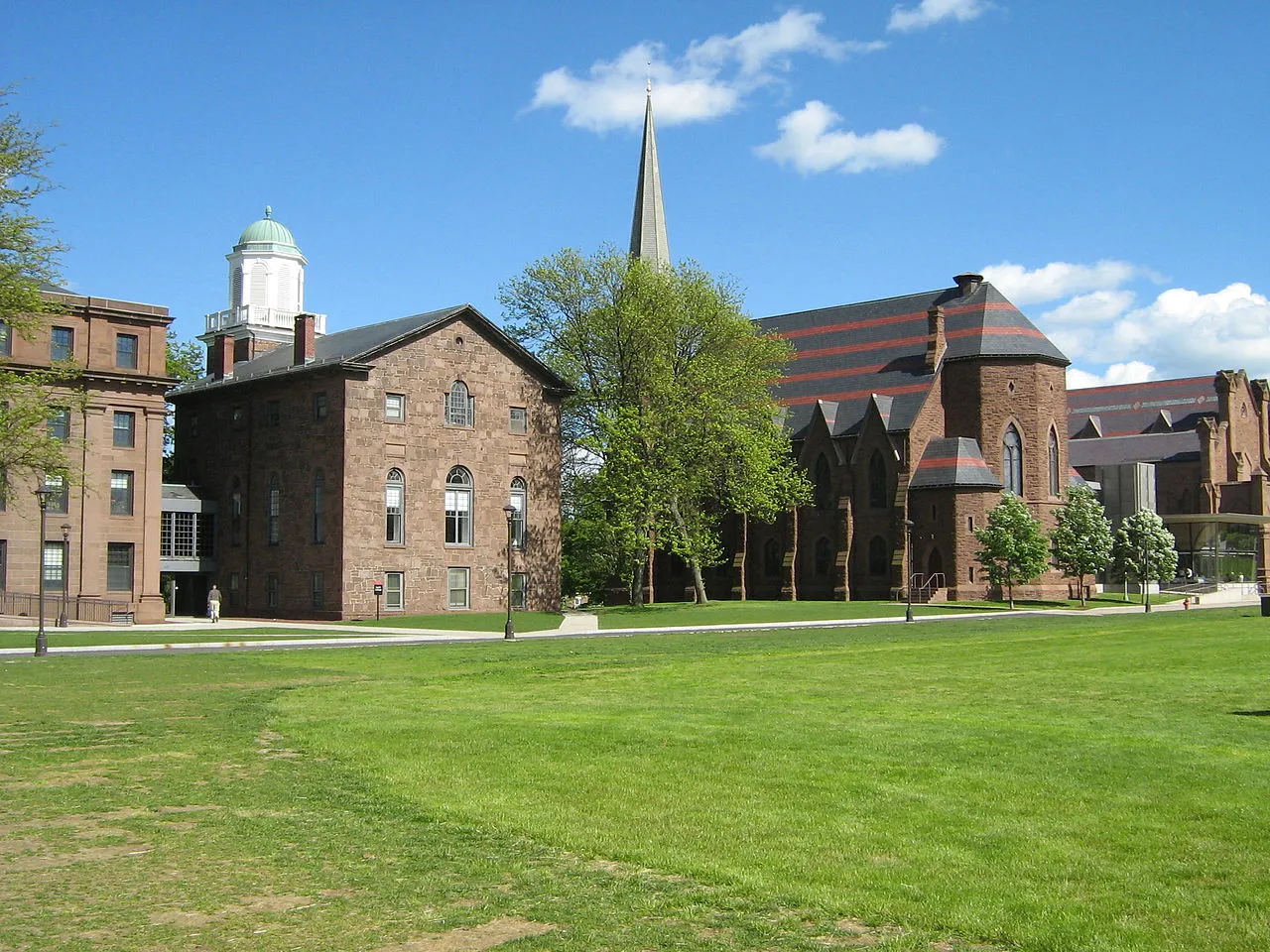
Wesleyan University, located in Middletown, Connecticut, made headlines last week after Delta Kappa Epsilon, a traditionally all-male fraternity, filed a lawsuit charging the school with ''sexual discrimination and false and deceptive practices'' after the administration mandated that all frats admit women. Teresa Mull

12:07 a.m. ET
Win McNamee/Getty Images

Right before delivering his first State of the Union address, President Trump signed an executive order to keep the U.S. military prison in Guantanamo Bay, Cuba, open and ready to accept new enemy combatants. His two predecessors, Presidents Barack Obama and George W. Bush, had worked to shut down the controversial prison, which Bush opened after the Sept. 11, 2001, terrorist attacks. Trump had promised to keep it active during the campaign, and while he has not sent any new detainees to Guantanamo, his order says the U.S. reserves the right to do so, if the defense secretary recommends it for people the U.S. captures in armed conflict.

Terrorist "are evil," and "when possible, we have no choice but to annihilate them," Trump said. "When necessary, we must be able to detain and question them. But we must be clear: Terrorists are not merely criminals. They are unlawful enemy combatants." He implicitly criticized Bush and Obama for releasing all but 41 of the 728 people detained there, at least 17 percent of whom re-engaged in military conflict, according to the latest report from the Director of National Intelligence. Almost all of the former detainees who reverted to armed conflict were released under Bush, and Trump said he's keeping the Obama-era detainee vetting process that has apparently proved effective.

Practically speaking, Trump's order won't do much, Obama's Guantanamo envy, Lee Wolosky, tells The Associated Press. "But as a symbolic matter, it changes a great deal because the two presidents before him were trying to close Guantanamo because they recognized that it was a detriment to our national security." J. Wells Dixon, a lawyer at the Center for Constitutional Rights, said that formally making it U.S. policy "to detain Muslims forever without charge in an offshore prison" is "politically expedient but exceedingly stupid no matter how you look at it," except as a terrorist recruitment bonanza. Peter Weber

January 30, 2018
Scott Olson/Getty Images

Rep. Luis Gutierrez (D-Ill.) was able to come up with one barbed compliment for President Trump, following his first State of the Union address.

"Although I disagreed with almost everything he said, for Trump, the speech was clear and well-delivered," Gutierrez said in a statement. "Whoever translated it for him from Russian did a good job." Gutierrez is one of the most outspoken members of Congress when it comes to helping young, undocumented people brought to the United States as children, and he said that while he remains hopeful, after hearing Trump's immigration proposal, he can't see Congress and the president coming to an agreement that protects DREAMers.

"The White House agenda is to gut legal immigration in exchange for allowing some of the DREAMers to live here," he said, and Democrats and Republicans who both support legal immigration won't go for this. "The DREAMers themselves have said they do not want legal status if it comes at the expense of others who will suffer more as part of the bargain," he added. "The speech did nothing to bring the pro- and anti-immigrant sides closer together."

Trump also refrained from mentioning the devastation in Puerto Rico from Hurricane Maria, and Gutierrez said Puerto Rico is "a metaphor for how this president sees all Latinos and people of color: he does not see us as his equals and he does not see us as his fellow human beings." When Gutierrez was born in 1953, "separate but equal was the law of the land," he added, and while he's proud of the progress that's been made since that time, he was "hoping to get through my life without having to witness an outwardly, explicitly racist American president, but my luck ran out." Catherine Garcia

January 30, 2018

In the Democratic response to President Trump's first State of the Union address, Rep. Joe Kennedy III (D-Mass.) said the current administration's "record is a rebuke to our highest American ideal, the belief that we are all worthy, that we are all equal, that we all count in the eyes of our law, our leaders, our God, and our government."

While the government is struggling to stay open, Russia is "knee-deep in our democracy," and the Justice Department rolls back "civil rights by the day," Kennedy said, the Democrats are choosing "a better deal for all who call this country home," including a living wage, pensions that are solvent, fair trade pacts, and a "health care system that offers mercy." The Trump administration "callously appraises our worthiness and decides who makes the cut and who can be bargained away," and pits people against one another, he said. "We are bombarded with one false choice after another: Coal miners or single moms. Rural communities or inner cities. The coast or the heartland. As if the mechanic in Pittsburgh and the teacher in Tulsa and the daycare worker in Birmingham are somehow bitter rivals, rather than mutual casualties of a system forcefully rigged for those at the top."

Americans are always striving for progress, Kennedy concluded, and politicians "can be cheered for the promises they make," but the "country will be judged by the promises we keep." Catherine Garcia

January 30, 2018
NICHOLAS KAMM/AFP/Getty Images

President Trump detailed his "four pillars" of immigration reform on Tuesday night during his first State of the Union address, claiming it was a "down-the-middle compromise and one that will create a safe, modern, and lawful immigration system."

The pillars include offering a path to citizenship for 1.8 million undocumented young people brought to the United States as children; building a wall along the U.S.-Mexico border and hiring more border agents; ending the visa lottery; and ending chain migration, which he said "protects the nuclear family." Trump said the United States has "outdated" immigration policies, and needs more "merit-based immigration" with skilled people "who want to work and who will contribute to our society and who will love and respect our country." Catherine Garcia

January 30, 2018
Win McNamee/Getty Images

In his State of the Union address, President Trump said it's time to rebuild America's "crumbling infrastructure," and called on Congress to "produce a bill that generates at least $1.5 trillion for the new infrastructure investment we need."

Trump said the United States was able to build the Empire State Building in just one year, and it's a "disgrace that it can now take 10 years just to get a permit approved for a simple road." The process must be streamlined down to one or two years, he said, so "we can reclaim our great building heritage." He promised to build "gleaming new roads, bridges, highways, railways, and waterways" and it will be done with "American heart, American hands, and American grit."

Trump also said it's important to invest in workforce development and job training and to open more vocational schools. "We want every American to know the dignity of a hard day's work," he said. "We want every child to be safe in their home at night and we want every citizen to be proud of this land we love so much. We can lift our citizens from welfare to work, from dependence to independence, and from poverty to prosperity." Catherine Garcia

January 30, 2018

President Trump started his first State of the Union address with praise for Rep. Steve Scalise (R-La.), who was shot last year while practicing for a congressional baseball game.

Trump called Scalise one of the "toughest people to serve in this House, a guy who took a bullet and almost died, and was back to work three and a half months later. The Legend from Louisiana, Congressman Steve Scalise." Scalise received a standing ovation, and hugged his fellow Republicans sitting next to him. Trump also thanked Capitol Police; Alexandria, Virginia, police; and the doctors, nurses, and paramedics who saved Scalise's life. Catherine Garcia

January 30, 2018
Zach Gibson/Getty Images

Deputy Attorney General Rod Rosenstein and FBI Director Christopher Wray spent their Monday appealing to White House Chief of Staff John Kelly, warning him of the danger in making a secret memo compiled by Republicans public, several people briefed on the meeting told The Washington Post.

The memo claims to show abuses by top FBI officials, and Rosenstein said that not only could the four-page document jeopardize classified information, but the Department of Justice is not convinced that it's even entirely accurate. Kelly told Rosenstein President Trump is leaning toward releasing the memo, but it will go through a review by the National Security Council and White House Counsel's Office, a senior administration official told the Post.

The meeting took place shortly before Republicans on the House Intelligence Committee voted to make the memo public, but voted against releasing a document written by Democrats and denied a request by Wray to talk to the committee about the intelligence behind the memo. Catherine Garcia

See More Speed Reads