If Virginia backs President Obama, which should become clear shortly after polls close at 7 p.m. EST, it would be reasonable to conclude that he's on his way to a second term. If Romney takes Virginia, Florida, and Ohio, it's a good bet that the GOP nominee is the one who's heading to the White House. There are plenty of nightmare scenarios, however, that would leave the result of the presidential election up in the air for days, or even weeks. Here, three ways the suspense could drag on and on:
1. An automatic recount in a key state
"The rules and thresholds differ from state to state," says Elizabeth Titus at Politico, "but if the difference between President Barack Obama and Mitt Romney is 0.5 percent in any one of them, that tends to be recount territory." So tiny is that sliver of votes that states are rarely required to hold recounts. And in most elections the winner has enough of a cushion to make the matter moot, anyway. This year, however, polls suggest that the leader's margin could be razor thin, so a contested result in a swing state could be all it takes to delay the result. In Virginia, for example, either candidate can request a recount if the margin of victory is less than 1 percent, and polls there put Obama and Romney closer than that going into Election Day.
The Week
Escape your echo chamber. Get the facts behind the news, plus analysis from multiple perspectives.
SUBSCRIBE & SAVE
Sign up for The Week's Free Newsletters
Join more than 350,000 subscribers and keep yourself informed with a selection of The Week’s most interesting, enlightening and entertaining stories - plus daily puzzles.
Join more than 350,000 subscribers and keep yourself informed with a selection of The Week’s most interesting, enlightening and entertaining stories - plus daily puzzles.
Latest Videos FromThe Week US
2. Ohio's provisional ballots
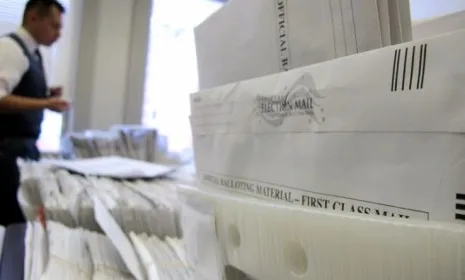
Pollsters consider Ohio the state most likely to decide the contest between Obama and Romney. Unfortunately, a quirk in Ohio's election law could leave the final outcome in that state unresolved for weeks, says Doug Mataconis at Outside the Beltway. The reason: Ohio Secretary of State Jon Husted decided to send an application for an Absentee Ballot to every Ohio voter — a first. About 1.4 million people returned applications for absentee ballots. So far, so good. "The fly in the ointment here" is that if any of those people decide to vote in person, instead of sending in their absentee ballots, they'll have to fill out provisional ballots (a rule imposed to make sure nobody votes twice), and, by law, the state can't even begin counting provisional ballots until Nov. 17. In 2008, there were 2008 such ballots cast, and with so many absentee ballots floating around this year there could be far more, meaning that, in a close race, the provisional ballots could determine the winner. "So, a close vote in Ohio could drag things out for a considerable amount of time."
3. Legal challenges over game-changing contested votes
The margins in several swing states look slimmer heading into Election Day than they were in 2000, when George W. Bush narrowly beat Al Gore, so both parties' legal teams are getting ready to mount court challenges in any key state where the vote is close, says HM Epstein at Examiner.com. They've got ready-made arguments, too, from new voting registration laws to "Mother Nature's excesses." For example, in the potentially crucial swing states of Pennsylvania and Ohio, thousands of voters remain without power in the wake of superstorm Sandy, a potential factor in a legal argument. If the vote comes down to a tight race in either of those states, grab some popcorn. "It is likely that we won't know who the next president of the United States may be until the dust settles from the legal wrangling over each contested vote."
Read more political coverage at The Week's 2012 Election Center.

 talking pointsLivestreaming an execution: cruelty or added deterrent?
 QUOTE OF THE DAY‘You don’t get to take a man from his family. You don’t get to take his very life, his whole future from him, and just walk away from it. Especially when that man is Tupac Shakur.’
 today’s big questionCan a Democrat win the Texas governor’s race?