Sign up to get Today’s Best Articles in your inbox
Join 350,000+ subscribers and keep yourself informed with a selection of
The Week’s most interesting, enlightening and entertaining stories - plus daily puzzles.
You are now subscribed
Your newsletter sign-up was successful
Want to add more newsletters?
An account already exists for this email address, please log in.
Did markets’ ‘Sell America’ trade force Trump to TACO on Greenland?
Investors navigate a suddenly uncertain global economy
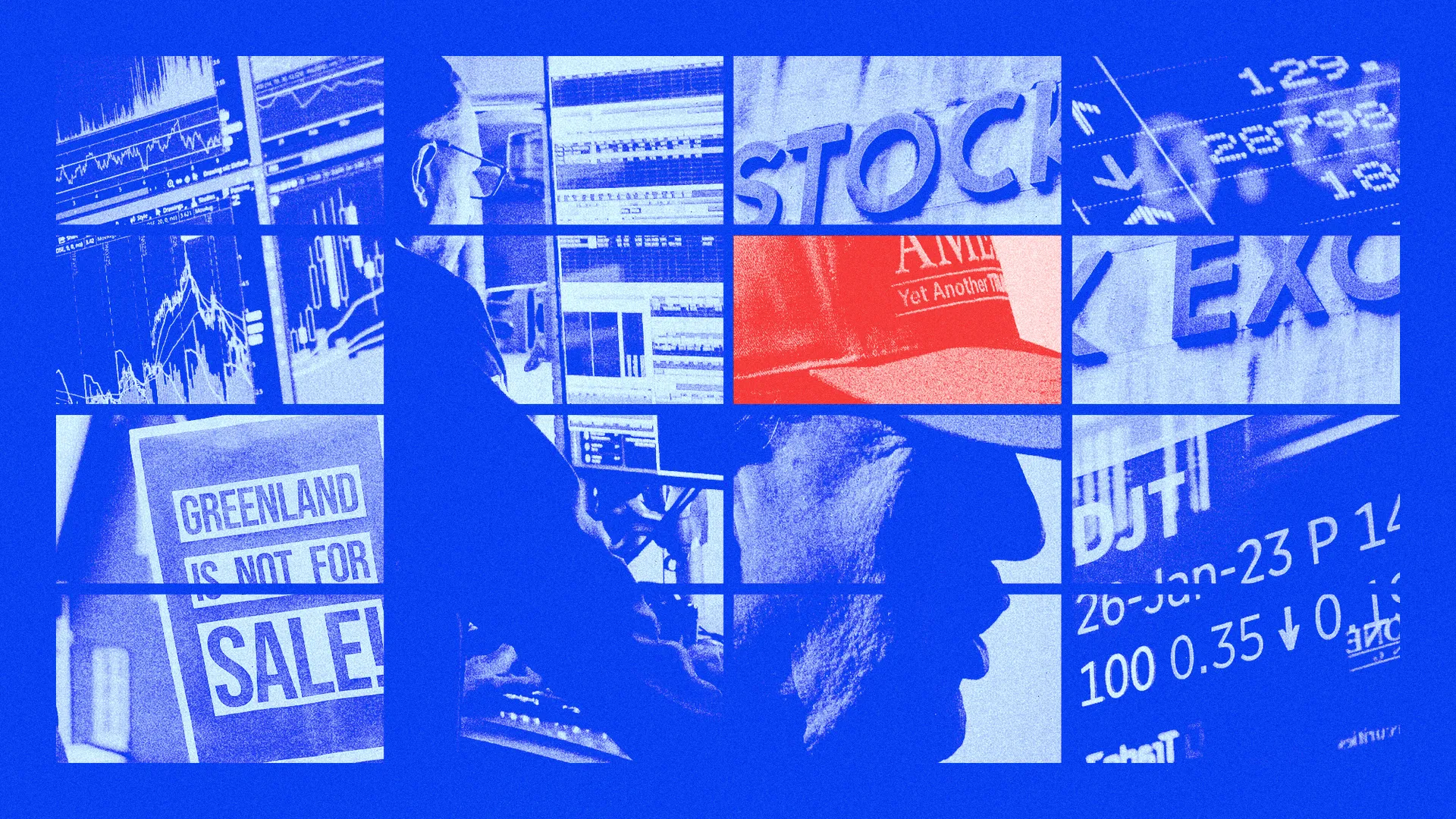
President Donald Trump threatened a massive new trade war against Europe in his bid to acquire Greenland. And the financial markets immediately tanked. Then on Wednesday, he backed down.
Trump dropped his tariff threats after meeting with European leaders in Switzerland, said CNN. NATO leaders agreed to a “framework of a future deal” on Greenland, Trump said on Truth Social. “I think it puts everybody in a very good position,” he told reporters. But the preliminary agreement came the day after “bond yields spiked and stocks sank” as investors registered the alarm over Greenland and raised fears of a surge in “Sell America” trading, said Politico. Some observers saw an old pattern at play in the president’ s sudden backpedaling. Trump is “being mocked for another ‘TACO’ (‘Trump always chickens out’) moment,” said CNN, likely because he was “spooked by the result of his own actions.”
The Greenland adventure has investors newly wary, said the Financial Times. The president’s unpredictability is “chipping away at the credibility of U.S. institutions,” said Altaf Kassam at State Street Investment Management. Others are more willing to stick it out, confident in the long-term trajectory of the U.S. economy. “We have seen plenty of bluster from Trump before,” said Mark Dowding at RBC BlueBay Asset Management.
The Week
Escape your echo chamber. Get the facts behind the news, plus analysis from multiple perspectives.
Join more than 350,000 subscribers and keep yourself informed with a selection of The Week’s most interesting, enlightening and entertaining stories - plus daily puzzles.
Join more than 350,000 subscribers and keep yourself informed with a selection of The Week’s most interesting, enlightening and entertaining stories - plus daily puzzles.
The “Sell America” trade is “not as bad as it sounds,” said Madison Mills at Axios. Investors are not worried that the “American economy is crashing” because of Trump’s actions. Rather, they think they can “make more money abroad.” That is true because of profits, not global tensions: International stocks “outperformed the S&P 500 in 2025,” making them more lucrative to stockholders. But financial realities should keep investors attached to the United States. “There is no alternative to U.S. Treasury bonds in terms of liquidity, safety and scale.”
Investors are “struggling” to adjust to the “fundamental shifts in the world’s geopolitical tectonic plates,” said Jamie McGeever at Reuters. How can the markets price in the “end of NATO and the U.S.-Europe alliance” or the rise of a “multi-polar world” divvied up between the U.S., Russia and China? Financial markets had maintained “relative calm” in the face of all that instability. This week’s market sell-off, though, was a sign that the “calm is fracturing.”
What next?
Europe is quietly lining up its weapons for the next trade war, if it comes. The continent owns $8 trillion of U.S bonds and equities, making Europe the “world’s biggest lender to the U.S.,” said Fortune. If Trump is willing to disrupt longstanding alliances in pursuit of his aims, said Deutsche Bank’s George Saravelos, it is “not clear why Europeans would be as willing to play this part.”
Wednesday’s news seemed to calm the markets, said CNBC. Tuesday’s “Sell America” trading “reversed on Wednesday,” with the Dow Jones Industrial Average surging nearly 600 points after Trump announced the Greenland deal.
Sign up to get Today’s Best Articles in your inbox
A free daily email with the day’s biggest news and analysis – and the best features from TheWeek.com
Joel Mathis is a writer with 30 years of newspaper and online journalism experience. His work also regularly appears in National Geographic and The Kansas City Star. His awards include best online commentary at the Online News Association and (twice) at the City and Regional Magazine Association.