Sign up to get Today’s Best Articles in your inbox
Join 350,000+ subscribers and keep yourself informed with a selection of
The Week’s most interesting, enlightening and entertaining stories - plus daily puzzles.
You are now subscribed
Your newsletter sign-up was successful
Want to add more newsletters?
An account already exists for this email address, please log in.
The 9 best historical fiction books of all time
From the French Revolution to early aviation, writers continue to draw inspiration from the past
The modern history of civilization provides ample, almost endless, inspiration for writers, who can draw on both well-known and obscure events to build dazzling narratives. From classic works to recent and more structurally daring standouts, historical fiction remains one of writing’s most popular forms.
‘A Tale of Two Cities’ by Charles Dickens (1859)
Some classic works of literature from centuries ago were themselves works of historical fiction, perhaps none more beloved than Charles Dickens’ sprawling saga “A Tale of Two Cities.” Set against the backdrop of events prior to, during and after the French Revolution, it’s the story of Lucie Manette and her two suitors, the wealthy Frenchman Charles Darnay and the melancholy English lawyer Sydney Carton, who bear a physical resemblance to one another that serves the plot machinations at key moments. “Epic in historical scale, it is also an intimate book, showing how the personal and political intermingle and what the causes and effects of violence are,” said Anita Sethi at The Guardian.
‘Cities of Salt’ by Abdelrahman Munif (1984)
Abdelrahman Munif’s haunting novel traces the rapid transformation of an unnamed Gulf country into a petrostate starting in the 1930s. Set in an oasis called Wadi Al-Uyoun, its historical arc begins with the arrival of American surveyors and concludes with the transformation of Harran from a sleepy fishing port to a kind of Dubai, casting a critical eye on corruption and the ways that Gulf societies were warped by such a sudden change. This “timely and intelligent novel” brilliantly “captures the confusion and, in the end, the sadness wrought by sudden change, by greed and by two peoples who understand too little of each other,” said David Lamb at the Los Angeles Times.
The Week
Escape your echo chamber. Get the facts behind the news, plus analysis from multiple perspectives.
Join more than 350,000 subscribers and keep yourself informed with a selection of The Week’s most interesting, enlightening and entertaining stories - plus daily puzzles.
Join more than 350,000 subscribers and keep yourself informed with a selection of The Week’s most interesting, enlightening and entertaining stories - plus daily puzzles.
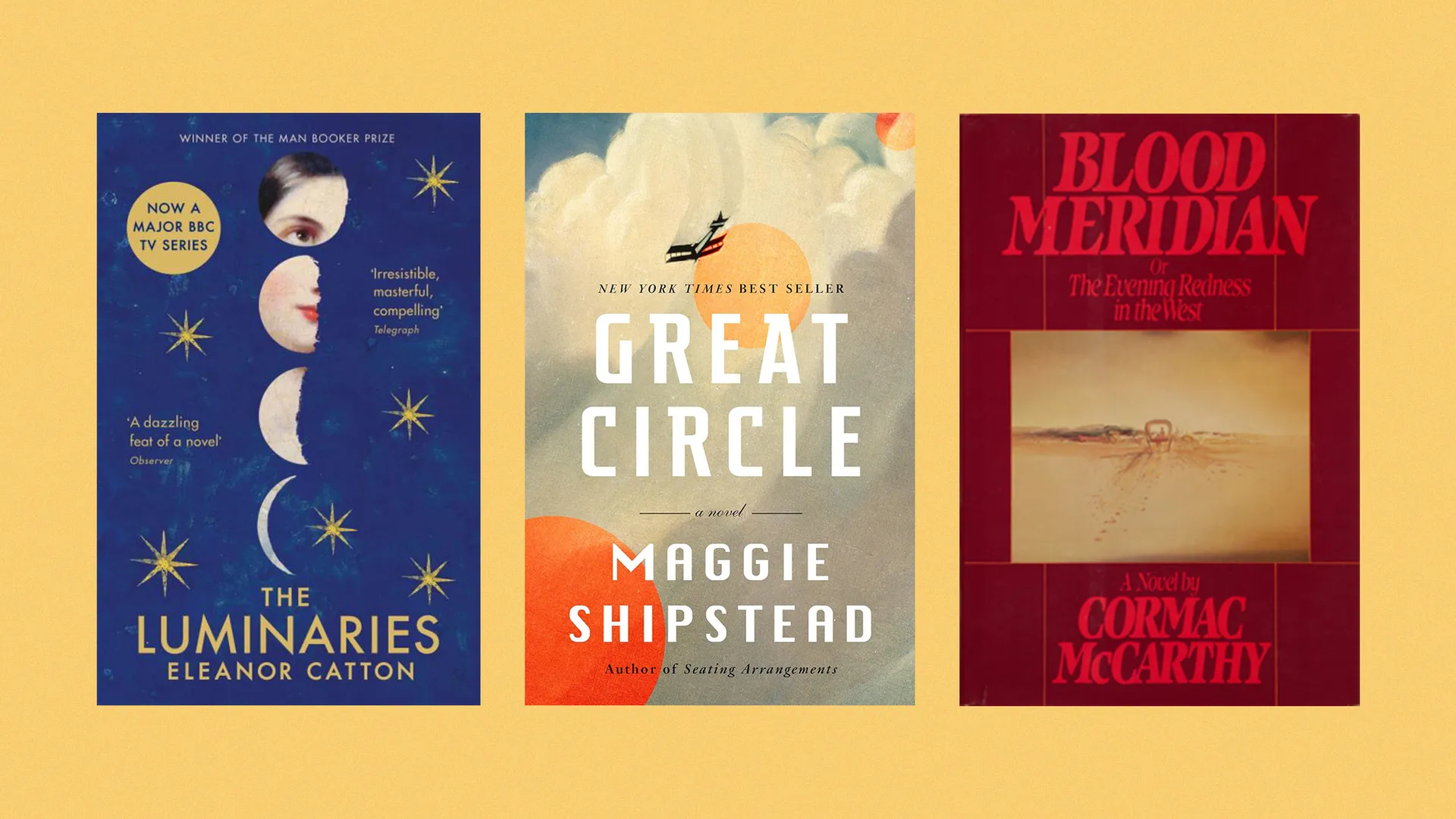
‘Blood Meridian: or the Evening Redness in The West’ by Cormac McCarthy (1985)
The Kid is an illiterate 14-year-old runaway with a “taste for mindless violence” who gets swept up in the gruesome rampage of the Glanton gang, led by the hairless, philosophizing sociopath Judge Holden. “The Judge” dispenses wisdom like “moral law is an invention of mankind for the disenfranchisement of the powerful in favor of the weak” as he commits unspeakable crimes.
The gang hunts members of the Apache tribe and sells their scalps at the behest of the Mexican government, and Cormac McCarthy’s unrelenting novel follows its members around Mexico and the American Southwest during the 1840s. This “extraordinary poetic novel” serves as an “exploration, at times explicitly philosophical, of the relationship between culture and violence,” said Andrew Hislop at the Times Literary Supplement.
‘Lonesome Dove’ by Larry McMurtry (1985)
Larry McMurtry’s Pulitzer Prize-winning novel is regarded as one of the finest novels of the American frontier. Augustus “Gus” McCrae and Woodrow Call are former rangers living in the titular border town in Texas when a former colleague, Jake Spoon, convinces them to pick up and move to the Montana Territory. Driving a herd of stolen cattle, the novel depicts their often violent and brutal journey from the Mexican border to Montana less as a heroic embodiment of the American spirit and more as a slow-moving tragedy. A “crushingly brutal” book, in McMurtry’s world “there’s also love and humor and heroism” in the air “despite the copious death,” said Nate Rogers at the Los Angeles Review of Books.
‘Wolf Hall’ by Hilary Mantel (2009)
Hilary Mantel’s “Wolf Hall” is the kind of sensation that pushed through the boundaries between literature and pop culture. The book is a fictionalized account of the erratic and emotional Henry VIII’s history-altering divorce and then marriage to Anne Boleyn, told through the eyes of the king’s adviser Thomas Cromwell.
Sign up to get Today’s Best Articles in your inbox
A free daily email with the day’s biggest news and analysis – and the best features from TheWeek.com
The book follows this story for the critical eight years between 1527 and 1535, which led to the enduring schism that created the Church of England. An “expansive novel that unfolds in bits of gossip and dreamlike flashback,” this revisionist portrait of Thomas Cromwell “could forever alter him in the popular imagination,” said Macy Halford at The New Yorker.
‘The Luminaries’ by Eleanor Catton (2013)
Eleanor Catton’s “The Luminaries” burst onto the literary scene by making her the winner of the prestigious Booker Prize for fiction at the age of 28. Set in 1866 New Zealand, it follows Walter Moody, a gold prospector who meets twelve local notables convening in his hotel to discuss a series of strange events, from disappearances and murders to a cache of stolen gold, that have engulfed the town.
The events are recounted from each of the locals’ perspectives and at 832 pages, it remains the longest Booker Prize winner. It’s a novel that is “trying both to revive plot as a literary mode and to consider what a storyline looks like in our real, unplotted life, in which things reveal themselves to have a shape only in retrospect,” said B.D. McClay at The New Yorker.
‘The Underground Railroad’ by Colson Whitehead (2016)
Colson Whitehead blends both science fiction and history with “Underground Railroad,” which imagines the slavery-era patchwork of safe houses and escape routes as a literal underground railroad. Cora, the granddaughter of a woman kidnapped from West Africa and sold into slavery, flees her captor’s plantation, plunging her into the book’s alternate steampunk reality where she is pursued by the merciless slave catcher Ridgeway. It is “essential reading, forcing us to examine the chasms that we have willingly created and maintained in our attempts to wrestle with the gravity of atrocity and turn away from our own roles in mythologizing its content and consequences,” said The Book Habit.
‘Great Circle’ by Maggie Shipstead (2021)
Maggie Shipstead sets her novel in two timelines. In one, we follow the exploits of an aviator named Marian Graves, from her impoverished Montana childhood to her improbable career as a fearless pilot, which culminates in an attempt to circumnavigate the globe. The second follows Hadley Baxter, a troubled actress who has signed on to star in a biopic of Graves after her journal from the grand flight is found.
Shipstead’s electrifying novel spans decades and brings the period of early aviation to thrilling life, in the process touching on themes of women’s empowerment and struggle. A novel that “starts high and maintains altitude,” it “grasps for and ultimately reaches something extraordinary,” said Lynn Steger Strong at The New York Times.
‘Matrix’ by Lauren Groff (2021)
The best historical fiction gives readers a visceral sense of what it might have been like to be alive at different points in history, something Lauren Groff excels at with “Matrix.” In Groff’s imagining, the real figure of Marie de France is a gangly teenager exiled by her lover, Eleanor of Aquitaine, to oversee a dreary English abbey sometime during the 12th century.
Marie painstakingly builds the abbey into a regional power center to which notables must pay their respects. Loosely based on real-life figures and events, “Matrix” is a “highly distinctive novel of great vigor and boldness” that plunges readers into everything from “mystical visions that may or may not be divine, to the earthy business of abbey pigs, diseases and account books,” said Alexandra Harris at The Guardian.
David Faris is a professor of political science at Roosevelt University and the author of "It's Time to Fight Dirty: How Democrats Can Build a Lasting Majority in American Politics." He's a frequent contributor to Newsweek and Slate, and his work has appeared in The Washington Post, The New Republic and The Nation, among others.