Sign up to get Today’s Best Articles in your inbox
Join 350,000+ subscribers and keep yourself informed with a selection of
The Week’s most interesting, enlightening and entertaining stories - plus daily puzzles.
You are now subscribed
Your newsletter sign-up was successful
Want to add more newsletters?
An account already exists for this email address, please log in.
One of life’s greatest thrills is watching wildlife in its natural habitat. The experience is even better when the animals live in a space where they are protected and decisions about the land are guided by conservation principles. Bring your binoculars, and see for yourself at these eight wildlife preserves and refuges.
Channel Islands National Marine Sanctuary, California
Visitors can spend hours watching California sea lions and elephant seals
(Image credit: Allen J. Schaben / Los Angeles Times / Getty Images)
Southern California’s Channel Islands are “called ‘North America’s Galapagos’ for a reason,” said Afar. Marine life thrives around the islands — 27 species of whales and dolphins live or pass through the area, along with elephant seals, harbor seals, sea lions, California brown pelicans and rare seabirds like the Scripps’ murrelet. It’s “common to see pods of dolphins” during ferry rides from Ventura, and you can also spot wildlife while “snorkeling, swimming and exploring tide pools.”
Crystal River National Wildlife Refuge, Florida
Manatees are gentle giants
(Image credit: Paul Cross / Miami Herald / Getty Images)
Established in 1983, Crystal River is the only national wildlife refuge in the U.S. created to protect the Florida manatee. Its centerpiece is the unspoiled Three Sisters Springs, where visitors can step onto elevated boardwalks for a “bird’s eye view” of the manatees swimming in “incredibly crystal-clear water,” said National Geographic. Manatee season is Nov. 15-March 31, when the marine mammals migrate to warm-water springs.
The Week
Escape your echo chamber. Get the facts behind the news, plus analysis from multiple perspectives.
Join more than 350,000 subscribers and keep yourself informed with a selection of The Week’s most interesting, enlightening and entertaining stories - plus daily puzzles.
Join more than 350,000 subscribers and keep yourself informed with a selection of The Week’s most interesting, enlightening and entertaining stories - plus daily puzzles.
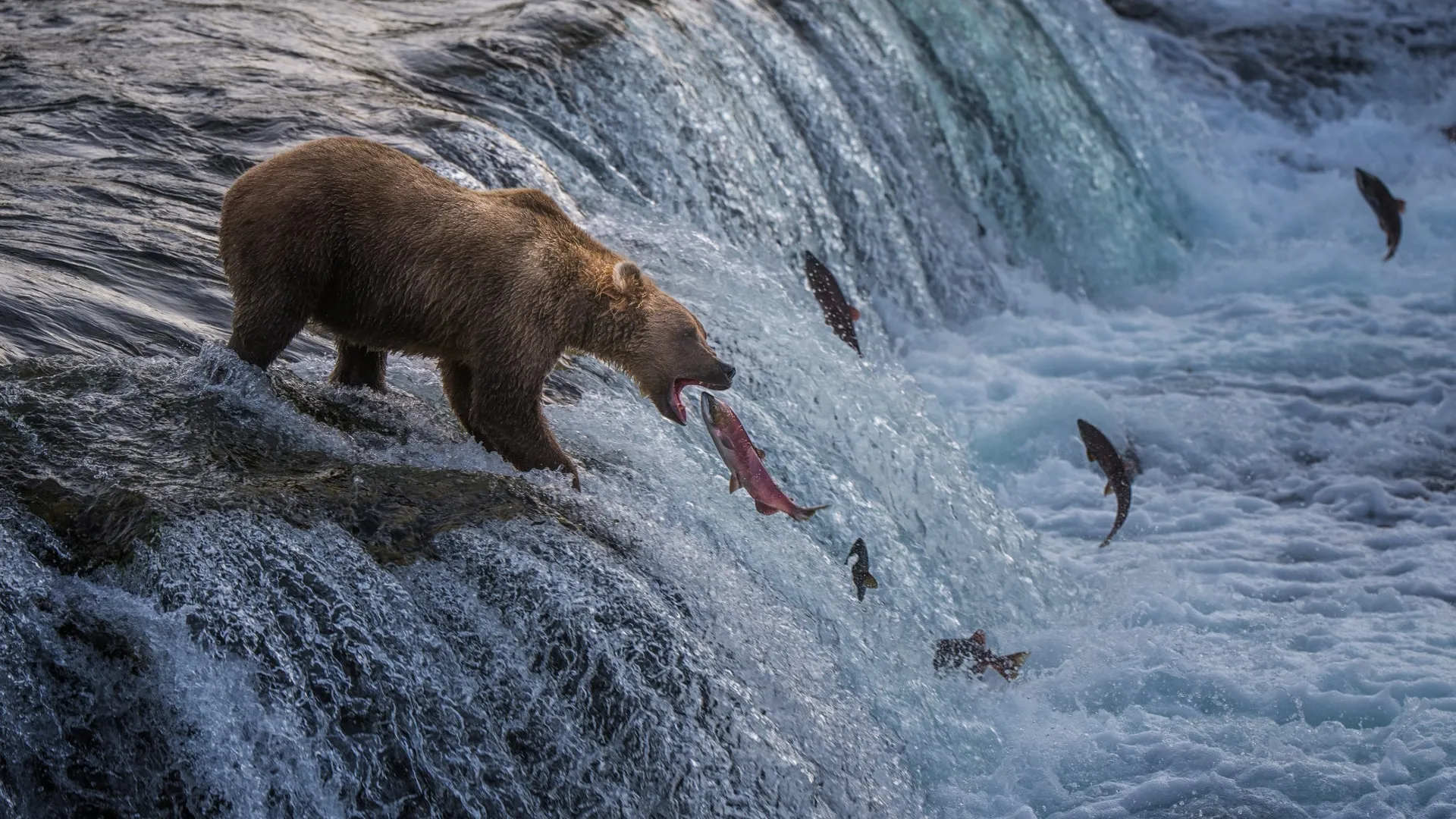
There are no roads to the park. Visitors must get here by boat or plane.
(Image credit: The Washington Post / Getty Images)
This is brown bear territory. Several thousand of the animals live in Katmai, where they eat sockeye salmon from the Brooks River to their heart’s content. During summer and into the fall, the bears famously feast in order to “build a heavy layer of fat to keep themselves warm through the glacial months,” said Outside. The biggest bruins are celebrated during Fat Bear Week, when the public votes on which one will “emerge supreme as the plumpest and most likely to survive the winter.”
Key Deer National Wildlife Refuge, Florida
Key deer are small and similar in size to a medium dog
(Image credit: pclark2 / Getty Images)
If you want to see the tiny key deer, there’s one place to go. The endangered animal can only be found in the Lower Florida Keys, where they swim between islands. Once you arrive at the Key Deer National Wildlife Refuge, it’s “surprisingly easy” to find the deer, said Southern Living.
They don’t shy from people and are often spotted strolling through wetlands and forests. Because of strong conservation efforts, several hundred Key deer live in the area, up from a low of 25 in the 1950s.
Okefenokee National Wildlife Refuge, Georgia
This is the largest wildlife refuge east of the Mississippi River
(Image credit: Megan Varner / Getty Images)
Many consider Okefenokee National Wildlife Refuge to be the “American South’s best-kept secret,” said National Geographic. It’s also one of the newest UNESCO World Heritage Sites, a “paradise” for visitors looking to see American alligators, American black bears, white-tailed deer, gopher tortoises and Eastern indigo snakes. Wildlife watching is a year-round event, and one of the best vantage points is the Owl’s Roost Tower above the swamp.
Sign up to get Today’s Best Articles in your inbox
A free daily email with the day’s biggest news and analysis – and the best features from TheWeek.com
Parker River National Wildlife Refuge, Massachusetts
Snowy owls are one of the refuge’s inhabitants
(Image credit: Craig F. Walker / The Boston Globe / Getty Images)
Birdwatchers flock to Parker River National Wildlife Refuge. It’s one of New England’s “premier birding destinations,” with more than 350 species recorded in the vicinity, said Travel and Leisure. Habitats include salt marsh, cranberry bogs and maritime shrubs and forests. Visitors can hike or bike along “scenic” trails to the best viewing spots.
Red Rock Lakes National Wildlife Refuge, Montana
The refuge was founded in the 1930s to protect the trumpeter swan
(Image credit: Art Wolfe / Getty Images)
The stunning Red Rock Lakes National Wildlife Refuge is west of Yellowstone National Park, with the Centennial Mountains standing tall over forests, lakes, grasslands, marshes and sand dunes. Bears, wolves, elk, river otters and more than 200 bird species live in the preserve, including hundreds of trumpeter swans. For the best chance of seeing cygnets (baby swans), visit during May and June.
Tallgrass Prairie National Preserve, Kansas
Of the 170 million acres of tallgrass prairie that once swathed North America, less than 4% remains
(Image credit: Marine2844 / Getty Images)
A visit to this Kansas preserve almost feels like stepping back in time to the 1800s, when tallgrass prairies and bison were both plentiful. About 500,000 bison still roam in the U.S., and a “hardy” herd of about 100 lives at Tallgrass Prairie National Preserve, said Atlas Obscura. To see them — from an appropriate distance, of course — visit the Windmill and West Traps pastures. There, the animals gather to “graze, relax and soak up the endless sun.”
Catherine Garcia has worked as a senior writer at The Week since 2014. Her writing and reporting have appeared in Entertainment Weekly, The New York Times, Wirecutter, NBC News and "The Book of Jezebel," among others. She's a graduate of the University of Redlands and the Columbia University Graduate School of Journalism.