The Week The Week
flag of US
US
flag of UK
UK
https://cdn.mos.cms.futurecdn.net/flexiimages/jacafc5zvs1692883516.jpg

SUBSCRIBE & SAVE

Less than $3 per week

Sign in
  • View Profile
  • Sign out
  • The Explainer
  • The Week Recommends
  • Newsletters
  • Cartoons
  • From the Magazine
  • The Week Junior
  • More
    • Politics
    • World News
    • Business
    • Health
    • Science
    • Food & Drink
    • Travel
    • Culture
    • History
    • Personal Finance
    • Puzzles
    • Photos
    • The Blend
    • All Categories
  • Newsletter sign up Newsletter
  • The Week Evening Review
    The Trump-Xi summit, airplane class disparity, and a South African influx

     
    today’s big question

    Can the US and China align on AI dangers?

    China and the U.S. are locked in a race to develop the most powerful artificial intelligence models. Industry leaders are increasingly calling for regulations and guardrails to keep the technology from threatening humanity, which means the competing nations must cooperate to rein in AI as it gallops ahead. But observers are skeptical that Washington and Beijing can find the will to do so.

    What did the commentators say?
    AI safety is “on the agenda” for this week’s summit between President Donald Trump and Chinese leader Xi Jinping, said The Associated Press. But both sides “see the other as the problem.” Trump has warned that “any efforts to regulate the technology would help China,” while Chinese leaders see talk of new safety rules as an attempt to slow their nation’s rapid advances so that the U.S. can create a “monopoly” on AI. 

    Chinese leaders don’t see AI as an “existential threat to humanity,” said Kyle Chan, of the Brookings Institution, at The New York Times. U.S. companies like Anthropic and OpenAI use AI to “develop even better AI systems,” creating concerns about a “feedback loop” in which humans “no longer have control over the process.” 

    Chinese companies like DeepSeek and Moonshot, by contrast, have “limited access to AI computing power” and see that tipping point as being a “long way off,” said the Times. Beijing is more worried about AI being used to spark a “mass movement powerful enough to topple the Communist Party.” 

    Beijing would be “perfectly happy to watch Washington scare America into slowing itself down,” said Rep. Kat Cammack (R-Fla.) at the National Review. China’s Communist leaders are “actively working to exploit Americans’ fears” about the technology, and Beijing wins every time the U.S. “makes itself slower, more expensive and more afraid to experiment.” 

    What next?
    The U.S. is proposing an “emergency AI hotline” with China, said Axios. “More transparency” between the world’s AI superpowers is “very important," said Treasury Secretary Scott Bessent to reporters, per the outlet. Still, neither nation “expects a breakthrough” at this week’s Trump-Xi summit, said The Economist. 


    QUOTE OF THE DAY

    ‘I am the code.’

    Trump to James McCrery, a former architect on the White House ballroom project, in response to the latter’s concerns that some design features violate building safety codes, according to a report by The Washington Post. McCrery reportedly warned many times that the preliminary design did not provide adequate emergency exit routes.


    the explainer

    Trump’s South Africa obsession upends the US refugee program

    The Trump administration notified Congress this week of plans to admit up to 17,500 refugees into the U.S. during the coming fiscal year. Notably, the vast majority of those refugees will be white South Africans, for whom this White House and President Donald Trump have become reliable international patrons.

    By focusing almost exclusively on Afrikaners, the white South African ethnic group responsible for that country’s former system of apartheid, Trump and his allies have dramatically reshaped the U.S. refugee program as a whole. And this change, critics argue, is at the material expense of other at-risk communities worldwide.

    How has Trump helped resettle Afrikaners?
    The White House has predominantly portrayed white South Africans seeking to resettle in the U.S. as “victims of racial oppression in postapartheid South Africa,” said CBS News. The South African government has “consistently denied” persecuting the primarily Dutch-descended community, said the State Department in its notification to Congress, per the outlet.

    America’s refugee resettlement program had “historically enjoyed strong bipartisan support” for welcoming “tens of thousands of refugees from countries around the world to new lives in America,” said The Associated Press. “Instead,” Trump has “transformed it into a vehicle to resettle” white South Africans in the U.S.

    Why are critics concerned?
    By focusing solely on South Africa, the Trump administration is “stranding people fleeing persecution without the safety they have been promised after years of waiting,” said the immigration advocacy group HIAS in a statement. A refugee program that “centers one group and sidelines all others” is an “abdication of our global ⁠humanitarian leadership ​and an abandonment of thousands of vulnerable ​families,” said Krish O’Mara Vignarajah, the president and CEO of refugee advocacy group Global Refuge, in a statement.

    What else has Trump done for white South Africans?
    One week before notifying Congress of its new, almost exclusively Afrikaner refugee resettlement plan, the Trump administration announced it would “revoke U.S. visas or reject visa applications” from foreign nationals “responsible for discrimination against whites and other minority groups in South Africa,” said the AP. In addition to encouraging Afrikaner resettlement in the U.S., said Al Jazeera, Trump last year “froze most foreign assistance” to South Africa.


    Statistic of the day

    1,063: The number of deaths or injuries caused by cluster munitions in 2025, according to the Cluster Munition Coalition. Most casualties were civilians, including at least 34 children. Ukraine had the “highest number of recorded casualties for the fourth consecutive year,” accounting for 87% of the global total, said Al Jazeera.


    in the spotlight

    The economy is K-shaping your next flight

    A K-shaped economy, in which the rich get richer while everybody else falls behind, is showing up at the airport. Airlines in desperate search of profits are expanding roomy first- and business-class seating on flights while economy class continues to get more cramped.

    ‘Literal experience of class division’
    American Airlines is “ripping up existing airplane configurations” to add more business-class seating, said CNBC. Half the airline’s revenues come from the 30% of seats in the high-end category, which is why the more expensive seating options are “only going to grow in our fleet,” said American Airlines CEO Robert Isom at an industry conference this week, per the outlet. 

    American’s newest Boeing 777 aircraft will feature a “monster 70-suite business-class cabin,” said CNBC. “Higher-spending” customers are a “bright spot” for airlines struggling with rising fuel costs. 

    Budget airlines are joining the rush. JetBlue is revamping its first-class cabins with “redesigned seats, premium amenities and upgraded seatback technology,” said Fox Business. Flyers are “increasingly looking for more premium experiences,” said JetBlue CEO Joanna Geraghty in a statement. 

    Southwest Airlines does not offer a first-class cabin on its flights. But it’s building deluxe lounges at four airports as it transitions from a no-frills carrier to an outfit “fighting competitors for bigger spenders,” said The Washington Post.

    Meanwhile, legroom for standard economy seats has shrunk from “roughly 35 inches in the 1970s to about 31 inches today,” said Simple Flying. The disparity between experiences in the front and back of airliners is the “literal experience of class division in America,” said Allison Morrow at CNN.

    Helping airlines be ‘resilient’
    Airlines not so long ago “routinely gave first- and business-class seats away in free upgrades” to loyal customers, said ABC News. But those days are done for, given the money that can be made from selling those tickets. 

    Economy passengers are still “essential for filling aircraft and covering fixed costs” for airlines, said Quartz. But revenue from pricier seating has “more than doubled” in the last decade, said Delta CEO Ed Bastian at a March conference, per ABC News. This can help airlines be “resilient through these tougher times.”


    Good day 👧

    … for record-setting. Lian Yunzhi, a 6-year-old girl from China, has become a new women’s world record holder by “solving Rubik’s Cubes at an average pace of just over 4 seconds per cube,” said The Associated Press. She’s the only female speedcuber to get an average below 4.5 seconds, at 4.27 seconds, said CCTV. 


    Bad day 💳

    … for cybersecurity. A Chinese hacker has deployed AI agents, launching cyberattacks on “as many as 100 organizations,” stealing 618,000 credit card details, said Forbes. The hacker automated the attacks with Chinese models DeepSeek and Kimi and Anthropic’s Claude in one of the “most severe abuses of AI for exploitation seen so far,” said Eyal Sela, a cybersecurity researcher, to the outlet.


    Picture of the day

    Pitch-perfect

    New York Yankees pitcher Max Fried warms up before the game against the Tampa Bay Rays at New York City’s Yankee Stadium. MLB season ends on Sunday, and the postseason begins Tuesday. The Los Angeles Dodgers are favorites to win this year’s World Series, which begins on Oct. 23.
    New York Yankees / Getty Images


    Puzzles

    Daily sudoku

    Challenge yourself with The Week’s daily sudoku, part of our puzzles section, which also includes guess the number

    Play here


    The Week recommends

    The best wildlife preserves in the country

    One of life’s greatest thrills is watching wildlife in its natural habitat. The experience is even better when the animals live in a space where they are protected and decisions about the land are guided by conservation principles. Bring your binoculars, and see for yourself at these wildlife preserves and refuges.

    Katmai National Park and Preserve, Alaska
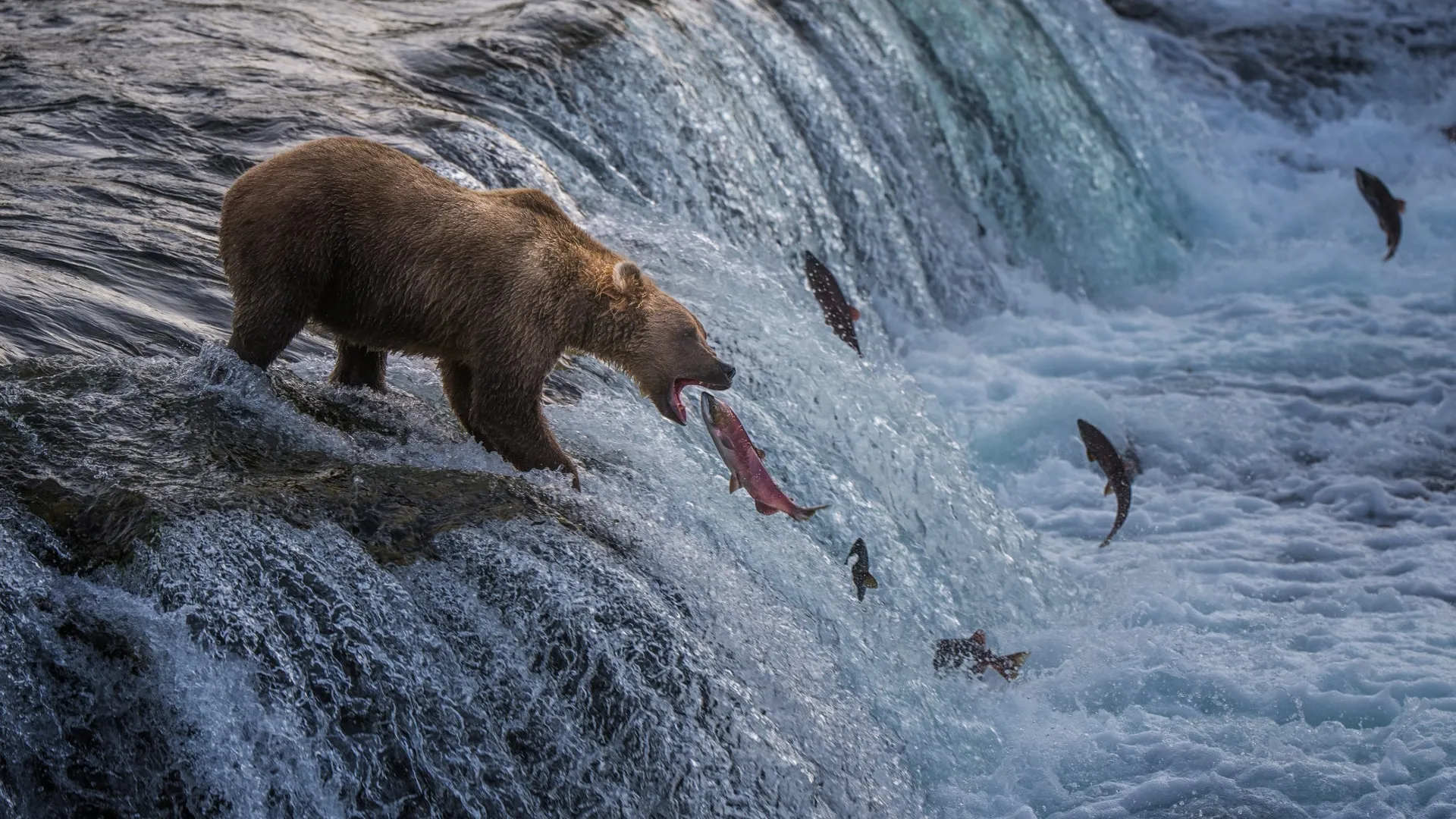
    This is brown bear territory. Several thousand of the animals live in Katmai, where they eat sockeye salmon from the Brooks River to their heart’s content. During summer and into the fall, the bears (pictured above) famously feast in order to “build a heavy layer of fat to keep themselves warm through the glacial months,” said Outside. 

    Key Deer National Wildlife Refuge, Florida
    If you want to see the tiny key deer, there’s one place to go. The endangered animal can only be found in the Lower Florida Keys, where they swim between islands. Once you arrive at the Key Deer National Wildlife Refuge, it’s “surprisingly easy” to find the deer, said Southern Living.

    Tallgrass Prairie National Preserve, Kansas
    A visit to this Kansas preserve almost feels like stepping back in time to the 1800s, when tallgrass prairies and bison were both plentiful. About 500,000 bison still roam in the U.S., and a “hardy” herd of about 100 lives at Tallgrass Prairie National Preserve, said Atlas Obscura. To see them — from an appropriate distance, of course — visit the Windmill and West Traps pastures, where they gather to “graze, relax and soak up the endless sun.”

    Read more


    Poll watch

    Democrats want Trump out of office by any means necessary, according to a Center for Strategic Politics survey of 683 Democratic voters. Many (75%) would be happy to hear the news that he had been impeached and convicted, while another 45% would be satisfied with hearing he had died. Only 23% would be OK with him being assassinated. 


    INSTANT OPINION

    Today’s best commentary

    ‘Normalizing Delcy Rodríguez won’t fix Venezuela’
    Juan Pablo Spinetto at Bloomberg
    “Given that nobody elected” Venezuelan Acting President Delcy Rodríguez to the “job she’s performing and that the constitutional rules governing Venezuela’s presidential vacuum have long been ignored, ‘dictator’ sounds about right,” says Juan Pablo Spinetto. But dictators “tend to do as they please,” while Delcy, “by contrast, appears to be taking all her cues” from Trump. And “no amount of hard-power realpolitik, oil thirst, business ambition and perverse public relations can turn a dictator-puppet-regent into a legitimate leader.”

    ‘Despite fewer deaths, the US is actually seeing more overdoses’
    Madeline Hilliard and Jim Crotty at The Hill
    An “abrupt, substantial decline in overdose deaths is an extraordinary public health achievement,” say Madeline Hilliard and Jim Crotty. But the “drop in deaths only tells part of the story.” As “overdose deaths have declined, nonfatal overdoses — when someone survives the emergency of too much substance shutting their body down — have actually increased.” Even when “survived, overdoses are often life-altering events with lasting impacts.” Preventing these “outcomes starts long before someone experiences an overdose.”

    ‘If you want to win working-class votes, run on working-class issues’
    Mindy Isser at In These Times
    If liberals are “serious about winning elections across the country, working-class voters must be at the center of this project,” says Mindy Isser. But “too many campaigns don’t make these voters’ priorities their focus.” For people “concerned about climate change, abortion rights, immigrants’ rights and protecting democracy, our most important task is to learn to talk across the diploma divide, or else we may have very little hope of making progress on our goals.”


    WORD OF THE DAY

    ferritin

    A protein that stores iron in the body. Combating “ferritin face” is the latest social media trend, as people claim that “low iron levels leave visible clues on your face” such as “dark circles under the eyes” or pale or gray-looking skin,” said The Conversation. Some influencers claim “raising their ferritin levels transformed their complexion in ways no product could.”


    Evening Review was written and edited by Theara Coleman, Nadia Croes, Catherine Garcia, Scott Hocker, Anya Jaremko-Greenwold, Justin Klawans, Joel Mathis and Rafi Schwartz, with illustrations by Julia Wytrazek.

    Image credits, from top: Illustration by Julia Wytrazek / Getty Images; Stephen Swintek / Getty Images; Chip Somodevilla / Getty Images; Hu Xiaolin / VCG / Getty Images
     

    Recent editions

    • Morning Report

      Trump’s Iran indecision lands at UN

    • Evening Review

      Trump’s Greenland deal

    • Morning Report

      Austin DoorDash driver detained with ICE bullet in neck

    VIEW ALL
    TheWeek
    • About Us
    • Contact Future's experts
    • Terms and Conditions
    • Privacy Policy
    • Cookie Policy
    • Advertise With Us
    • FAQ
    Add as a preferred source on Google Add as a preferred source on Google

    The Week is part of Future US Inc, an international media group and leading digital publisher. Visit our corporate site.

    © Future US, Inc. Full 7th Floor, 130 West 42nd Street, New York, NY 10036.