Sign up to get Today’s Best Articles in your inbox
Join 350,000+ subscribers and keep yourself informed with a selection of
The Week’s most interesting, enlightening and entertaining stories - plus daily puzzles.
You are now subscribed
Your newsletter sign-up was successful
Want to add more newsletters?
An account already exists for this email address, please log in.
Jam doughnut rock spotted on Mars leaves Nasa baffled
'We were absolutely startled,' admit scientists as Opportunity Rover captures image of new rock
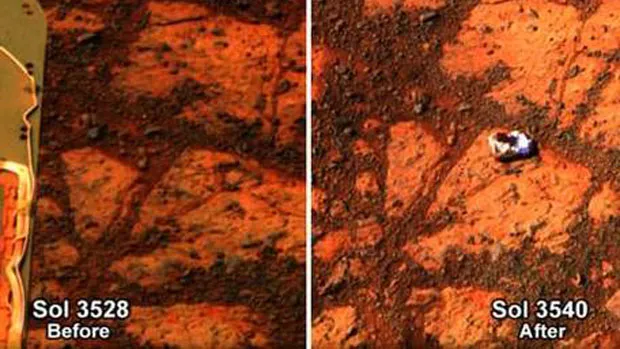
A MYSTERY Martian rock that appeared from nowhere and looks like a jam doughnut has left Nasa baffled.
Scientists monitoring images taken by the Mars Opportunity rover's panoramic camera spotted the fist-sized rock and named it "Pinnacle Island".
Lead scientist Steve Squyres, of Cornell University, told Discovery News: "It's about the size of a jelly doughnut. It was a total surprise, we were like 'wait a second, that wasn't there before, it can't be right. Oh my god! It wasn't there before!' We were absolutely startled."
The Week
Escape your echo chamber. Get the facts behind the news, plus analysis from multiple perspectives.
Join more than 350,000 subscribers and keep yourself informed with a selection of The Week’s most interesting, enlightening and entertaining stories - plus daily puzzles.
Join more than 350,000 subscribers and keep yourself informed with a selection of The Week’s most interesting, enlightening and entertaining stories - plus daily puzzles.
Squyres believes that the odd specimen may have been unearthed by the wheels of the Rover or the impact of a nearby meteorite.
Another theory is that the rock came from a smoking hole in the ground nearby, but Squyres says this is less likely.
"Mars keeps throwing new stuff at us," the scientist told Discovery, before explaining that, wherever it had come from, the mystery rock had somehow been flipped over. "[The rock] obligingly turned upside down, so we're seeing a side that hasn't seen the Martian atmosphere in billions of years and there it is for us to investigate. It's just a stroke of luck."
Squyres said that the rock, which is being tested by the rover, is "like nothing we've ever seen before".
Sign up to get Today’s Best Articles in your inbox
A free daily email with the day’s biggest news and analysis – and the best features from TheWeek.com
It is high in sulphur and very high in magnesium – with twice as much manganese as anything scientists have ever seen on Mars.
"I don't know what any of this means. We're completely confused," he said. "Everybody on the team is arguing and fighting. We're having a wonderful time!"
Squyres was speaking at an event held by the Nasa Jet Propulsion Laboratory to mark the 10th anniversary of the arrival of the Opportunity rover on Mars.
Its twin rover, Spirit, succumbed to the Martian elements in 2009 when it became stuck in a sand trap and lost contact with Earth.