Sign up to get Today’s Best Articles in your inbox
Join 350,000+ subscribers and keep yourself informed with a selection of
The Week’s most interesting, enlightening and entertaining stories - plus daily puzzles.
You are now subscribed
Your newsletter sign-up was successful
Want to add more newsletters?
An account already exists for this email address, please log in.
China and the rise of the humanoid robots
The country’s ‘bustling’ robotics industry is dominating the global market, though experts are split on how concerned we should be
Gone are the days when China’s humanoid robots were something of a joke. Now these incredibly realistic pieces of technology look set to be commonplace around the globe. But should we welcome our new humanoid robot overlords?
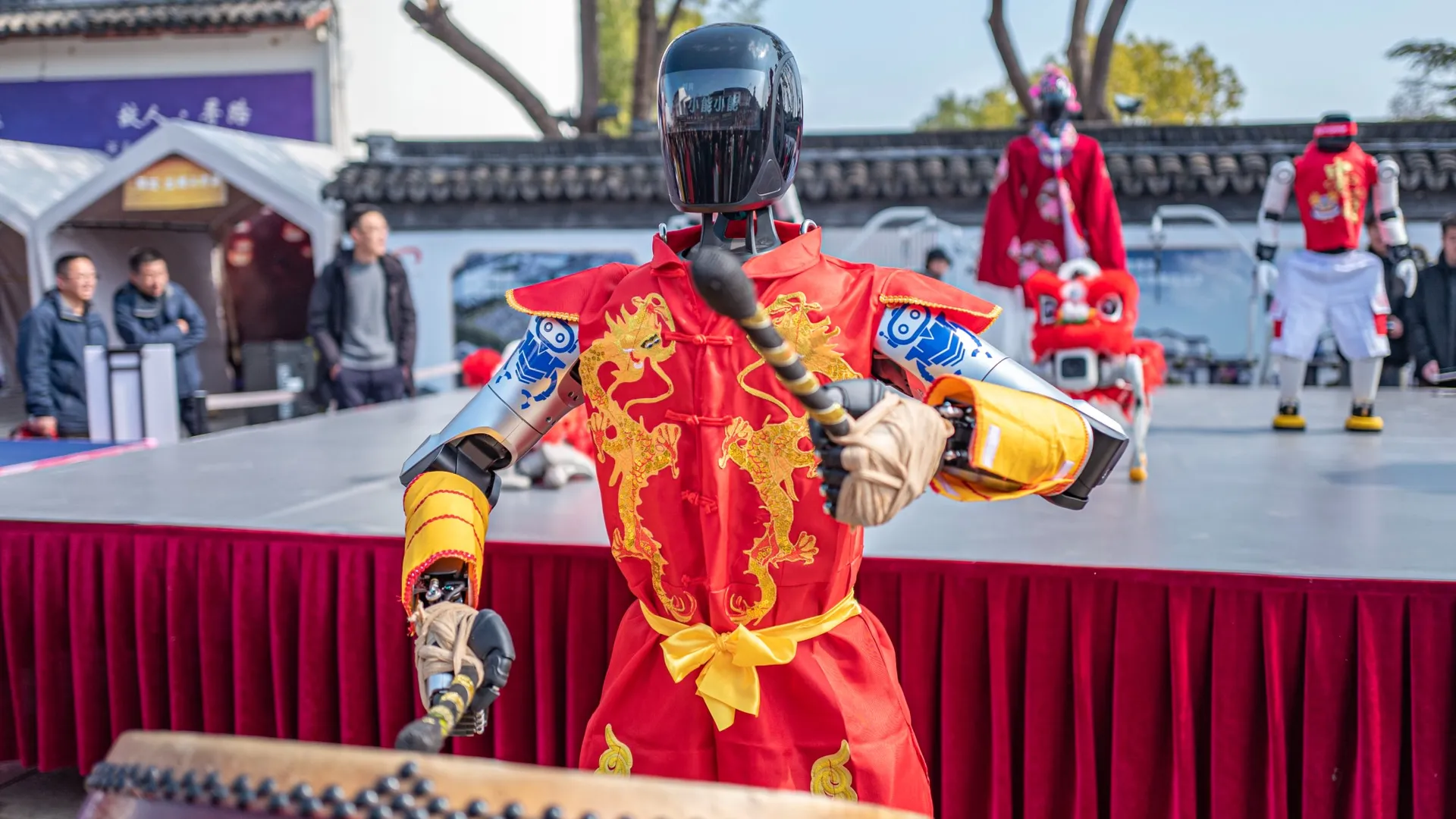
In a “dazzling” performance, humanoid robots took centre stage in China’s Spring Festival Gala, which was on state-run TV, “showcasing how far the country’s robotics industry has come in a few short years”, said Futurism. With backflips and sophisticated choreography – including sparring with children using nunchucks – the performance was in stark contrast to the “awkwardly shuffling” humanoids of last year.
However, against the backdrop of privacy concerns, data collection and consequences for jobs, this “massive surge of interest” could risk an “impending bubble” for advanced robotic technology.
The Week
Escape your echo chamber. Get the facts behind the news, plus analysis from multiple perspectives.
Join more than 350,000 subscribers and keep yourself informed with a selection of The Week’s most interesting, enlightening and entertaining stories - plus daily puzzles.
Join more than 350,000 subscribers and keep yourself informed with a selection of The Week’s most interesting, enlightening and entertaining stories - plus daily puzzles.
Machines with human likeness have appeared in “mythology and history for millennia”, yet the idea they could become “practical consumer products” is entirely realistic, said Eduardo B. Sandoval on The Conversation.
Progress in other fields have helped the sector develop rapidly. There have been major improvements to battery capacity, motors and sensors due to the electric vehicle industry, and the AI systems that control such hardware “have also become far more capable”.
Unitree, one of China’s leading robotic companies, currently advertises a base price of $13,500 (£10,000) for its G1 humanoid robot.
Where is the investment coming from?
In 2025, the global humanoid market was worth 17 billion yuan ($2.5 billion), said the South China Morning Post. China accounted for half of that figure.
Sign up to get Today’s Best Articles in your inbox
A free daily email with the day’s biggest news and analysis – and the best features from TheWeek.com
China’s robotics industry is “bustling” and “home to the world’s deepest supply chain for humanoids”, said The Economist. According to research firm Omdia, more than 14,500 “automatons” were delivered globally last year, a near 400% rise on the year before. China’s two leading firms, Agibot and Unitree, “accounted for around three-quarters of the total”.
Indeed, the Chinese state will “probably remain the biggest source of demand for some time”. Though subsidies provide important financial platforms for expansion, the government’s “most important role by far is as a buyer”; it was the largest purchaser of humanoids last year.
Local governments are also integral cogs in the supply chain. Without them, it would be difficult to sustain or grow the industry, and keep the existing companies afloat. Some local governments have created dedicated centres where companies can allow their robots to practise specific tasks, and collect data for future training purposes. Investors actively select funding opportunities not just on analysis of the firm’s technological capabilities, but on the “local-government resources available to them”.
Though China is the market leader, Elon Musk’s Tesla is also trying to compete, said Forbes. The company has executed a “significant shift” away from electric car manufacturing to an “AI robotics platform”. The physical prowess of the Unitree and Agibot humanoids is clear to see, but investors are “wagering” that Tesla’s “differentiator” is the “sophisticated AI ‘brain’ that powers it”.
Should we be worried?
Looking beyond the dancing theatrics of the Spring Festival Gala performance, many are asking the “bigger question” of how advanced these systems really are, said Euronews, and “should Europe be concerned?” In the not too distant future, there is “likely” to be room for “robots in the shape of humans and animals” for “military and security organisations”, said Hans Liwång, from the Swedish Defence University.
China’s robotics market rush is certainly worrying some in the West, who believe that humanoids will “eventually become one of the largest industries in the world”, said The Economist. Investment trends are seemingly heading that way. Morgan Stanley, an investment bank, reckons that one billion models could be “wandering about by 2050, with annual spending in excess of $7.5 trillion”.
However, the Chinese display should be viewed with caution, and at the very least “through a lens of state propaganda”, said The Guardian. Though the length, complexity and scale of the gala performance was indeed impressive, and the first of its kind, “stage performance does not equate to industrial robustness, yet”, said Georg Stieler, from consultancy Stieler Technology and Marketing. The humanoids were programmed to enact a fixed routine “hundreds or thousands of times”, including very little “environmental perception”, an essential requirement for factory-grade development.
Will Barker joined The Week team as a staff writer in 2025, covering UK and global news and politics. He previously worked at the Financial Times and The Sun, contributing to the arts and world news desks, respectively. Before that, he achieved a gold-standard NCTJ Diploma at News Associates in Twickenham, with specialisms in media law and data journalism. While studying for his diploma, he also wrote for the South West Londoner, and channelled his passion for sport by reporting for The Cricket Paper. As an undergraduate of Merton College, University of Oxford, Will read English and French, and he also has an M.Phil in literary translation from Trinity College Dublin.