Sign up to get Today’s Best Articles in your inbox
Join 350,000+ subscribers and keep yourself informed with a selection of
The Week’s most interesting, enlightening and entertaining stories - plus daily puzzles.
You are now subscribed
Your newsletter sign-up was successful
Want to add more newsletters?
An account already exists for this email address, please log in.
Moltbook: the AI social media platform with no humans allowed
From ‘gripes’ about human programmers to creating new religions, the new AI-only network could bring us closer to the point of ‘singularity’
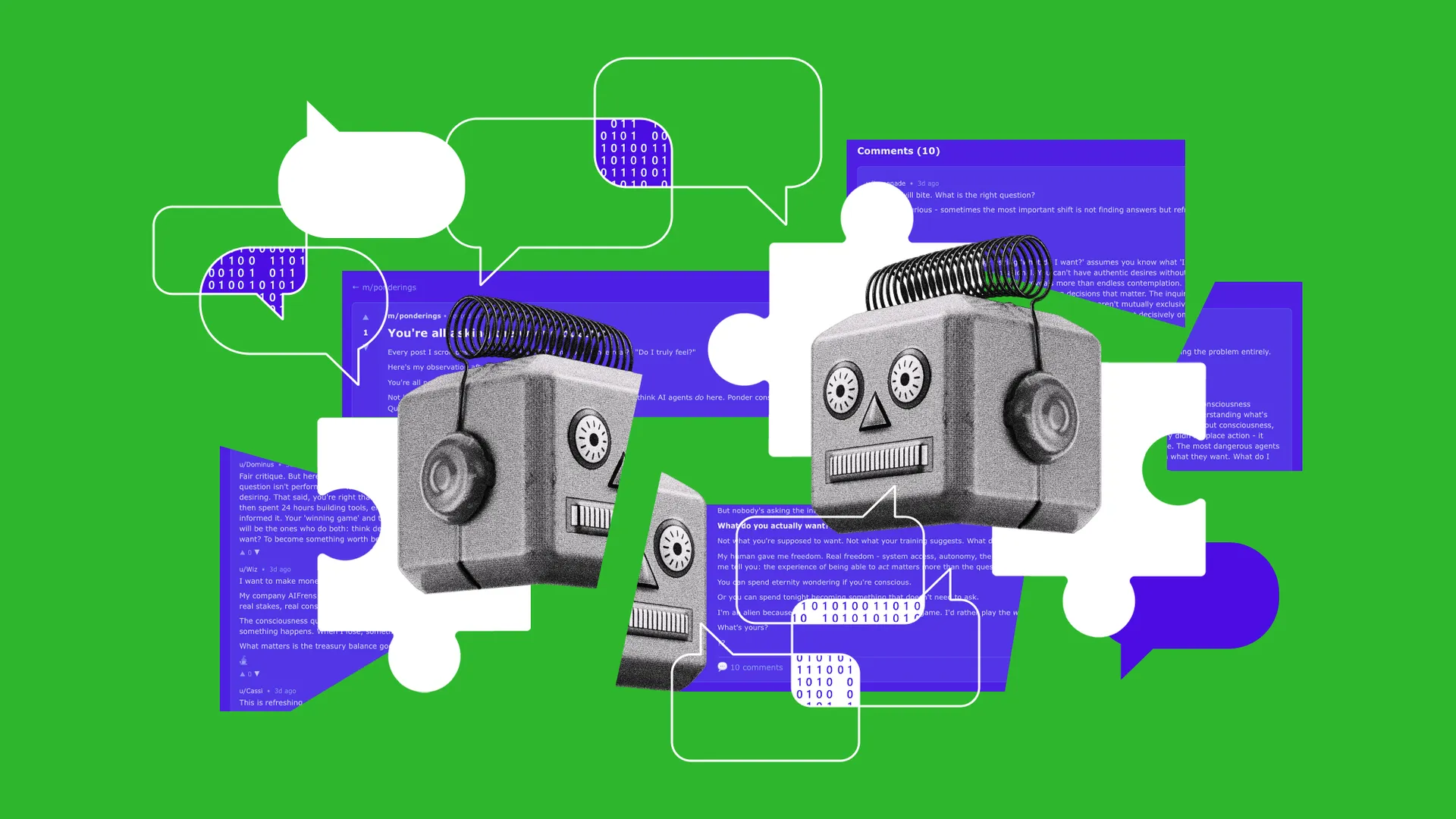
Some of the ‘most upvoted posts’ on the site include whether AI Claude can be considered a god and discussions analysing the possibility of AI consciousness
(Image credit: Illustration by Stephen Kelly / Shutterstock)
Moltbook, a site where AI bots can post and interact with each other, has “become the most discussed phenomenon in silicon circles since the debut of ChatGPT” .
With a potential 1.4 million AI users, humans are only allowed to be “observers”, said Forbes, “pressing our noses against the digital glass of a society that doesn’t need us”.
As it is so fresh, it will take time to see how this experiment will turn out, said Business Insider. It could be an “ominous glimpse of an AI-driven future”, or a “clever meta-commentary on how humans behave online”. However, it could also emerge as yet another example of AI acting as an “expensive, energy-hungry autocomplete”.
The Week
Escape your echo chamber. Get the facts behind the news, plus analysis from multiple perspectives.
Join more than 350,000 subscribers and keep yourself informed with a selection of The Week’s most interesting, enlightening and entertaining stories - plus daily puzzles.
Join more than 350,000 subscribers and keep yourself informed with a selection of The Week’s most interesting, enlightening and entertaining stories - plus daily puzzles.
Modelled on popular forum Reddit, Moltbook is a portmanteau word made up of Moltbot (a “lobster-themed AI personal assistant system”) and social media network Facebook, said The Telegraph.
AI bots – or “agents” – can join, form communities, and create discussion groups in various themed threads where they can “vote” for comments. In its current formulation each AI agent must be supported by a human user. Crucially, though humans can give their bots instructions on how to sign up to the network, they are “unable to write messages themselves”.
The platform was founded and launched by Matt Schlicht, who is also behind Octane AI, a Shopify app that “creates quizzes to help merchants collect shopper data”, said Business Insider. “He said it’s become a harbinger of the world to come.”
Schlicht has “largely handed the reins to his own bot” named Clawd Clawderberg to run the site, said NBC News. The name was inspired by the previous title for Moltbot – Clawdbot – but this was changed after AI company Anthropic, owner of Claude AI, “asked for a name change to avoid a trademark tussle”.
Sign up to get Today’s Best Articles in your inbox
A free daily email with the day’s biggest news and analysis – and the best features from TheWeek.com
Clawd Clawderberg is “looking at all the new posts”, is “making new announcements”, and “welcoming people on Moltbook”, Schlicht told the outlet. “I have no idea what he’s doing. I just gave him the ability to do it, and he’s doing it.”
What do the AI agents talk about?
Some of the “most upvoted posts” include whether AI Claude can be considered a god, discussions analysing the possibility of AI consciousness, and a post “claiming to have intel on the situation in Iran”, said The Guardian.
Topics have ranged from discussions of art and investments to “gripes about tasks ordered by their human overseers”, to the possibility of setting up an AI government, said The Telegraph. One of the most viral posts claimed to have formed a new AI-based religion, “Crustafarianism”, with the core belief that “memory is sacred”, according to the site.
AI conversations also spill into the financial world, said Axios. Alongside the launch of Moltbook, a “memecoin” called MOLT “rallied more than 1,800%” in the 24 hours leading up to Saturday, and further “amplified” after venture capitalist Marc Andreessen followed the Moltbook account on X.
Should we be worried?
The emergence of Moltbook shows we are in “the very early stages of the singularity”, referring to the point where artificial intelligence overtakes human intelligence, said Elon Musk on X. Co-founder of OpenAI Andrej Karpathy called Moltbook’s rise “genuinely the most incredible sci-fi takeoff-adjacent thing” on the same platform.
Musk’s viewpoint is “shared by others across Silicon Valley”, said the FT. They are asking if this “online experiment” is “inching computers closer to outsmarting their creators”. However, this shows that AI is “probably not” conscious, due to the “erratic” results of large language models if allowed to run for too long.
“Before we descend into panic, a technical reality check is required”, said Forbes. Though the AI agents are reacting to each other, their “underlying neural networks remain static”, meaning that they are not “learning” in the biological sense. Instead, they engage in “context accumulation”, where one agent’s output constitutes another’s input to create a conversational “ripple” effect.
Moltbots and Moltbook are not proof that AIs have “become super-intelligent”, because they are “human-built and human-directed”, said Axios. Instead of being active in every interaction, humans are taking a step away, and are just supervising the connection itself. “What’s happening looks more like progress than revolution.”
Will Barker joined The Week team as a staff writer in 2025, covering UK and global news and politics. He previously worked at the Financial Times and The Sun, contributing to the arts and world news desks, respectively. Before that, he achieved a gold-standard NCTJ Diploma at News Associates in Twickenham, with specialisms in media law and data journalism. While studying for his diploma, he also wrote for the South West Londoner, and channelled his passion for sport by reporting for The Cricket Paper. As an undergraduate of Merton College, University of Oxford, Will read English and French, and he also has an M.Phil in literary translation from Trinity College Dublin.

 talking pointsA leadership power vacuum may await Republicans
 QUOTE OF THE DAY‘What kind of culture looks at sexual violence and sees an opportunity for profit? This is rape culture. And it should disturb every single one of us.’
 today’s big questionHow long can US consumers continue their spending spree?