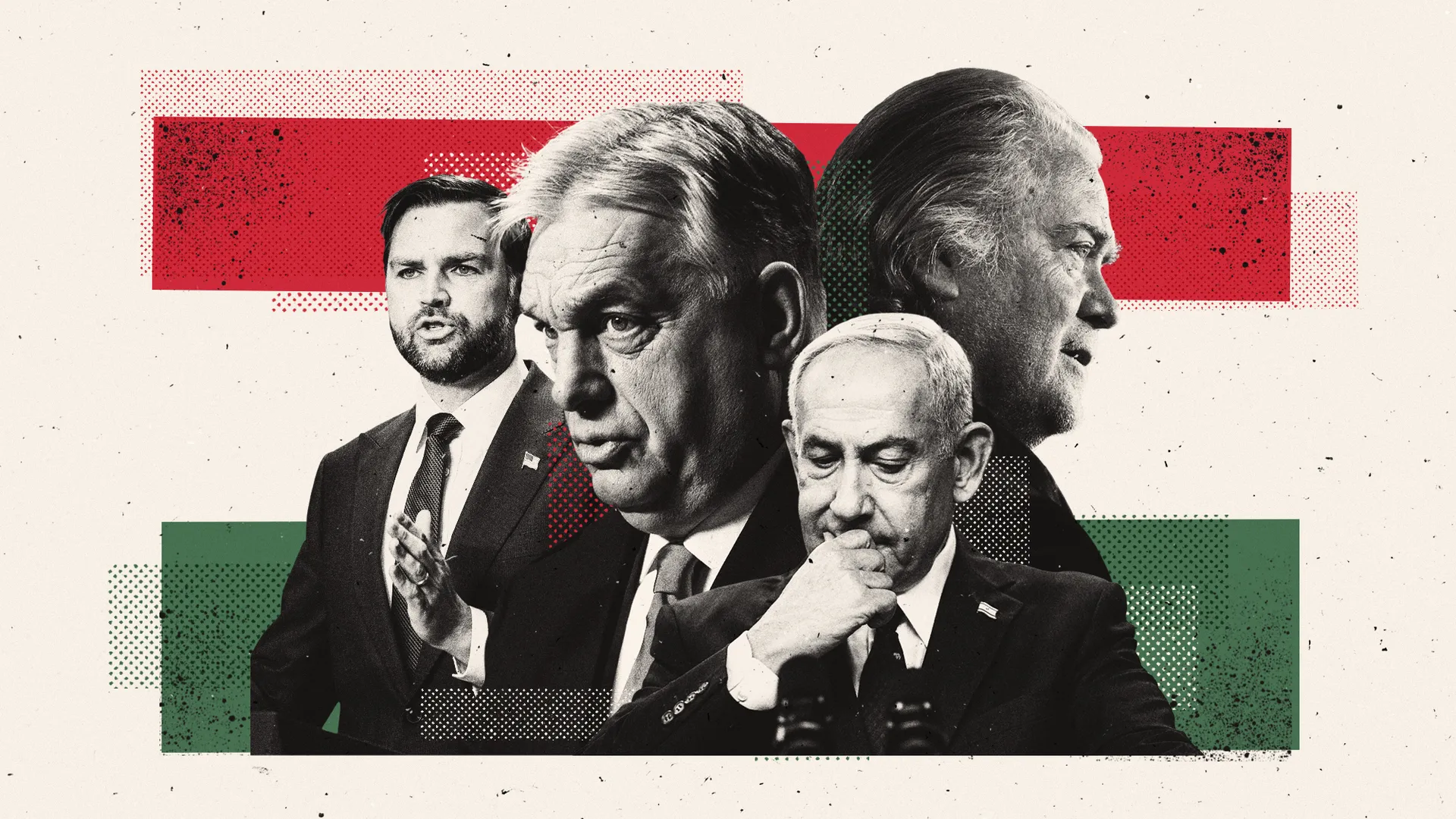
The United States under President Donald Trump is, for the time being, the brightest star in a growing network of ultra-nationalist governments hoping to reshape the global order in their authoritarian mold. While MAGA America is the powerhouse, it’s Prime Minister Viktor Orbán’s Hungary that has been the backbone of the worldwide lurch rightward. Yet as Hungarians prepare to vote on April 12, Orbán and his Fidesz party seem headed for an electoral upset that could send shock waves across hard-right spheres.
Government ‘revered by authoritarians everywhere’
A “pro-Kremlin, anti-EU strongman” who has spent nearly two decades “building a template for Christian nationalist rule,” Orbán is now the “cornerstone of President Trump’s vision for Europe,” Axios said. In the 16 years since he was first elected, Orbán forged a “state apparatus — courts, media, election administration — loyal to his party” and has “never lost under the system he built.”
As the “center of the Trump administration’s shifting policy toward Europe,” Orbán’s Hungary “firmly” aligned itself with “far-right parties and immigration restrictionists in countries such as France and Germany,” said Al Jazeera. While this has “mired relationships in Europe,” it has also been a “source of inspiration for the U.S.”
The Week
Escape your echo chamber. Get the facts behind the news, plus analysis from multiple perspectives.
SUBSCRIBE & SAVE
Sign up for The Week's Free Newsletters
Join more than 350,000 subscribers and keep yourself informed with a selection of The Week’s most interesting, enlightening and entertaining stories - plus daily puzzles.
Join more than 350,000 subscribers and keep yourself informed with a selection of The Week’s most interesting, enlightening and entertaining stories - plus daily puzzles.
Latest Videos FromThe Week US
“Whatever Hungary decides will resonate throughout Europe,” said Argentine President Javier Milei, a South American nationalist, during his address at last month’s Conservative Political Action Conference in Budapest. Orbán is a “beacon” for those who “refuse to accept that the West’s destiny is one of managed decline.”
CPAC-Hungary, where Milei spoke, has become an “important calendar event for Euro-Atlantic hard-right networking,” said Balkan Insight. The event hosted “667 foreign guests from 51 countries” who heard from “prominent European political figures” such as far-right Dutch PVV leader Geert Wilders and Alice Weidel of Germany’s ultra-nationalist AfD. Israeli Prime Minister Benjamin Netanyahu, while initially scheduled to appear in person, instead sent a “warm message of support” in pretaped remarks played on the conference’s first day, Cleveland Jewish News said.
Orbán is “revered by authoritarians everywhere,” said Salon. But as a “path-breaking autocrat” who has demonstrated a “new soft fascism,” his potential loss is making many of those same authoritarians “nervous.”
Effects that would ‘reverberate well beyond Hungary’
Should Orbán’s government fall, the “dreams” of his authoritarian admirers in the MAGA movement “might be shattered” as well, said Vox. As a “close Russian ally,” Orbán’s loss would be a “considerable boon to the Ukrainian war effort — and a significant blow to the Kremlin.” Cumulatively, then, Hungary’s elections are “not just like any other vote,” and could end up as “one of the most significant elections of the entire year, and perhaps even the decade.”
An Orbán loss would prompt authoritarian allies to ask “what it could mean for them,” said Salon. “After all,” his “anti-democratic” domestic policies were designed to “not only prevent a defeat from happening” but to “keep people from ever wanting it to happen.” Such a defeat would “reverberate well beyond Hungary,” calling into question the “durability of a political system” marked by “hardline nationalism and an erosion of democratic checks” and “touted as a blueprint for reshaping Western democracy” by many conservatives, said Reuters.
“I am here for a simple reason,” Vice President JD Vance said at a pro-Orbán rally in Budapest this week: “I admire what you are fighting for.” But Vance’s visit may have ultimately done “more harm for Orbán than good,” The Guardian said. By asserting that the Trump administration would work with any eventual Hungarian elected leader, the vice president seemingly undercut Orbán’s campaign promise that “he — and his connections — were the only means of keeping Hungary safe in a volatile world.”
For some observers, Vance’s visit is unlikely to change the electoral calculus in Hungary, where “domestic issues such as the cost of living dominate the election,” said Reuters. No matter what happens in Hungary’s immediate future, Orbán’s global footprint will surely be felt for years to come.