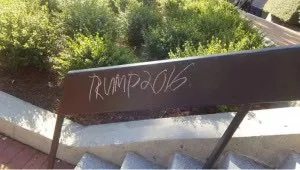
Tuesday evening's hullabaloo centered around an incident at Georgia's Emory University, in which someone wrote "Trump 2016" in chalk all over the college campus. The ensuing panic among students became the subject of ridicule by everyone from Gawker ("these kids are extreme weenie babies") to New York ("College can be a stressful period").
Chalk one up to Donald Trump at Emory University: https://t.co/HNu1XP2oTz #gapol pic.twitter.com/eufzPIVUEM
— Greg Bluestein (@bluestein) March 22, 2016
Emory University President James Wagner was further mocked after he promised to review security footage in order to catch the Trump-supporting chalk-vandal. "Your 'unexpected' chalker is engaging in a political debate that will continue through the first Tuesday in November. It is an important and necessary debate. Deal with it, or get thee to a monastery," the Atlanta Journal Constitution jeered.
Others, however, think the students protesting the slogans have a point:
Libertarian writer Jeffrey Tucker was present on campus earlier this week, when the messages first appeared. He told me that I was wrong to mock legitimate criticisms of the "Trump 2016" scrawlings, which he characterized as vandalism of private property. The campus is a fairly apolitical place and the Trump messages were widely perceived as racial intimidation against the campus's significant minority population — not mere political advocacy — according to Tucker.
"It was like cross burning," Tucker told me. "It was on private property. It was extremely damaging and the students and faculty were totally embarrassed... it was absolutely intended to intimidate everyone and it worked." [Reason.com]
Trump is undoubtedly a divisive figure — and one everyone has an opinion of. Emory's saga is likely far from over. Jeva Lange
On Thursday, Jair Bolsonaro, a far-right Brazilian presidential candidate, was stabbed in Minas Gerais while campaigning, his son tweeted.
Flavio Bolsonaro said his father sustained damage to his liver, lung, and intestine. "He lost a lot of blood," he said, and was "almost dead" when he arrived at a local hospital. Bolsonaro's running mate, Gen. Antonio Hamilton Mourao, told Reuters he is now in serious but stable condition. "He underwent surgery, which was successful and he is doing okay," Mourao said. "But his state remains delicate."
Video recorded during Bolsonaro's campaign stop shows him being carried on a person's shoulders, surrounded by supporters. A knife is then seen being raised in the air, then plunging into Bolsonaro's abdomen, Reuters reports. Brazil's Federal Police released a statement saying officers were accompanying Bolsonaro when the attack took place, and the "aggressor" was caught and detained. The incident is now under investigation. Catherine Garcia
Ford announced Thursday it is recalling roughly 2 million F-150 pickups, after more than 20 people in the United States and Canada have reported smoke or fire coming from the seat belts.
The company said the recall affects some Regular Cab and SuperCrew Cab trucks, from model years 2015-18, sold in the U.S., Canada, and Mexico. Ford conducted an investigation and found that front seat belt pretensioners "can generate excessive sparks when they deploy," which could start a fire in the vehicle's carpet or insulation.
The National Highway Traffic Safety Administration opened its own preliminary investigation last month after receiving five complaints, NPR reports, and found that "two fires self-extinguished, while the other three vehicles were totally destroyed by the fire." Ford told U.S. securities regulators in a filing on Thursday that the recall will cost about $140 million, The Associated Press reports. Catherine Garcia
Loads of Trump administration officials have denied writing an anonymous op-ed in The New York Times that described an internal "resistance" in the White House.
Treasury Secretary Steven Mnuchin, for example, said that it is "laughable" to think he could be the author. Spoken like a possible suspect, right? In light of the White House "witch hunt" to determine who wrote the op-ed, a vintage Wall Street Journal headline resurfaced Thursday as readers remembered a similarly mysterious source: Deep Throat.
"If you drink scotch, smoke, and read, maybe you're 'Deep Throat,'" the Journal wrote. "Almost anyone can qualify as capital tries to guess Watergate story source." Deep Throat was the name of the source who offered key information to journalists Bob Woodward and Carl Bernstein as they investigated the Watergate scandal. Deep Throat ultimately turned out to be FBI Associate Director Mark Felt — but in June 1974, Felt denied that he was the source.
"Felt says he isn't now, nor has he ever been, Deep Throat," reads the article. "Of course, says the former acting associate director of the FBI, if he really were Deep Throat, you'd hardly expect him to admit it, now would you? Not that he is, Mr. Felt quickly adds."
The article points out that Felt, and others, aren't likely to "just blurt out" that they are responsible for bringing an administration "to its knees." So simply asking officials whether they authored the piece may not lead to the truth — and maybe Sen. Rand Paul (R-Ky.) had the right idea in taking more drastic measures. Summer Meza
A "senior official in the Trump administration" wrote an anonymous op-ed in The New York Times on Wednesday, claiming there's a "resistance" within the White House. Amateur detectives want to know who it is. There are dozens of potential culprits, but these administration officials have so far denied responsibility. Kathryn Krawczyk
Vice President Mike Pence. The vice president is "above such amateur acts," his communications director tweeted Thursday morning.
Secretary of State Mike Pompeo. The top diplomat told reporters a "disgruntled, deceptive bad actor" wrote the letter, but it wasn't him, per NBC News.
Secretary of Defense James Mattis. A Pentagon spokeswoman simply told Reuters that "it was not [Mattis'] op-ed."
National Intelligence Director Dan Coats. Despite recently criticizing Trump, neither Coats nor his "principal deputy" wrote the piece, he said in a statement.
Secretary of Housing and Urban Development Ben Carson. A spokesperson told The Guardian that Carson isn't responsible.
Secretary of Homeland Security Kirstjen Nielsen. This "political attack" is beneath her, a spokesperson told NBC News.
Secretary of the Treasury Steven Mnuchin. "It is laughable to think this could come from the secretary," Mnuchin's public affairs assistant tweeted.
Office of Management and Budget Director Mick Mulvaney. Not him, a spokesperson told NBC News.
Secretary of Energy Rick Perry. "Hiding behind anonymity and smearing the president ... makes you a coward," Perry tweeted.
Ambassador to Russia John Huntsman. His time spent communicating with Moscow taught him to "never send an anonymous op-ed," a spokesperson says.
First Lady Melania Trump. Whoever wrote it is "sabotaging this country," she told CNN.
White House Counsel Don McGahn. He'll be leaving the White House soon, but still didn't write it, per CNN.
Secretary of Labor Alex Acosta. He "does not play these sophomoric Washington games," a spokesperson said.
Secretary of Veterans Affairs Robert Wilkie. It's not him "nor anyone else at the VA," a spokesperson told CNN.
Secretary of Commerce Wilbur Ross. He tweeted that he's "thoroughly appalled" by it.
Small Business Administration Administrator Linda McMahon. Nope, she tweeted.
Secretary of Health and Human Services Alex Azar. Nah, per The Guardian.
CIA Director Gina Haspel. A spokesperson told NBC News: "No!"
Ambassador to the United Nations Nikki Haley. No, she told CNN.
Acting EPA Administrator Andrew Wheeler. "That's a no," a spokesman said.
Secretary of Transportation Elaine Chao. "For those who have inquired," no, a spokeswoman told CNN.
Secretary of Education Betsy DeVos. She "does not play Washington insider games," the department's press secretary tweeted.
U.S. Trade Representative Robert Lighthizer. It's a "complete and total fabrication," he said in a statement to CNN.
White House counselor Kellyanne Conway. "Of course not," she told NBC News.
Attorney General Jeff Sessions. Even Trump's public enemy is a no, a spokesperson told CNN.
National Security Agency Director Paul Nakasone. Not him, per an NSA tweet.
This list has been updated as more officials have denied responsibility.
Burt Reynolds, the legendary actor who brought his trademark swagger to dozens of films and TV shows over a decades-long career, has died at the age of 82.
Reynolds' manager, Erik Kritzer, confirmed to The Hollywood Reporter that the actor died Thursday morning at Jupiter Medical Center in Florida. TMZ is reporting that Reynolds went into cardiac arrest and that his family was by his side when he died. The actor had been dealing with various health issues over the past few years, having had heart surgery in 2010 and having been hospitalized with flu symptoms in 2013, People reports.
Born in 1936, Reynolds rose to fame in part due to his role as Quint Asper on Gunsmoke, which helped him transition into an extraordinarily successful movie career. While he made his film debut in 1961, it was 1972's Deliverance that kickstarted a truly phenomenal run for the actor, who was quite prolific throughout the 1970s and 1980s, starring in back-to-back hit action and comedy films like Smokey and the Bandit and The Cannonball Run. He was so prolific, in fact, that he at one time had four separate movies in theaters at once, The Hollywood Reporter notes. In 1997, Reynolds was nominated for his first and only Academy Award for playing porn director Jack Horner in Paul Thomas Anderson's Boogie Nights.
Reynolds had not stopped working in recent years, and he had been announced as part of the cast of Quentin Tarantino's new film Once Upon a Time in Hollywood, which hits theaters in July 2019. However, Reynolds had not yet filmed his scenes, having been scheduled to do so in a few weeks, and thus the role will need to be recast, according to The Hollywood Reporter. Brendan Morrow
The Catholic Church's Pennsylvania scandal could be headed north.
New York Attorney General Barbara Underwood has launched a civil investigation into the state's Catholic churches, she announced Thursday. To get it started, she's subpoenaed the state's eight dioceses for all their records regarding child sexual abuse allegations, a source tells The Associated Press.
A massive investigation and report into Pennsylvania's Catholic churches exposed over 1,000 abuse allegations against 300 priests last month. It drew apologies from as far up as the Vatican, but also led victims around the world to share their stories and sparked incredible condemnation of the Catholic Church.
Underwood's announcement addressed the Pennsylvania revelations and encouraged New York victims to report their stories even if they happened years ago. And in a telling display of where the investigation might be headed, Underwood reportedly sent subpoenas to the seven Catholic dioceses of New York state and the archdiocese in New York City, per AP. They request abuse allegations, records of churches paying off victims, and anything else that internal church investigations dug up.
Church leaders have said they'll cooperate with Underwood's civil investigation even if it transforms into a criminal one, AP reports. The attorney general's office is also working with local prosecutors, who can launch criminal investigations within their jurisdictions. Kathryn Krawczyk
Why launch a White House "witch hunt" to figure out who wrote an anonymous op-ed about internal "resistance" when officials can just take a lie detector test?
Sen. Rand Paul (R-Ky.) thinks a quick sit down for a polygraph test would be faster than asking every White House official whether they wrote in The New York Times that President Trump is "amoral." He told reporters on Thursday: "I think if you have a security clearance in the White House I think it would be acceptable to use a lie detector test and ask people whether they are talking to the media against the policy of the White House," reports CNN.
Paul, who previously suggested the use of lie detector tests to determine who leaked transcripts of communications between former National Security Adviser Michael Flynn and a Russian ambassador, said it was important to figure out who wrote the op-ed this week. Some experts disagree that lie detector tests are effective, but Paul said they are used on CIA and FBI agents, so they should be used on administration officials, too. "This could be very dangerous if the person who is talking to the media is actually revealing national security secrets," he said. "So yes, I think we need to get to the bottom of it." Summer Meza