Sign up to get Today’s Best Articles in your inbox
Join 350,000+ subscribers and keep yourself informed with a selection of
The Week’s most interesting, enlightening and entertaining stories - plus daily puzzles.
You are now subscribed
Your newsletter sign-up was successful
Want to add more newsletters?
An account already exists for this email address, please log in.
Emmanuel Macron plays down backstop hopes
French president responds after Germany gives Boris Johnson 30 days to find Brexit solution
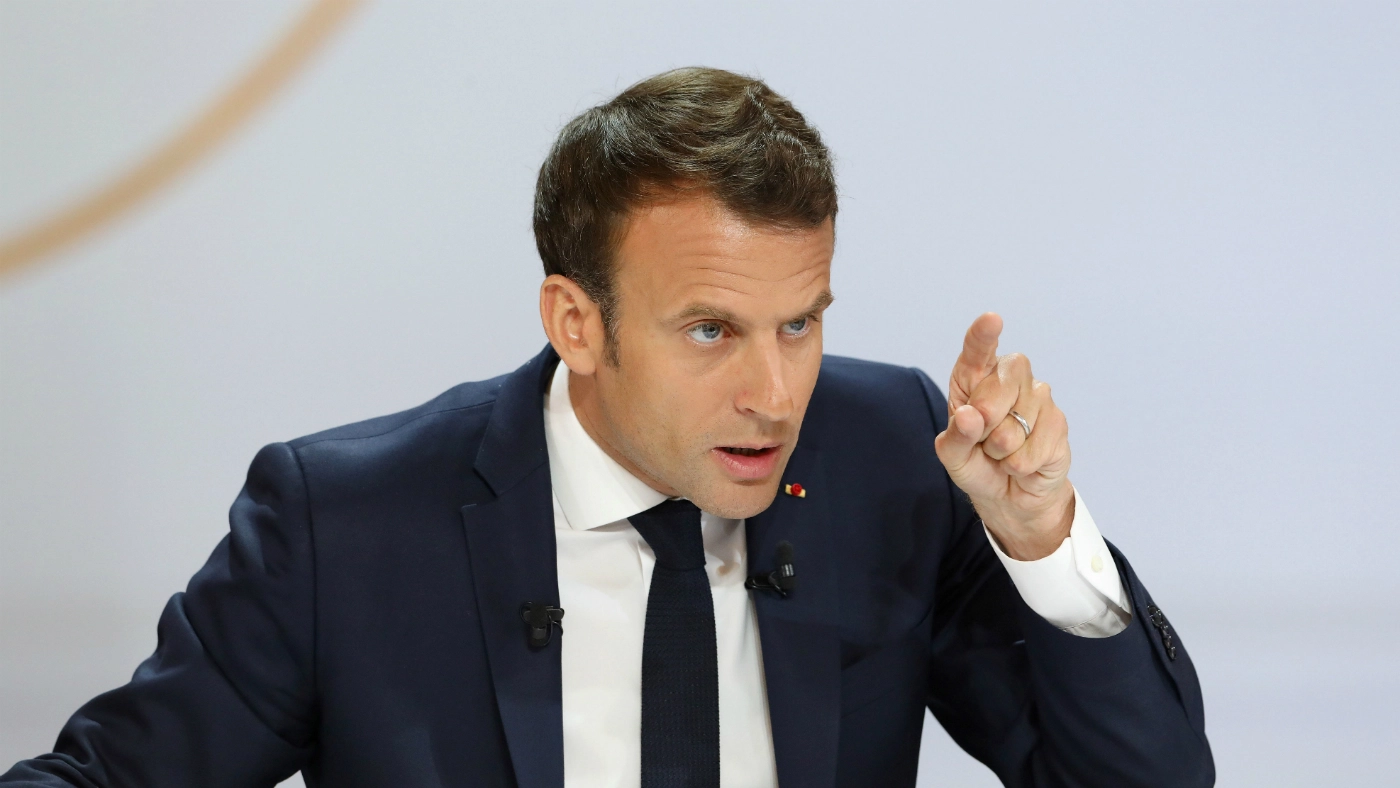
French President Emmanuel Macron has played down hopes of finding a solution to the Irish backstop problem, the main obstacle in the Brexit negotiations.
German Chancellor Angela Merkel yesterday surprised many when she said a solution might be possible within 30 days. Prime Minister Boris Johnson responded by saying he was “more than happy” with such a “blistering timetable”.
However, Sky News says that “in truth Mrs Merkel never proposed such a ‘timetable’”, and was “merely suggesting that if the UK could come up with an alternative solution to the Irish backstop that was acceptable to the EU then a no-deal Brexit might be averted”.
The Week
Escape your echo chamber. Get the facts behind the news, plus analysis from multiple perspectives.
Join more than 350,000 subscribers and keep yourself informed with a selection of The Week’s most interesting, enlightening and entertaining stories - plus daily puzzles.
Join more than 350,000 subscribers and keep yourself informed with a selection of The Week’s most interesting, enlightening and entertaining stories - plus daily puzzles.
In any case, the French president quickly poured cold water over the upsurge of optimism, saying that reopening negotiations on the issue was “not an option” because, says The Guardian, Merkel’s comments were “set against a backdrop of pessimism in France”.
The Times predicts that Macron will take a “harsher” line when he meets Johnson today. “An official at the Elysee Palace said that a no-deal Brexit was now ‘the most likely’ outcome and that Britain would still have to pay the £39 billion divorce settlement,” it explains.
Macron has also told Johnson that a no-deal Brexit would be Britain’s fault and warned that a trade deal with the US would set up an “historic vassalisation” of the UK.
He said: “Can [the cost of a hard Brexit] be offset by the United States of America? No. And even if it were a strategic choice, it would be at the cost of a historic vassalisation of Britain. I don’t think this is what Boris Johnson wants. I don’t think it is what the British people want.”
Sign up to get Today’s Best Articles in your inbox
A free daily email with the day’s biggest news and analysis – and the best features from TheWeek.com
Macron added that “the point can’t be to exit Europe and say ‘we’ll be stronger’ before, in the end, becoming the junior partner of the United States, which are acting more and more hegemonically”.
However, Johnson continues to suggest that a late deal can be struck. The prime minister said: “I have, in my life, watched a lot of European negotiations and, believe me, it looks at first as though it is, you know, irresistible force and immovable object.
“What in my experience happens is that people find a way through and I think that if we approach this with sufficient patience and optimism, as I say, we can get this done and it is in the final furlong generally when the horses change places and the winning deal appears.”
Johnson is to travel this weekend to the G7 summit in France for further talks, including with Donald Tusk, the president of the European Council.