Sign up to get Today’s Best Articles in your inbox
Join 350,000+ subscribers and keep yourself informed with a selection of
The Week’s most interesting, enlightening and entertaining stories - plus daily puzzles.
You are now subscribed
Your newsletter sign-up was successful
Want to add more newsletters?
An account already exists for this email address, please log in.
Is the US about to lose its measles elimination status?
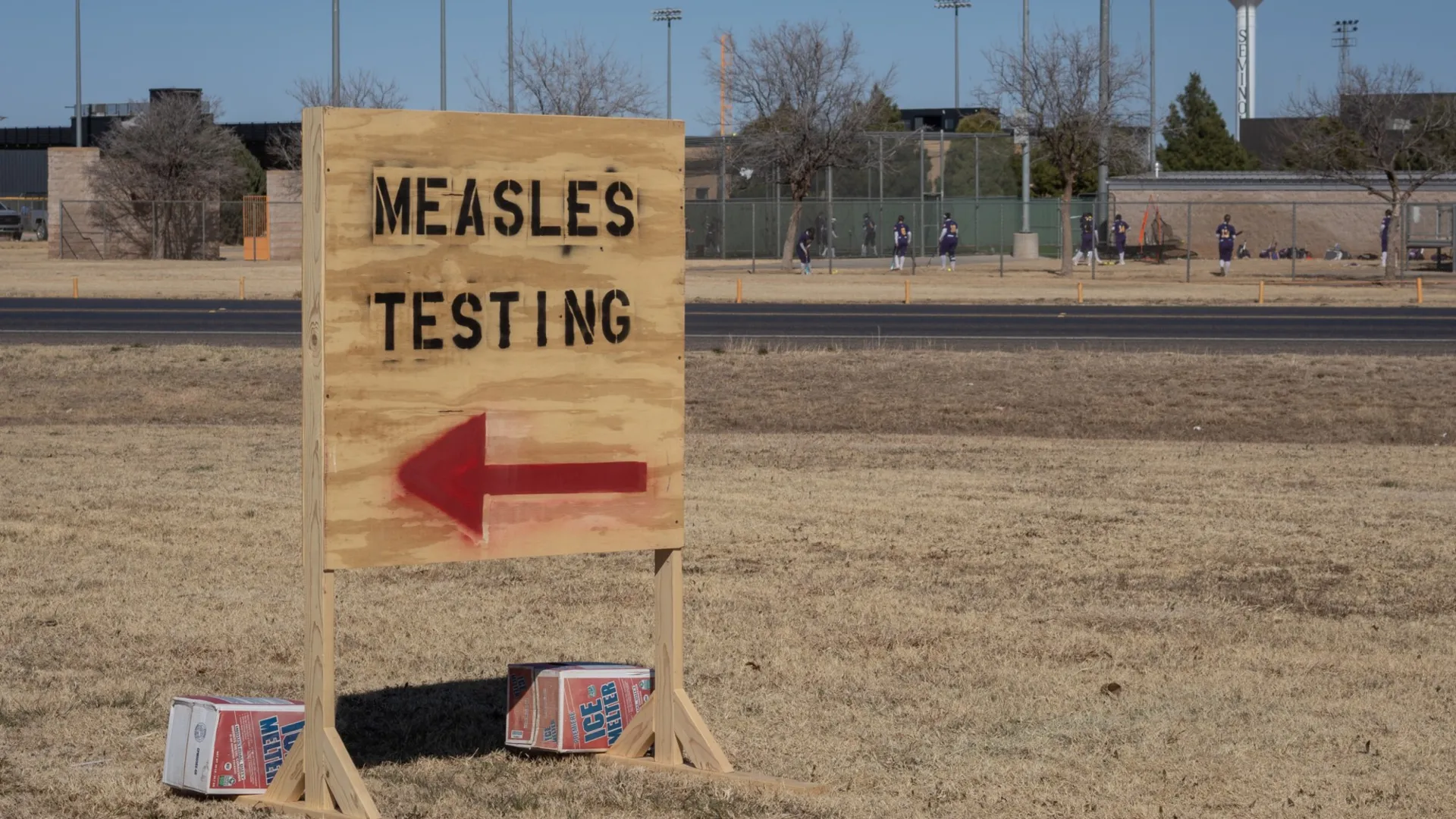
Amid an outbreak last year, signs point the way to measles testing in the parking lot of the Seminole Hospital District on Feb. 27, 2025, in Seminole, Texas
One of the big victories of American science in the last few decades was conquering measles. But that achievement is being reversed, as the U.S. now stands on the brink of losing its measles elimination status.
Measles cases are “skyrocketing” across the country, with cases reported in nine states, and “hundreds” of patients were quarantined in South Carolina in late December, said Axios. Some of the surges in disease are happening in places where the measles vaccination rate is under the 95% level that public health officials say is “necessary to contain the virus’ spread.” A “record share” of kindergartners were exempted from the vaccine last school year, said CNN, “marking the fifth year in a row” that coverage fell short of the 95% target.
The Pan American Health Organization will review America’s measles elimination status in April, said USA Today. The designation is “more symbolic than anything” but still carries some meaning. The designation is a “significant public health signal,” said the group.
The Week
Escape your echo chamber. Get the facts behind the news, plus analysis from multiple perspectives.
Join more than 350,000 subscribers and keep yourself informed with a selection of The Week’s most interesting, enlightening and entertaining stories - plus daily puzzles.
Join more than 350,000 subscribers and keep yourself informed with a selection of The Week’s most interesting, enlightening and entertaining stories - plus daily puzzles.
Some experts believe the verdict has already been handed down. America’s public health system is “blue in the ICU,” said Dr. Demetre Daskalakis, the former director of the National Center for Immunization and Respiratory Diseases. “I don’t need to check its pulse to know” that it’s hurting.
What did the commentators say?
The South Carolina quarantines are “just a taste of what’s coming” under the anti-vaccine stewardship of Health and Human Services Secretary Robert F. Kennedy Jr., said The Washington Post editorial board. It might be easy to dismiss the loss of measles elimination status, but outbreaks “almost certainly will become more frequent and more intense in the coming years” thanks to the loss of vaccination coverage. Other vaccine-preventable diseases like whooping cough and chicken pox will also surge. Without a reversal, “expect more horror stories like those from South Carolina.”
Measles is a “nasty virus,” said Children’s Hospital of Philadelphia in a blog post. Most people survive an infection, but it can cause “many different complications,” including blood clotting and suppression of the victim’s immune system, and can lead to miscarriages during pregnancy. The current surge of the disease means exposure to the virus is “more likely than it was even a year ago.” The larger problem is that measles is “usually the first, but not the only, pathogen to show itself” when vaccination rates drop. If vaccines are “cast aside, it will not be the only disease to return.”
What next?
Public health authorities consider a virus endemic “after one year of continuous transmission,” said NBC News. That’s a status that will be achieved in the U.S. if the current measles outbreaks can be traced back to the first West Texas measles case a year ago. That possibility is astonishing to some health experts. In most cases, it’s “unheard of to lose your elimination status,” said Amira Albert Roess, a professor of global health and epidemiology at George Mason University, to NBC News, “unless it was a war-torn, collapsing country.”
Sign up to get Today’s Best Articles in your inbox
A free daily email with the day’s biggest news and analysis – and the best features from TheWeek.com
Joel Mathis is a writer with 30 years of newspaper and online journalism experience. His work also regularly appears in National Geographic and The Kansas City Star. His awards include best online commentary at the Online News Association and (twice) at the City and Regional Magazine Association.