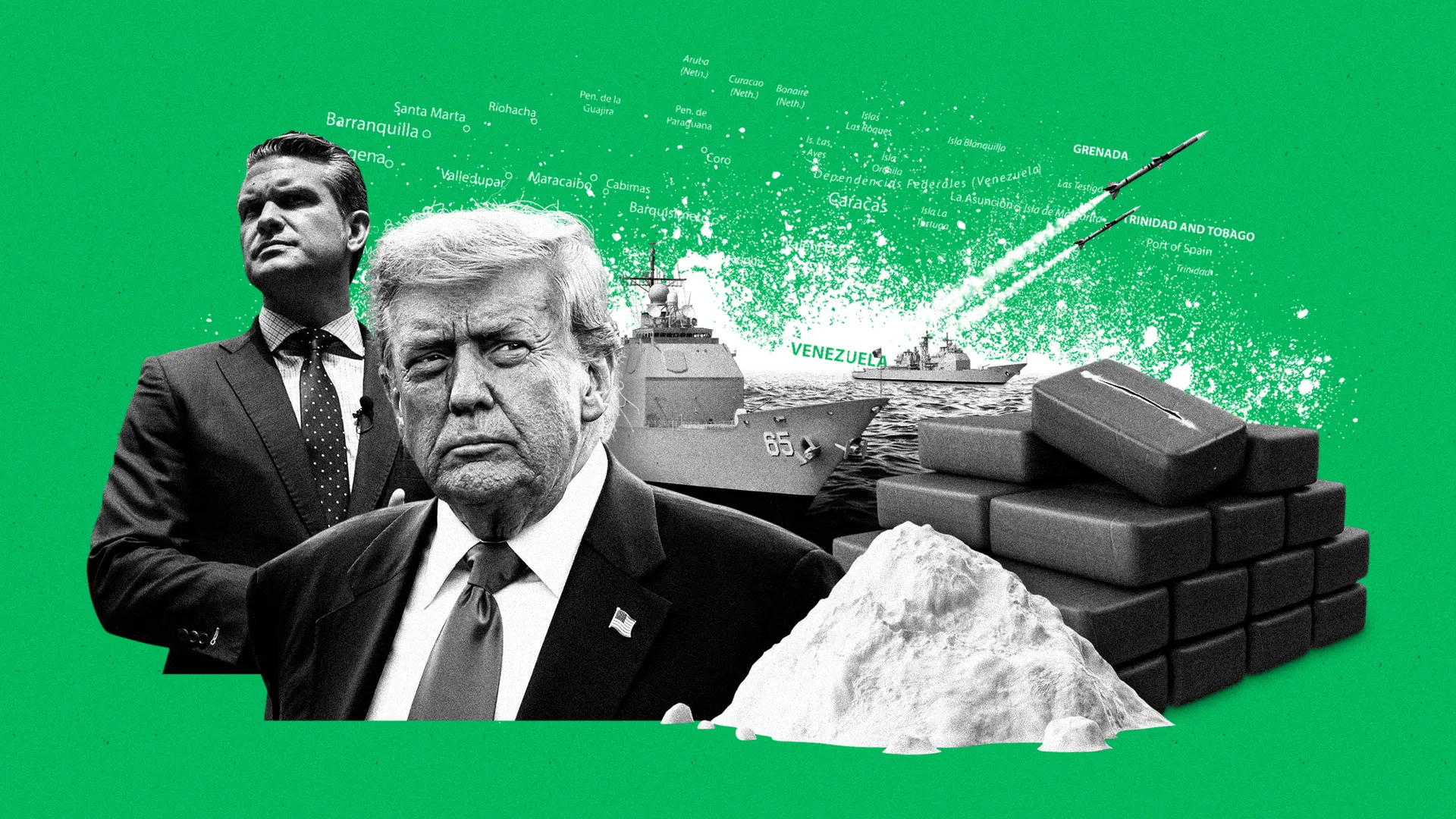
The old "war on drugs" slogan is no longer hyperbole. President Donald Trump is claiming the right to kill suspected drug traffickers, last week approving a deadly attack on a suspected drug-running boat off Venezuela.
The American war on drugs is "officially a war, not a mere law enforcement action," said Axios. By designating traffickers as "terrorists," Trump has claimed the "right to kill them before they or their drugs reach this country." Other suspected "narcoterrorists" will "face the same fate," said Defense Secretary Pete Hegseth. But the boat strike has drawn sharp criticism at home and abroad. The killing of crime suspects was a "murder anywhere in the world," said Colombian President Gustavo Petro. "What if we make a mistake and they happen to be people fleeing the Venezuelan dictator?" said Sen. Rand Paul (R-Ky.) on Newsmax.
'Act of war'
Trump has crossed a "line that dates back to the Revolution," said The Atlantic. Crime-fighting has "traditionally been outside" the scope of the U.S. military's mission. In the wake of the United States' revolt against an "overbearing" British Empire, officials governed with a sense that the military "should defend the country from external threats but not be used to routinely enforce the law." Under Trump, the "mission has changed."
The Week
Escape your echo chamber. Get the facts behind the news, plus analysis from multiple perspectives.
SUBSCRIBE & SAVE
Sign up for The Week's Free Newsletters
Join more than 350,000 subscribers and keep yourself informed with a selection of The Week’s most interesting, enlightening and entertaining stories - plus daily puzzles.
Join more than 350,000 subscribers and keep yourself informed with a selection of The Week’s most interesting, enlightening and entertaining stories - plus daily puzzles.
Latest Videos FromThe Week
The Venezuela strike "was an act of war," said Julio Ricardo Varela at MSNBC. Trump produced a "blurry video" of the deadly explosion, but that does not prove "who was aboard, what they were doing or whether drugs were even present." In truth, Venezuela "doesn't really produce that much cocaine." But its anti-American government provides a "ready stage" for a president who has "built his return to power on projecting American strength abroad" with actions reminiscent of 19th-century U.S. adventurism in Latin America. The U.S. is "again using a familiar script to justify actions that will destabilize a hemisphere."
"Is it awesome to see bad guys getting blown up? Sure," said Jim Geraghty at the National Review. But is it consistent with the American Constitution and laws that mostly prohibit the "use of the American military in domestic law enforcement"? That is murky. If the government is going to "bomb and shoot up Venezuelan drug cartels," that is probably the "sort of thing that ought to be authorized by Congress."
'Testing the limits'
"The laws of war forbid the killing of civilians," said Tim Weiner at Codeword. Trump designating the Venezuelan crime syndicate Tren de Aragua a "terrorist organization" does not give him the legal "right to assassinate its members." The lawful way to stop a drug shipment is to "intercept and board the boat — not blow it out of the water."
The White House justification for the strike "essentially boils down to this: Trust us," said W.J. Hennigan at The New York Times. Trump is betting Americans have become so used to War on Terror missions in the Middle East that "they'll be indifferent to extrajudicial executions" closer to home. Trump is "again testing the limits of his powers as commander in chief."