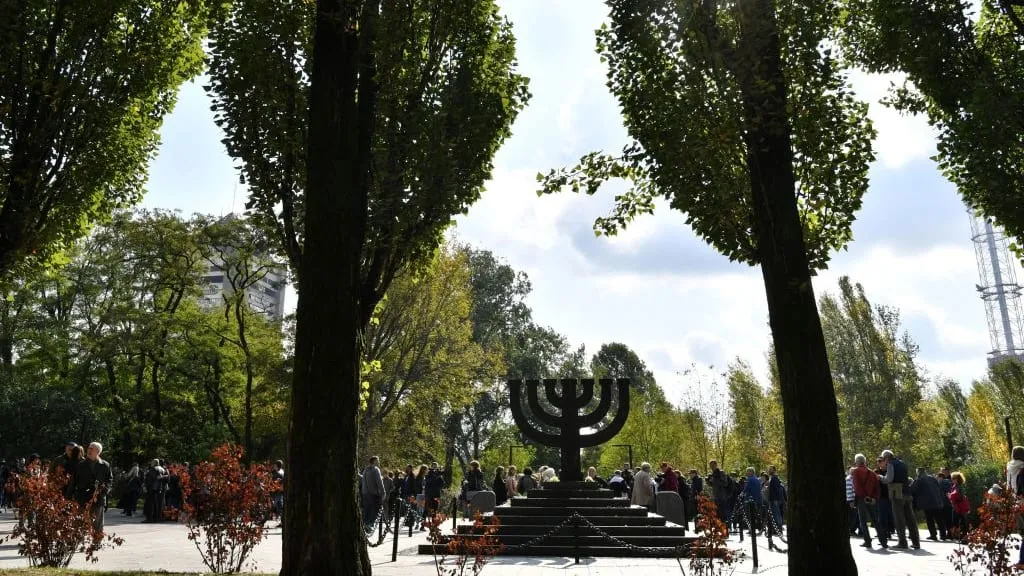
Zelensky says Russian missile hit site of Babyn Yar Holocaust Memorial Center
A free daily email with the biggest news stories of the day – and the best features from TheWeek.com
You are now subscribed
Your newsletter sign-up was successful
The Babyn Yar Holocaust Memorial Center site in Kyiv was hit by a Russian missile on Tuesday, Ukrainian President Volodymyr Zelensky confirmed, killing at least five people.
As part of the same attack, the city's main television and radio tower was also struck, The Washington Post reports.
Over the course of two days in September 1941, Nazi killing squads murdered more than 33,000 Jews at Babyn Yar, also known as Babi Yar, a ravine on the outskirts of Kyiv. In a tweet, Zelensky asked, "To the world: what is the point of saying 'never again' for 80 years if the world stays silent when a bomb drops on the same site of Babyn Yar? At least five killed. History repeating...."
The Week
Escape your echo chamber. Get the facts behind the news, plus analysis from multiple perspectives.
Sign up for The Week's Free Newsletters
From our morning news briefing to a weekly Good News Newsletter, get the best of The Week delivered directly to your inbox.
Yad Vashem, Israel's memorial to the victims of the Holocaust, condemned the strike, saying in a statement that "rather than being subjected to blatant violence, sacred sites like Babi Yar must be protected. Of course, the security and wellbeing of civilians must be universally and absolutely respected. We continue to follow with grave concern the outrageous acts of aggression being perpetrated against civilian targets in Ukraine."
Russia has claimed it is not targeting civilian sites, only military infrastructure. However, since the Russian invasion of Ukraine started last week, there have been strikes in Kyiv and other Ukrainian cities, with artillery shells and missiles hitting residential areas.
A free daily email with the biggest news stories of the day – and the best features from TheWeek.com
Catherine Garcia has worked as a senior writer at The Week since 2014. Her writing and reporting have appeared in Entertainment Weekly, The New York Times, Wirecutter, NBC News and "The Book of Jezebel," among others. She's a graduate of the University of Redlands and the Columbia University Graduate School of Journalism.
-
Buddhist monks’ US walk for peaceUnder the Radar Crowds have turned out on the roads from California to Washington and ‘millions are finding hope in their journey’
-
American universities are losing ground to their foreign counterpartsThe Explainer While Harvard is still near the top, other colleges have slipped
-
How to navigate dating apps to find ‘the one’The Week Recommends Put an end to endless swiping and make real romantic connections
-
What is ‘Arctic Sentry’ and will it deter Russia and China?Today’s Big Question Nato considers joint operation and intelligence sharing in Arctic region, in face of Trump’s threats to seize Greenland for ‘protection’
-
What would a UK deployment to Ukraine look like?Today's Big Question Security agreement commits British and French forces in event of ceasefire
-
Would Europe defend Greenland from US aggression?Today’s Big Question ‘Mildness’ of EU pushback against Trump provocation ‘illustrates the bind Europe finds itself in’
-
Did Trump just end the US-Europe alliance?Today's Big Question New US national security policy drops ‘grenade’ on Europe and should serve as ‘the mother of all wake-up calls’
-
Is conscription the answer to Europe’s security woes?Today's Big Question How best to boost troop numbers to deal with Russian threat is ‘prompting fierce and soul-searching debates’
-
Trump peace deal: an offer Zelenskyy can’t refuse?Today’s Big Question ‘Unpalatable’ US plan may strengthen embattled Ukrainian president at home
-
Vladimir Putin’s ‘nuclear tsunami’ missileThe Explainer Russian president has boasted that there is no way to intercept the new weapon
-
The Baltic ‘bog belt’ plan to protect Europe from RussiaUnder the Radar Reviving lost wetland on Nato’s eastern flank would fuse ‘two European priorities that increasingly compete for attention and funding: defence and climate’