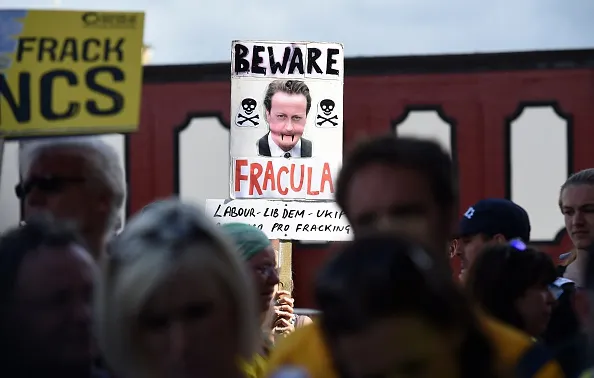
Professor says women 'don't understand' the science behind fracking
A professor in Britain who is also the chairwoman of the U.K.'s top shale gas lobby is defending her comments about women opposing fracking because they "don't understand" the process.
Averil Macdonald, who teaches scientific engagement at the University of Reading and is chairwoman of U.K. Onshore Oil and Gas, told the British newspaper The Times that women likely can't comprehend fracking — which entails drilling and then injecting chemicals, sand, and highly pressurized water into rock to release oil and natural gas — because they gave up learning about science as teenagers. "Frequently the women haven't had very much in the way of a science education because they may well have dropped science at 16," she said. "That is just a fact." Women, she said, "not only do show more of a concern about fracking, they also know that they don't know and they don't understand. They are concerned because they don't want to be taking [it] on trust. And that's actually entirely reasonable."
A YouGov poll from April says 43 percent of British people are opposed to fracking, with 32 percent in favor. Using a University of Nottingham poll that states 58 percent of men support fracking compared to 31.5 percent of women, Macdonald said: "Why are men persuaded? That's because an awful lot of facts have been put forward. Men will say, 'Fair enough, [I] understand.' But women, for whatever reason, have not been persuaded by the facts."
The Week
Escape your echo chamber. Get the facts behind the news, plus analysis from multiple perspectives.
Sign up for The Week's Free Newsletters
From our morning news briefing to a weekly Good News Newsletter, get the best of The Week delivered directly to your inbox.
On Twitter, Macdonald faced a backlash, with Labour MP Louise Haigh tweeting: "I can assure Averil Macdonald that I understand fracking fine and am opposed to it nonetheless." Macdonald wrote an op-ed for The Guardian defending herself, saying it's "ironic" she has been criticized for her comments when in fact she wants to "inspire" girls to study and have careers in science and technology.
A free daily email with the biggest news stories of the day – and the best features from TheWeek.com
Catherine Garcia has worked as a senior writer at The Week since 2014. Her writing and reporting have appeared in Entertainment Weekly, The New York Times, Wirecutter, NBC News and "The Book of Jezebel," among others. She's a graduate of the University of Redlands and the Columbia University Graduate School of Journalism.
-
Political cartoons for November 30Cartoons Sunday's political cartoons include the Saudi-China relationship, MAGA spelled wrong, and more
-
Rothermere’s Telegraph takeover: ‘a right-leaning media powerhouse’Talking Point Deal gives Daily Mail and General Trust more than 50% of circulation in the UK newspaper market
-
The US-Saudi relationship: too big to fail?Talking Point With the Saudis investing $1 trillion into the US, and Trump granting them ‘major non-Nato ally’ status, for now the two countries need each other
-
Blue Origin launches Mars probes in NASA debutSpeed Read The New Glenn rocket is carrying small twin spacecraft toward Mars as part of NASA’s Escapade mission
-
Dinosaurs were thriving before asteroid, study findsSpeed Read The dinosaurs would not have gone extinct if not for the asteroid
-
SpaceX breaks Starship losing streak in 10th testspeed read The Starship rocket's test flight was largely successful, deploying eight dummy satellites during its hour in space
-
Rabbits with 'horns' sighted across Coloradospeed read These creatures are infected with the 'mostly harmless' Shope papilloma virus
-
Lithium shows promise in Alzheimer's studySpeed Read Potential new treatments could use small amounts of the common metal
-
Scientists discover cause of massive sea star die-offSpeed Read A bacteria related to cholera has been found responsible for the deaths of more than 5 billion sea stars
-
'Thriving' ecosystem found 30,000 feet underseaSpeed Read Researchers discovered communities of creatures living in frigid, pitch-black waters under high pressure
-
New York plans first nuclear plant in 36 yearsSpeed Read The plant, to be constructed somewhere in upstate New York, will produce enough energy to power a million homes