September 3, 2019

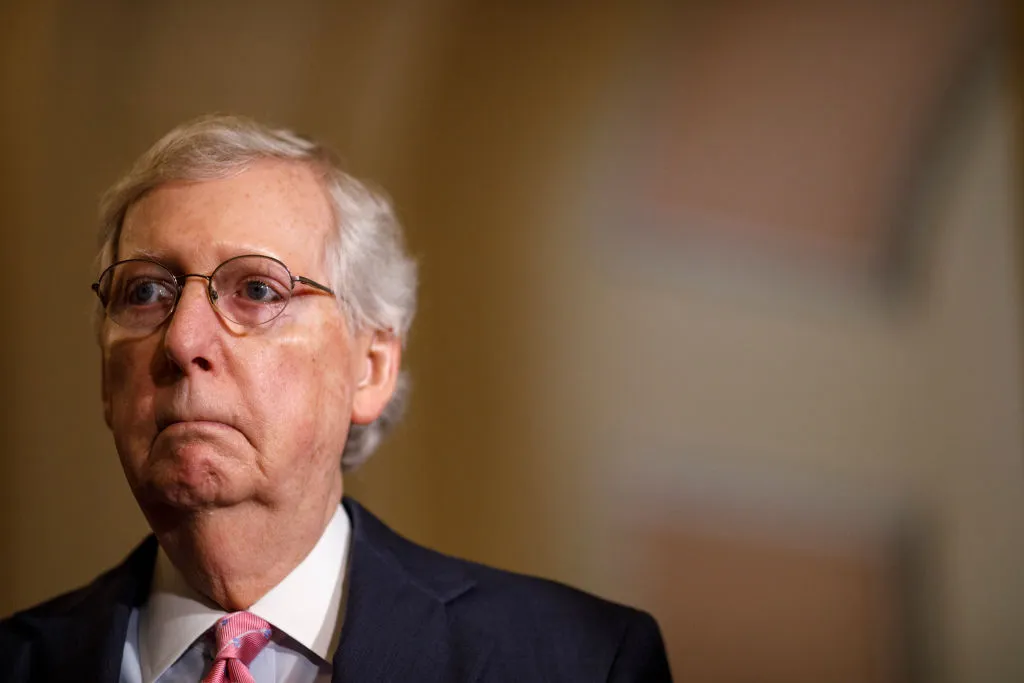
Senate Majority Leader Mitch McConnell (R-Ky.) really doesn't like when people refer to him as "Moscow Mitch," and wishes everyone who calls him Moscow Mitch would just think about how much the nickname Moscow Mitch hurts his feelings.

On Tuesday, McConnell appeared on The Hugh Hewitt Show, and said it's not fair that he's been dubbed Moscow Mitch, calling it "modern-day McCarthyism." He got the name in July, after he blocked election security bills that had bipartisan support. The move came right after more warnings were made public about Russia attempting to interfere in the 2020 elections. "Unbelievable for a Cold Warrior like me who spent a career standing up to the Russians to be given a moniker like that," McConnell said.

He's been called Moscow Mitch by constituents and colleagues alike, and McConnell made it clear to Hewitt that only he can give himself unflattering nicknames — earlier this year, he bestowed upon himself the title "Grim Reaper," as he planned on killing all progressive policy proposals. "You know, I laugh about things like the Grim Reaper, but calling me Moscow Mitch is over the top," McConnell said. Catherine Garcia

10:51 p.m.

Every man has his price, and for Rudy Giuliani, it appears to be $20,000 a day.

Several people with knowledge of the matter told The New York Times that Giuliani, the former mayor of New York City and President Trump's personal lawyer, has asked the Trump campaign for $20,000 a day to cover his legal services. Giuliani is overseeing the campaign's many court challenges in Trump's attempt to change the outcome of the election.

Multiple Trump advisers and aides opposed Giuliani receiving such a hefty amount, the Times reports, and it's unclear how much Giuliani will get when the legal battles are done. Giuliani denied the report, telling the Times he "never asked for $20,000." He added that anyone who says he requested $20,000 a day is "a liar, a complete liar," and "the arrangement is, we'll work it out at the end."

On Nov. 4, the day after the election, Giuliani approached Trump and asked to get paid for his legal services, people with knowledge of the matter told the Times. Giuliani has been encouraging Trump to believe in baseless conspiracy theories about voting machine irregularities and other claims of fraud, the sources added, and they believe he is fanning the flames so Trump continues to file lawsuits, thus lining Giuliani's pockets. Read more at The New York Times. Catherine Garcia

9:38 p.m.

The Wayne County Board of Canvassers in Michigan voted unanimously Tuesday night to certify the results of the Nov. 3 election, after earlier reaching a deadlock when the two Republican members voted against certifying the results and the two Democrats voted in favor.

Wayne County, home to Detroit, is Michigan's largest county, and the unofficial election results showed Biden with 67.99 percent of the votes cast and President Trump with 30.59 percent. New York Times correspondent Kathy Gray tweeted that the "decision to actually certify the election came after about three hours of voters loudly calling out the board for trying to disenfranchise Detroit voters."

Earlier in the meeting, the board's Republican chairwoman, Monica Palmer, said that because there are discrepancies between the number of absentee ballots recorded as being cast and the number of absentee ballots counted, "we do not have have complete and accurate information on those poll books." In response, Democratic vice chairman Jonathan Kinloch said that "most of this is human error. ... It's not based on fraud."

In addition to certifying the results, the board also voted to direct Michigan Secretary of State Jocelyn Benson (D) to "do a comprehensive audit of the out-of-balance precincts," Gray tweeted. She added that the board did not explain why it "basically said never mind, we changed our minds and certified the results." Catherine Garcia

9:10 p.m.

On Tuesday, the four-member Wayne County Board of Canvassers in Michigan failed to certify the Nov. 3 election results, with the two Republicans on the committee voting against certifying the results and the two Democrats voting in favor.

Wayne County, the largest county in Michigan and home to Detroit, is heavily Democratic. President-elect Joe Biden has a nearly 150,000-vote lead in Michigan, and Republicans have filed multiple lawsuits in the state in an attempt to keep him from being the certified winner. In Wayne County, the unofficial election results show Biden with 67.99 percent of the votes cast and President Trump with 30.59 percent.

The board's Republican chair, Monica Palmer, said during the meeting that because there are discrepancies between the number of absentee ballots recorded as being cast and the number of absentee ballots counted, "we do not have have complete and accurate information on those poll books." Democratic vice chair Jonathan Kinloch replied that "most of this is human error. ... It's not based on fraud." The Detroit Free Press notes there were unexplained discrepancies with the August primary election, and the board unanimously supported certifying the results.

Almost immediately after the vote, Michigan Republican Party Chair Laura Cox released a statement saying she was "proud that, due to the efforts of the Michigan Republican Party, the Republican National Committee, and the Trump campaign, enough evidence of irregularities and potential voter fraud was uncovered, resulting in the Wayne County Board of Canvassers refusing to certify their election results."

Michigan Democratic Party Chair Lavora Barnes had a different take, calling the vote "an outrageous display of partisan posturing" and saying the Republican members "have chosen to tarnish their personal legacy by picking up the GOP banner of making allegations without any evidence." Disregarding the "will of the voters in Michigan is not only shameful," she added, "but a complete dereliction of duties."

Tuesday was final day for the county to certify the results, and Michigan Secretary of State Jocelyn Benson (D) said the Board of State Canvassers will take over the responsibility. Catherine Garcia

7:54 p.m.

President Trump tweeted on Tuesday evening that he has fired Christopher Krebs, the head of the Department of Homeland Security's Cybersecurity and Infrastructure Security Agency who has been debunking conspiracy theories about voter fraud since Election Day.

Trump has been spreading multiple baseless claims about the election, including that it was "rigged" by Democrats and there was mass voting by dead people. In his tweet about Krebs, Trump claimed that it was "inaccurate" for Krebs to say the election was secure, and "therefore, effective immediately," Krebs has been terminated. Last week, Krebs told people close to him that due to his efforts to debunk disinformation, he believed he would soon be fired, Reuters reports.

Last week, top cybersecurity officials with the Election Infrastructure Government Coordinating Council Executive Committee and the Election Infrastructure Sector Coordinating Council released a joint statement saying there is "no evidence that any voting system deleted or lost votes, changed votes, or was in any way compromised." In fact, they declared, the 2020 presidential election was "the most secure in American history." Catherine Garcia

6:52 p.m.

Sen. Chuck Grassley (R-Iowa), the president pro tempore of the Senate and third in the presidential line of succession, announced on Tuesday evening that he has tested positive for the coronavirus. 


Earlier in the day, Grassley shared that he had been exposed to COVID-19 and was in quarantine. After his positive test result, Grassley, 87, tweeted that he is "feeling good and will keep up on my work for the people of Iowa from home. I appreciate everyone's well wishes and prayers and look forward to resuming my normal schedule soon."

Grassley was on the Senate floor on Monday, and removed his mask while giving a speech, The Washington Post reports. Catherine Garcia

5:41 p.m.

One of the rare legal victories President Trump's campaign picked up in its election challenge was taken away, dealing another blow to the increasingly long-shot effort.

Pennsylvania's Supreme Court on Tuesday reversed a court order that required Philadelphia election officials to let observers within six feet of vote counters after the Trump campaign alleged observers were being kept too far away at 15 to 18 feet. The state's high court, in a 5-2 decision (two of the justices preferred to rule it as moot), said Pennsylvania law gives Philadelphia officials a lot of leeway to decide the rules for observers.

Plus, even the two conservative justices who dissented acknowledged that the Trump campaign's argument that legitimate votes should be invalidated because of improper observation practices was "misguided," The Guardian reports. Tim O'Donnell

5:39 p.m.

COVID-19 and some Republican defectors led to a defeat for President Trump in the Senate on Tuesday.

Trump had nominated Judy Shelton to the Federal Reserve Board — a controversial pick considering Shelton has repeatedly criticized the board's power and is an advocate of returning to the gold standard. But with two Republican senators out after potential exposure to COVID-19, and three Republicans opposed to the nominee, a vote to advance Shelton's nomination failed Tuesday.

Earlier this week, Sen. Lamar Alexander (R-Tenn.) said he would join Sens. Susan Collins (R-Maine) and Mitt Romney (R-Utah) in opposing Shelton's nomination. That left Republicans with just 50 votes in support of the Shelton, which fell to 47 as Sens. Chuck Grassley (R-Iowa) and Rick Scott (R-Fla.) stayed home to quarantine after coronavirus exposure and Sen. Bill Cassidy (R-La.) missed the vote as well. Meanwhile Democrats rounded up 50 votes as Vice President-elect Kamala Harris returned to the chamber.

But it's not game over for Shelton's nomination yet. Senate Majority Leader Mitch McConnell (R-Ky.) switched his vote to oppose Shelton at the end of Tuesday's vote, allowing him to bring her nomination up again once those missing senators return. Still, Democrat Mark Kelly of Arizona will likely join the Senate after Thanksgiving now that he's won Arizona's special election to fill the late John McCain's seat. He'll replace Sen. Martha McSally (R), further complicating Shelton's future vote even if all Republicans are accounted for.

Trump nominated Shelton, a conservative economic commentator, after his adviser Stephen Moore withdrew from consideration when sexist past comments resurfaced. Kathryn Krawczyk

See More Speed Reads