Sign up to get Today’s Best Articles in your inbox
Join 350,000+ subscribers and keep yourself informed with a selection of
The Week’s most interesting, enlightening and entertaining stories - plus daily puzzles.
You are now subscribed
Your newsletter sign-up was successful
Want to add more newsletters?
An account already exists for this email address, please log in.
Could the Iran war pop the AI bubble?
A perfect storm may finally topple a long-risky pillar of the 21st-century global economy
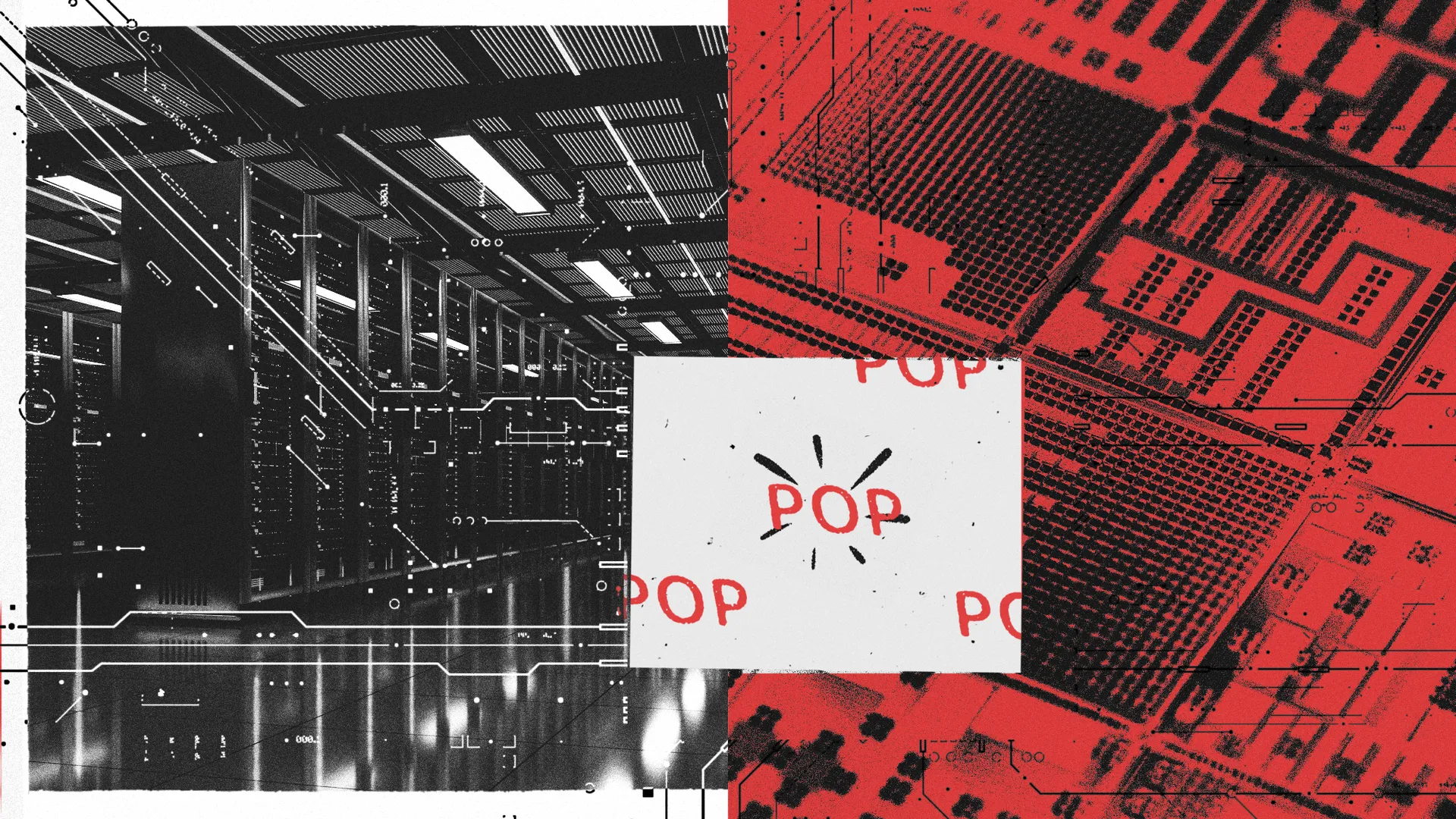
As AI adoption across personal and professional vectors increases so do the risks the industry takes on in the name of commercial growth and financial dominance. Mere weeks into the Iran war, the conflict has laid bare many of the fault lines upon which the AI industry has built its foundations. The result is a potentially perfect storm of intersecting factors that could pop the artificial intelligence industry bubble.
What did the commentators say?
The sprawling artificial intelligence industry has “propped up global trade and investment” and “pushed stock markets from the U.S. to Asia to record highs” for the past three years, said the Financial Times. But as one of the most “power-hungry inventions ever,” with a “slick chip production line that can cross more than 70 borders before reaching the final consumer,” the “fragilities in the AI supply chain” are now at particular risk from the ongoing U.S.-Israeli war on Iran. “Hidden behind the fury” of the war have been new insights into AI and its mass adoption that will be “felt by all of humanity,” said Bhaskar Chakravorti, the dean of global business at Tufts University’s Fletcher School of Law and Diplomacy, at Foreign Policy.
Admitting he’s been an “AI enthusiast since 1991,” Chakravoriti said that while research suggests AI “can be transformational in a breadth of areas,” he is now “placing a high probability on an AI doomsday.” Multiple distinct “horsemen” of possible disaster range from an “epistemic crisis” to “wars, hot and cold.” Industry observers have “fretted publicly about an AI bubble” for the “better part of the past year,” said The Atlantic. But where fears of an AI crash leading to a “chain reaction across the financial system” once “felt hypothetical,” they now seem “plausible and, to some, almost inevitable.”
The Week
Escape your echo chamber. Get the facts behind the news, plus analysis from multiple perspectives.
Join more than 350,000 subscribers and keep yourself informed with a selection of The Week’s most interesting, enlightening and entertaining stories - plus daily puzzles.
Join more than 350,000 subscribers and keep yourself informed with a selection of The Week’s most interesting, enlightening and entertaining stories - plus daily puzzles.
The Iran war has particularly unveiled a “paradox” for AI, said Bloomberg. The war could “destabilize” significant monetary investment in AI from Gulf State allies, while “surging energy costs threaten to make data centers far more expensive to run.” The resulting “aftershocks of the conflict” seem “less likely to kill the AI boom entirely” than to “cleave the market in two,” leaving juggernauts like Microsoft, Alphabet and Amazon the “most exposed to the shifting financial landscape.” High-profile startups like OpenAI and Anthropic, conversely, are poised to be “more insulated” from the fallout.
If the Iran war is what truly “brought conflict to Silicon Valley,” said Fox News, then the industry “was not ready” for what this conflict would expose. “Consider the threat receiving almost no attention,” which also carries perhaps the “greatest economic consequence for Americans at home”: helium production, a third of which takes place in Qatar. “No helium. No chips. No AI.” Without these elements, the “military edge carrying this war degrades.” The Middle East conflict “is proving, in real time” that the large-scale data centers used to power AI platforms can themselves be “wartime targets.”
What next?
The present day AI industry is “not made for the turbulence its leaders have helped usher in,” said The Atlantic. Even if AI manufacturers are “merely forced to slow down,” the “viability” of the enormous amounts of money leveraged to support the industry will “likely be called into question” in ways that could be “devastating for many.”
Although the war, as it currently stands, won’t see hyperscalers “walking away” from their existing infrastructure in the Middle East, it may “impact future investment in the case of drawn-out hostilities,” said CNBC. The war could “reduce the region’s appeal” as an AI data center hub, said the Financial Times, while national sovereign wealth funds might move to “redirect planned AI investments to local security needs.”
Sign up to get Today’s Best Articles in your inbox
A free daily email with the day’s biggest news and analysis – and the best features from TheWeek.com
Rafi Schwartz has worked as a politics writer at The Week since 2022, where he covers elections, Congress and the White House. He was previously a contributing writer with Mic focusing largely on politics, a senior writer with Splinter News, a staff writer for Fusion's news lab, and the managing editor of Heeb Magazine, a Jewish life and culture publication. Rafi's work has appeared in Rolling Stone, GOOD and The Forward, among others.