Sign up to get Today’s Best Articles in your inbox
Join 350,000+ subscribers and keep yourself informed with a selection of
The Week’s most interesting, enlightening and entertaining stories - plus daily puzzles.
You are now subscribed
Your newsletter sign-up was successful
Want to add more newsletters?
An account already exists for this email address, please log in.
Why recognizing Somaliland is so risky for Israel
By wading into one of North Africa’s most fraught political schisms, the Netanyahu government risks further international isolation
In the decades since residents in Somalia’s northwest region broke away from the East African nation during its 1991 civil war, Somaliland, as the area is known, has existed largely in geopolitical stasis. It has enjoyed relative stability and transfers of power despite no global recognition — until now.
On Friday, the Israeli government became the first United Nations member nation to officially recognize Somaliland as an “independent and sovereign state,” pledging in a press release to “immediately expand its relations” with the nascent African nation through “extensive cooperation in the fields of agriculture, health, technology and economy.” Israel is still internationally ostracized over its war in Gaza, and by recognizing Somaliland, the country risks antagonizing its regional neighbors and the global community.
How did Israel and Somaliland get to this point?
Ties between the government of Israel and authorities in Somaliland “emerged” during the former’s search for countries “willing to take in Gazans it was looking to move out of the Strip during the war,” said the Times of Israel. Also central to Israel’s “motivation for deepening ties with Somaliland” is Somaliland’s “proximity to Yemen.” Access to Somaliland ground and airspace could be used to “conduct strikes and surveil the Iran-backed Houthi rebels in Yemen.” Israel’s upgraded relations are a “breakthrough” in Somaliland’s “quest for international recognition,” The Guardian said. Somaliland officials hope Israel’s move will “break decades of diplomatic isolation” and “encourage other countries to follow suit,” said DW.
The Week
Escape your echo chamber. Get the facts behind the news, plus analysis from multiple perspectives.
Join more than 350,000 subscribers and keep yourself informed with a selection of The Week’s most interesting, enlightening and entertaining stories - plus daily puzzles.
Join more than 350,000 subscribers and keep yourself informed with a selection of The Week’s most interesting, enlightening and entertaining stories - plus daily puzzles.
In its announcement, Israel framed its decision as “in the spirit of the Abraham Accords,” the Trump administration-led normalization effort between Israel and various Arab and Muslim states in the region. Somaliland President Abdirahman Abdullahi has similarly expressed hopes that his nation will join the accords in the near future.
Who is and isn’t happy and why?
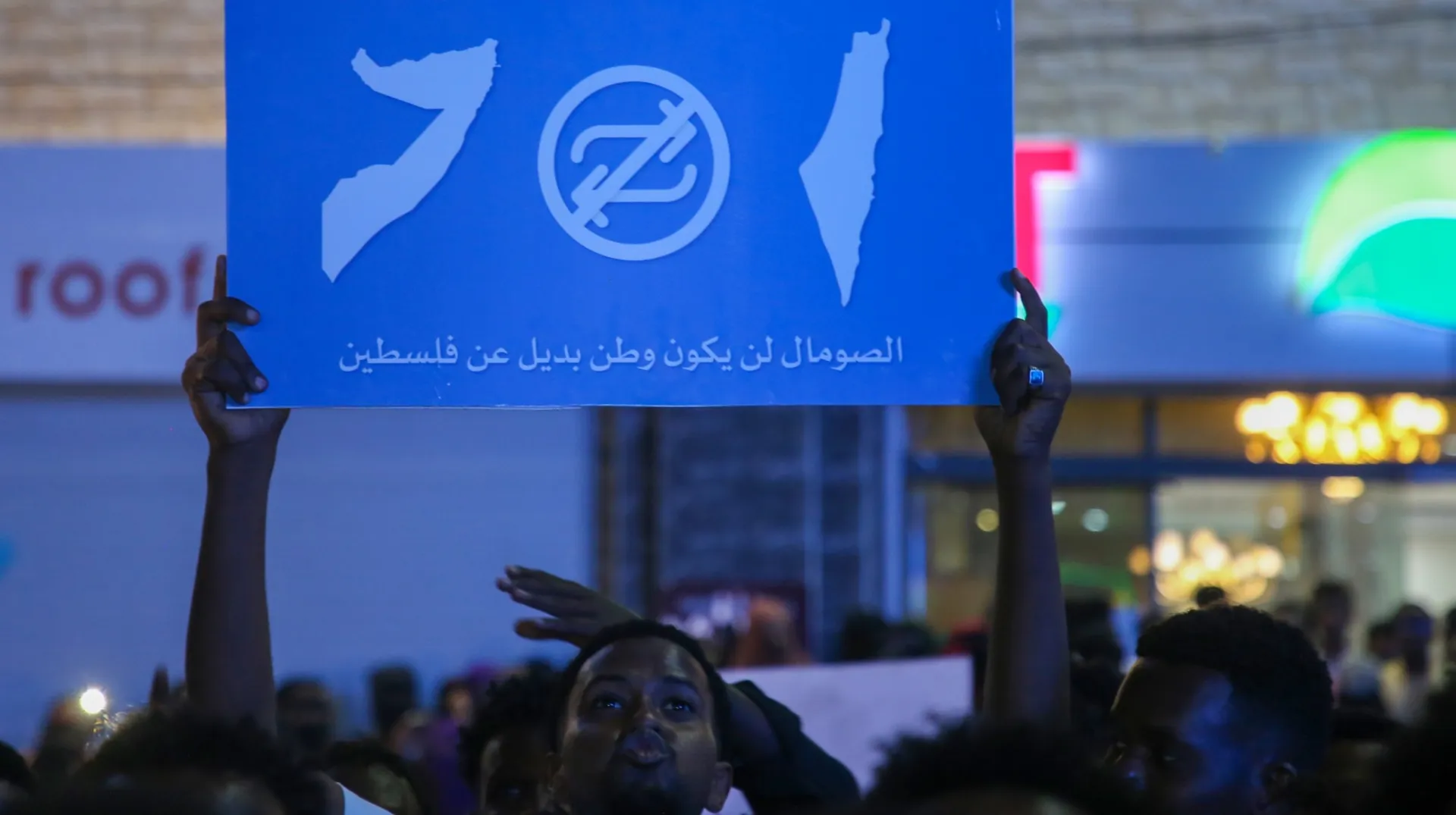
While both Israeli and Somaliland officials have spent the days since their announcement celebrating their newfound relationship, the global community wasted little time broadly condemning the agreement. Any effort to “undermine the unity, sovereignty, and territorial integrity of Somalia” not only runs counter to the AU at large, but “risks setting a dangerous precedent with far-reaching implications for peace and stability across the continent,” said African Union Chairperson H.E. Mahmoud Ali Youssouf in a statement that did not mention Israel.
The European Union’s diplomatic arm reiterated the “importance of respecting” a united Somalia in a brief statement. It also called for “meaningful dialogue” to resolve the intra-Somali conflict.
News of the upgraded relationship between Israel and Somaliland was welcomed, however, by some countries, including Taiwan, which hailed the “like-minded democratic partners sharing the values of democracy, freedom and rule of law” in a statement. In return, the Chinese government, which claims authority over Taiwan, decried Israel’s violation of Somalia’s integrity. And while Israel’s move has been widely condemned across the Arab and Muslim world, the United Arab Emirates, an Abraham Accords signatory, “notably did not condemn” the upgraded relationship, said Israel’s YNet news. “This was not coincidental,” as the UAE has recently been “developing ties” with Somaliland as well.
Sign up to get Today’s Best Articles in your inbox
A free daily email with the day’s biggest news and analysis – and the best features from TheWeek.com
What next?
Although Israel is “rushing to attach great importance” to its diplomatic decision as a crucial step in any military action against Yemen, as the “bridesmaid of relations between Somaliland and Israel,” the UAE is in “no hurry to renew the war against the Houthis,” said Haaretz. A “possible result” is an Israeli military presence in the area, but one that is “constrained by the United Arab Emirates’ policies and its regional commitments to its neighbors.”
Somaliland officials hope Israel’s recognition will set the stage for a more impactful agreement with the Trump administration. However, President Donald Trump has “sounded unimpressed by the Muslim-majority state offering to join the Abraham Accords,” said the New York Post. “Just say, ‘No, comma, not at this —” Trump began explaining when the paper asked if he would support Somaliland recognition, before correcting himself. “Just say, ‘No.’”
Rafi Schwartz has worked as a politics writer at The Week since 2022, where he covers elections, Congress and the White House. He was previously a contributing writer with Mic focusing largely on politics, a senior writer with Splinter News, a staff writer for Fusion's news lab, and the managing editor of Heeb Magazine, a Jewish life and culture publication. Rafi's work has appeared in Rolling Stone, GOOD and The Forward, among others.