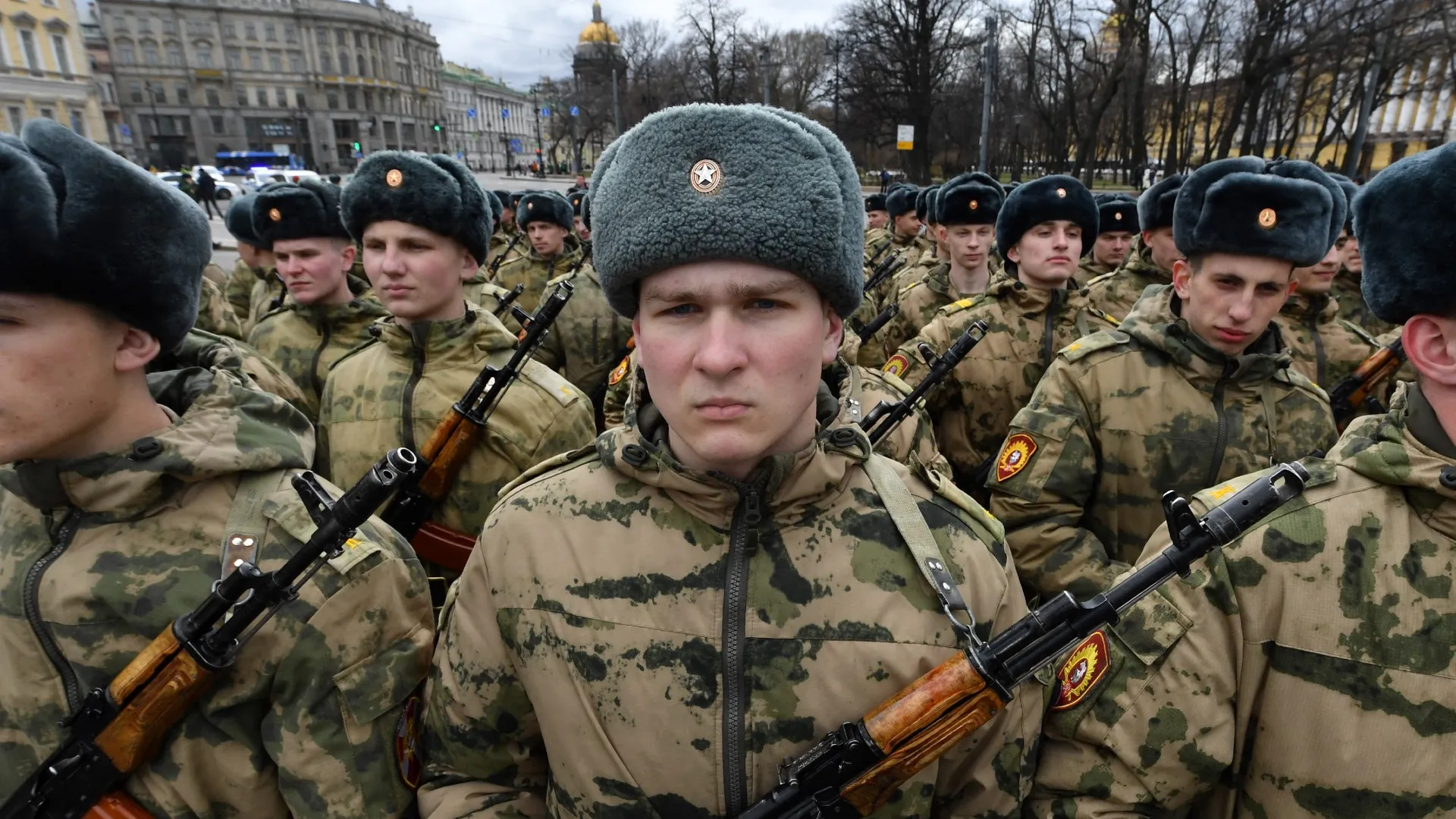
Russian commanders are charging “up to £30,000 to spare soldiers from the front lines in Ukraine”, said The Telegraph. Recruits unwilling or unable to pay are “reset” – a “euphemism for sending them to their deaths” in large-scale offensives with astronomical casualty rates.
Wounded soldiers must “pay thousands” to be declared unfit for active service, said PBS. Those who do not are “forced to literally limp into battle”. Seth Jones, from the Center for Strategic and International Studies, said that injured soldiers, sometimes on crutches, are being “used as bait” to “draw fire” from hidden Ukrainian artillery.
Estimates put the number of Russian casualties in the war against Ukraine since 2022 at around 1.2 million, according to the CSIS. Ukrainian officials have also claimed that in March Russia suffered its highest number of losses – more than 35,000 killed or seriously wounded – since the launch of Ukraine’s “Army of Drones” programme last year, said the UK Defence Journal.
The Week
Escape your echo chamber. Get the facts behind the news, plus analysis from multiple perspectives.
SUBSCRIBE & SAVE
Sign up for The Week's Free Newsletters
Join more than 350,000 subscribers and keep yourself informed with a selection of The Week’s most interesting, enlightening and entertaining stories - plus daily puzzles.
Join more than 350,000 subscribers and keep yourself informed with a selection of The Week’s most interesting, enlightening and entertaining stories - plus daily puzzles.
Latest Videos FromThe Week US
‘System of extortion’
“Corruption and slave labour have long been features of the Russian and Soviet armies,” said The Economist. Soldiers are not just seen as “grunts” – serving as “cannon fodder” for their superiors – but more troublingly as a “source of enrichment”.
There is a “system of extortion and punishment” in the Russian ranks, where infantry soldiers must “buy their own” military gear. Other collections begin “under the pretext of raising money for drones, equipment or food”, but payments are expected to continue. “Soldiers who refuse to pay may be thrown into dug-out pits for torture.”
In extreme cases, sources have reported that commanders “requisition troops’ bank cards and PIN codes” before sending them into battle. “The dead are declared missing, and commanders withdraw the money they earned from their bank accounts”. As one soldier was told by a new commanding officer, survival is “not a matter of luck, but of ability to pay”.
In the Russian military, “men learn quickly to fear their commanders more than their foe”, said PBS. Videos appear on social media depicting the “horrific punishments” faced by soldiers if they fail to pay up, with reports of some “being locked in cages, electrocuted and sexually assaulted”. According to the independent Russian station Radio Echo, nearly 12,000 complaints were filed over six months last year, accusing commanders of “corruption and violence towards their own men”.
‘Public resentment’
The Russian military recruitment drive has “poured blood and money into the system, resulting in a vast battlefield economy”, said The Economist. The front line has become a “marketplace where everything has a price: drones, medals, home leave and life itself”.
The problem is widespread, said The New York Times. In the last two years, “at least 12 high-ranking Russian military officials and generals, as well as dozens of lower-ranking officers, have been indicted on corruption charges”.
Most recently, Lieutenant Colonel Konstantin Frolov – known as “Executioner” – has been put on trial in a military court, facing charges of fraud, bribery and weapons trafficking. He is accused by the Investigative Committee (Russia’s equivalent of the FBI) of leading a scheme where “more than 30 soldiers and medics” in his regiment “used weapons to shoot themselves in order to obtain payouts for battlefield injuries”. The plot reportedly defrauded the army of “200 million rubles, or $2.6 million”.
This case in particular has “fed public resentment of the economic and social privileges” of high-ranking officials, who are accused of perpetuating the war “only for the money”.

 talking pointsLivestreaming an execution: cruelty or added deterrent?
 QUOTE OF THE DAY‘You don’t get to take a man from his family. You don’t get to take his very life, his whole future from him, and just walk away from it. Especially when that man is Tupac Shakur.’
 today’s big questionCan a Democrat win the Texas governor’s race?