-
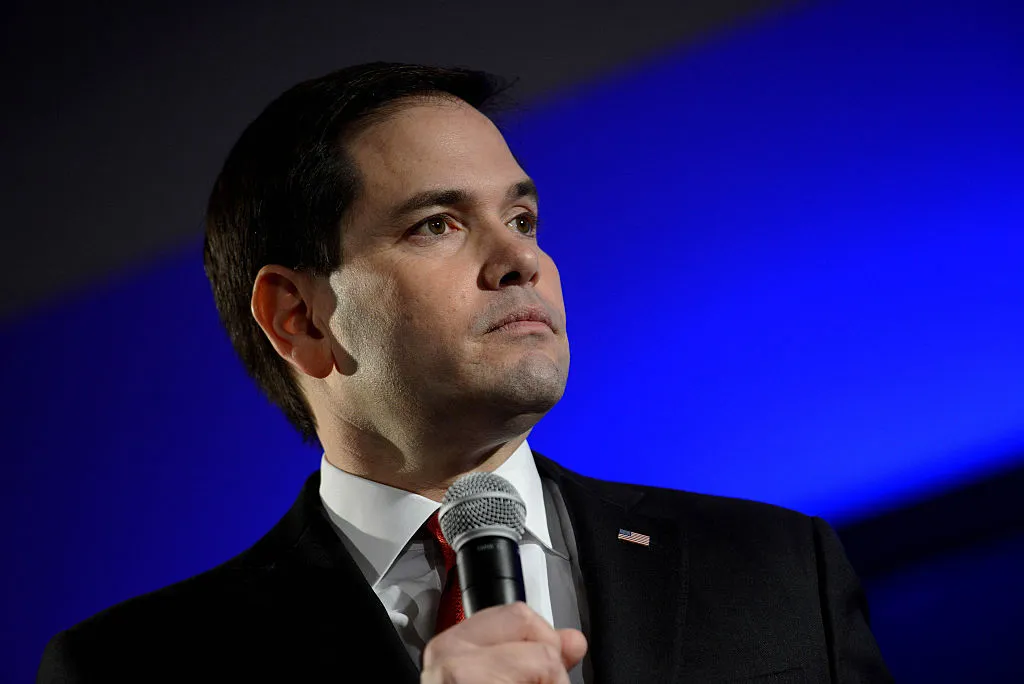
Could Marco Rubio lose his Senate race?
October 28, 2016 -
David Perdue decides against 2022 Senate run
10:49 a.m. -
Democrats may drop $15 minimum wage from coronavirus relief because 2 senators oppose it
10:35 a.m. -
The common cold may be ready for its big comeback
9:59 a.m. -
Texas racked up a $50 billion energy bill last week. It's not clear who's going to pay it.
9:03 a.m. -
Ted Cruz says his wife is 'pissed' over leaked Cancun texts
8:50 a.m. -
Late night hosts mock Ted Cruz's lame post-Mexico photo ops, cheer Trump's tax returns defeat
6:46 a.m. -
Facebook, Australia reach agreement to end week-long news blockade
4:40 a.m.
Marco Rubio really wants to hold onto his Senate seat, he swears — but it seems like Florida voters may not be so sure.
After his failed presidential bid, the Florida Republican swore up and down he'd be a "private citizen" come January 2017, right up until he reversed course and announced he'd run for re-election to the Senate. Rubio's flip-flop was largely interpreted in part as an effort to help Republicans hold onto their Senate majority, with Rubio being a strong candidate against Democratic opponent Rep. Patrick Murphy. But a new Public Policy Polling survey shows Rubio locked in a dead heat with Murphy:
Florida (@ppppolls)
PRES
Clinton 48
Trump 44
SEN
Rubio 46
Murphy 46https://t.co/Q3aH4z1FHq— Luke Brinker (@LukeBrinker) October 28, 2016
Public Policy Polling surveyed 742 likely Florida voters for this poll from Oct. 25-26, and the results have a 3.6-point margin of error. But while the poll shows the two men in a dead heat, its results also hint at how either candidate can get a leg up in the race: PPP noted that undecided voters are "looking at gun violence prevention as a major factor in their upcoming vote," with 72 percent of these undecided respondents supporting background checks for all gun sales.
Rubio has said he was moved to jump back into the Senate race in part by the deadly June attack on an Orlando nightclub, where a lone gunman killed 49 people — though last December he voted against a measure that would have expanded background checks.
Rubio has also been attempting to distance himself from Donald Trump, who trails Hillary Clinton in the same PPP poll by 4 points in the Sunshine State. But Rubio has affirmed that he'll be voting for Trump, so whether Rubio's delicate dance around the Republican nominee will help or hurt him remains to be seen. The RealClearPolitics average of polls of the Rubio-Murphy race shows the incumbent hanging on to a 3.6-point lead — but it also shows Murphy has been steadily gaining support in recent weeks. The two held their second and final debate Wednesday at Broward College near Fort Lauderdale, which you can read more about at the Miami Herald. Kimberly Alters
Former Sen. David Perdue (R-Ga.) won't be pursuing a 2022 Senate comeback bid after all.
Perdue, who lost his Senate seat to Sen. Jon Ossoff (D-Ga.) during Georgia's runoff elections in January, announced Tuesday that "after much prayer and reflection," he has decided not to run for Senate in Georgia in 2022.
"This is a personal decision, not a political one," Perdue said, adding that he will "do everything I can" to ensure the eventual Republican candidate wins the seat.
The former Georgia senator had been considering challenging Sen. Raphael Warnock (D-Ga.), who in 2022 would be running for a full six-year term after completing the term of Sen. Johnny Isakson (R-Ga.). In fact, Perdue recently filed paperwork to run, and a senior adviser confirmed to The Atlanta Journal-Constitution that he was "leaning heavily toward" running.
Former Sen. Kelly Loeffler (R-Ga.) and former Rep. Doug Collins (R-Ga.) have also been considering running for the Senate seat, the Atlanta Journal-Constitution noted, but they had reportedly been waiting to see what Perdue would do before making a decision. Brendan Morrow
Despite Sen. Joe Manchin's (D-W.Va.) promise to vote for his party's coronavirus relief bill, his and Sen. Kyrsten Sinema's (D-Ariz.) opposition to the package's $15 minimum wage hike may still sink it.
Progressives' long fight for a $15 federal minimum wage finally found its vehicle in the COVID-19 relief package currently being considered in the Senate. As it stands, the bill will raise the minimum wage from $7.25 to $9.50 once it's passed, and keep growing annually until it reaches $15 in 2025. But Manchin would prefer the cap to remain at $11 per hour, and Sinema doesn't think it should be in the bill at all, leaving the party at an impasse they plan to solve with help from the Senate parliamentarian, Politico reports.
The parliamentarian advises senators on the rules and procedures of the body, especially when it comes to a Reconciliation bill, which the Democrats are using to push through their relief bill without GOP support. Republicans and Democrats are planning to meet with the parliamentarian Wednesday to argue against and for the wage hike, respectively, Politico reports. The GOP says the hike will hurt small businesses struggling in the pandemic, while Manchin has argued "throwing $15 out there right now just makes it very difficult in rural America," despite the wage increase not taking full effect for years.
The impasse has Democrats considering knocking the hike to just $11 or $12/hour, Rep. John Yarmouth (D-Ky.) told Politico. Still, progressives led by Senate Budget Committee Chair Bernie Sanders (I-Vt.) are standing firm, with Sanders telling reporters on Monday that "I think we're going to pass [the bill] as it is." Kathryn Krawczyk
Get ready for a burst of the common cold, Stat News reports.
In a recently published study, researchers in Hong Kong analyzed a surge in rhinovirus — one of the most common causes of the common cold — infections among students when they returned to classrooms in the fall after months of schools being shuttered. Ben Cowling, a professor of infectious diseases epidemiology at the University of Hong Kong and senior author of the study, told Stat he expects other places will experience a similar pattern as schools reopen.
The theory is that "susceptibility" to rhinoviruses may have increased because people were less exposed throughout the COVID-19 pandemic and subsequently had fewer chances to build up immunity. The "hardy" Rhinoviruses also may be more resistant to protective measures like mask-wearing and social distancing than their coronavirus and influenza counterparts, per Stat.
While the common cold is a far less serious health threat than COVID-19, the Hong Kong researchers did note that the outbreaks in the city included more severe rhinovirus infections than normally seen, with some children needing hospital care. That's prompted concern about a similar decrease in resistance to influenza leading to a "severe" flu season whenever coronavirus restrictions are significantly scaled back. Read more at Stat News. Tim O'Donnell
When demand for energy rose sharply last week in unseasonably frigid Texas, and power plants started going offline, the state Public Utility Commission (PUC) allowed wholesale electricity prices to jump to the maximum rate of $9 per kilowatt-hour, a 7,400 percent increase over the normal rate of 12 cents per kilowatt-hour, The Texas Tribune reports. "The rate hike was supposed to entice power generators to get more juice into the grid, but the astounding costs were also passed directly on to some customers."
Texas became national news because its power grid, overseen by the Electric Reliability Council of Texas (ERCOT), nearly collapsed and 4.5 million customers lost power. But "now that the lights are back on in Texas, the state has to figure out who's going to pay for the energy crisis," Bloomberg News reports. "It will likely be ordinary Texans."
"The price tag so far: $50.6 billion, the cost of electricity sold from early Monday, when the blackouts began, to Friday morning," Bloomberg estimates. "That compares with $4.2 billion for the prior week." Texas allows energy retailers to compete for customers, and those who opted for variable-rate plans face huge bills — up to $17,000 in one case. But even utilities with fixed-rate plans "that ran up huge losses as the cost of electricity skyrocketed last week will inevitably try to recoup those through their customers, taxpayers, or bonds," Bloomberg reports.
Texas Gov. Greg Abbott (R), who appointed the PUC, said Sunday he will work with the legislature to address the huge energy bills. But the customers' pain is the energy industry's gain, ProPublica and The Texas Tribune report. After a 2014 freeze, Houston's CenterPoint Energy bragged to investors that it "benefited significantly" from high energy prices during the resulting power squeeze, adding, "To the extent that we get another polar vortex or whatever, absolutely, we'll be opportunistic and take advantage of those conditions."
Under the Texas system, power companies not only aren't required to produce enough energy to avoid blackouts, "they are incentivized to ramp up generation only when dwindling power supplies have driven up prices," ProPublica and the Tribune report. That's incentive structure is a recipe for near-misses — and blackouts, said University of Houston energy expert Ed Hirs.
It is also bad politics right now. "We cannot allow someone to exploit a market when they were the ones responsible for the dire consequences in the first place," said state Rep. Brooks Landgra (R). Peter Weber
Sen. Ted Cruz's (R-Texas) wife apparently had a mole in one of her recent group chats, and she's not happy.
The Texas senator sat down on Tuesday with the Ruthless podcast after drawing outrage for flying to Cancun with his family while Texas suffered through power outages last week. Amid the scandal, The New York Times managed to obtain texts Cruz's wife, Heidi, sent to their friends and neighbors about the trip.
"Heidi's pretty pissed at that," Cruz said of the leaked texts. "She actually was over at her neighbor's house yesterday sort of walking through [it]."
Cruz noted his wife texted their neighbors, a group that includes both Republicans and Democrats, and he decried the texts leaking to the media as an example of the "ridiculously politicized and nasty" climate, adding, "Here's a suggestion: just don't be a--holes. Just treat each other as human beings."
The text messages obtained by the Times revealed how quickly Cruz's widely-panned trip to Cancun came together amid the crisis in Texas, with the senator's wife texting that her house was "FREEZING" and asking, "Anyone can or want to leave for the week? We may go to Cancun." The Times noted the messages were "provided to The New York Times and confirmed by a second person on the thread, who declined to be identified because of the private nature of the texts." Kwame Anthony Appiah, The New York Times Magazine's "in-house ethicist," told the Times the situation "strikes me as a pretty substantial breach of norms about confidentiality."
Cruz, who has since expressed regret over his trip to Cancun, didn't say on the podcast whether he's figured out who was behind the leak, though one can only presume a full, possibly years-long investigation is underway. Brendan Morrow
Sen. Ted Cruz (R-TX) tells @RuthlessPodcast his wife Heidi is “pretty pissed” about the leaked Cancun texts:
“It's a sign of how ridiculously politicized and nasty and just ... Here’s a suggestion, just don’t be assholes. Just treat each other as human beings.” pic.twitter.com/ANtsOFmkfu
— The Recount (@therecount) February 23, 2021
Sen. Ted Cruz (R-Texas) finally found a place colder than last week's Texas freeze — and the reception he got from Texans after returning from his truncated Mexican vacation, The Late Show imagined Monday night.
"Following the backlash over his trip to Cancun, Sen. Ted Cruz spent the weekend trying his best to help the people of Texas," Jimmy Fallon said at The Tonight Show. But his "photo op didn't work out too well. Most people just drove away when he tried showing them his vacation photos." But "Cruz tried to be helpful in other ways," he said. "Later he showed Texans how to make frozen margs with the snow in their living rooms."
"Sorry, Cruz," but "doing the literal bare minimum for the sake of the cameras" at this point "is the politician version of coming home with flowers the day after Valentine's Day," Trevor Noah said at The Daily Show. "It's not nothing, but your a-- is still sleeping on the couch."
"Every detail that comes out of this story is more Ted Cruzier than the last one," like that he invited his college roommate on the family vacation he blamed on his daughters, Stephen Colbert said at The Late Show. And "it gets worse, because after Cruz returned we found out he left his dog behind."
Also, former President Donald Trump finally lost his tax return battle, and "given the potential charges, the former president could be sent to jail if convicted," Colbert said. "I can't wait to see it all play out in the new Netflix series Orange Is the New Orange."
Once New York prosecutors get Trump's tax returns, "we'll finally have the evidence we need to lock Hillary up — or something like that," Jimmy Kimmel joked at Kimmel Live. "Life is funny, isn't it? One day you're building walls, the next they're closing in on you." And the Ted Cruz story "is only getting funnier," he said. "Only Ted Cruz would think he can repair his image by touching a maskless constituent two days after getting off an international flight."
"United Airlines announced over the weekend that they launched an investigation into who leaked data about Sen. Ted Cruz's travel itinerary amid media coverage of his trip to Cancun, Seth Meyers said at Late Night. "They're trying to figure out who would have a motive, and they narrowed it down to everybody." Peter Weber
Facebook said Tuesday it will end its week-long blockade of Australian news sites after reaching agreement with the Australian government on a pending law that forces Facebook and Google to pay news providers for their content. "Facebook has refriended Australia, and Australian news will be restored to the Facebook platform," Treasurer Josh Frydenberg told reporters on Tuesday.
Frydenberg said after tough negotiations with Facebook's Mark Zuckerberg, the Australian government will introduce four amendments to its News Media Bargaining Code legislation, giving Facebook and Google, among other things, more time to reach agreement with news providers before a government arbitration panel steps in with a binding deal. The new code would prevent Facebook, Google, and eventually other Big Tech companies from using their digital dominance to strong-arm news businesses into take-it-or-leave-it compensation deals.
"Going forward, the government has clarified we will retain the ability to decide if news appears on Facebook so that we won't automatically be subject to a forced negotiation," Facebook's head of global news partnerships, Campbell Brown, said in a statement. Frydenberg said Australia's fight with Facebook had been a "proxy battle for the world," as other countries consider similar measures. Nobody is sure how Australia's new law, once enacted, will work in practice. Australian lawmakers will begin debating the amendments on Tuesday.
Google, after first threatening to pull its search engine from Australia, changed course and started reaching deals with Australian news publishers. Its deal with News Corp, which has a dominant presence in Australia, is global in scope. Facebook's news ban initially also blocked Australian government sites with COVID-19, public health, and emergency services, sparking widespread outrage in the country. Peter Weber