Sign up to get Today’s Best Articles in your inbox
Join 350,000+ subscribers and keep yourself informed with a selection of
The Week’s most interesting, enlightening and entertaining stories - plus daily puzzles.
You are now subscribed
Your newsletter sign-up was successful
Want to add more newsletters?
An account already exists for this email address, please log in.
Blinken calls for a diplomatic solution as U.S. prepares to back Ukrainian insurgency
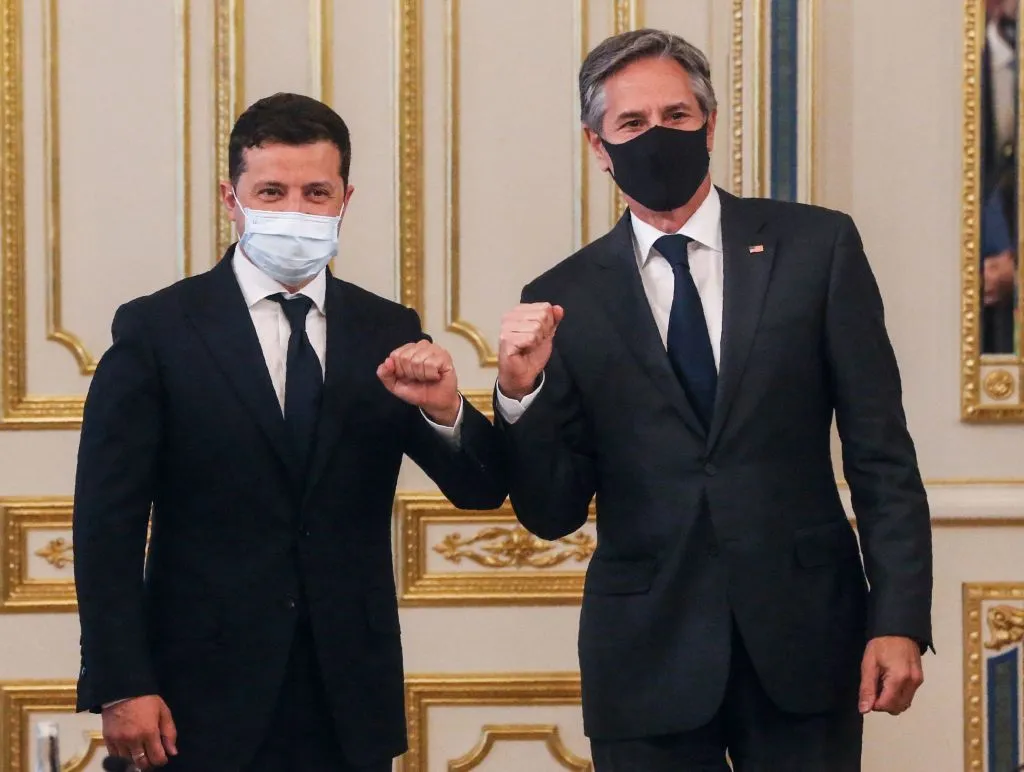
U.S. Secretary of State Antony Blinken met with Ukrainian President Volodymyr Zelenskiy in Kyiv Wednesday and warned that Russia could invade "on very short notice," Reutersreports.
In the meantime, Blinken said, the U.S. will continue encouraging Russia to remain on "the path of diplomacy and dialogue" rather than the "path of … confrontation and consequences."
During a panel discussion Wednesday, Russian deputy foreign minister Sergei Ryabkov said there "is no risk of a larger scale war to start to unfold in Europe or elsewhere."
The Week
Escape your echo chamber. Get the facts behind the news, plus analysis from multiple perspectives.
Join more than 350,000 subscribers and keep yourself informed with a selection of The Week’s most interesting, enlightening and entertaining stories - plus daily puzzles.
Join more than 350,000 subscribers and keep yourself informed with a selection of The Week’s most interesting, enlightening and entertaining stories - plus daily puzzles.
"We do not want and will not take any action of aggressive character. We will not attack, strike, invade … Ukraine. It has been said dozens of times in recent weeks, and I just reconfirmed this," Ryabkov said.
His reassurances come only days after the U.S. reportedly received intelligence that Russia was planning a "false flag" operation to justify an invasion.
According to NPR, the Biden administration said Wednesday it would provide $200 million in military aid to Ukraine if Russia invades.
More extreme measures are on the table as well.
Sign up to get Today’s Best Articles in your inbox
A free daily email with the day’s biggest news and analysis – and the best features from TheWeek.com
The New York Timesreported Friday that Defense Secretary Lloyd Austin had made a phone call to his Russian counterpart in which he threatened U.S. support for an anti-Russian insurgency within Ukraine.
"[I]f it turned into a Ukrainian insurgency, Putin should realize that after fighting insurgencies ourselves for two decades, we know how to arm, train and energize them," retired four-star U.S. Navy Admiral James Stavridis told the Times.
Blinken and Russian Foreign Minister Sergei Lavrov are set to meet Friday in Geneva to discuss whether "there is a possible diplomatic off-ramp to this crisis," a State Department official said.
Previous talks between the U.S. and Russia have failed to reach a solution as each side refused to give in to the other's demands.
Grayson Quay was the weekend editor at TheWeek.com. His writing has also been published in National Review, the Pittsburgh Post-Gazette, Modern Age, The American Conservative, The Spectator World, and other outlets. Grayson earned his M.A. from Georgetown University in 2019.