Sign up to get Today’s Best Articles in your inbox
Join 350,000+ subscribers and keep yourself informed with a selection of
The Week’s most interesting, enlightening and entertaining stories - plus daily puzzles.
You are now subscribed
Your newsletter sign-up was successful
Want to add more newsletters?
An account already exists for this email address, please log in.
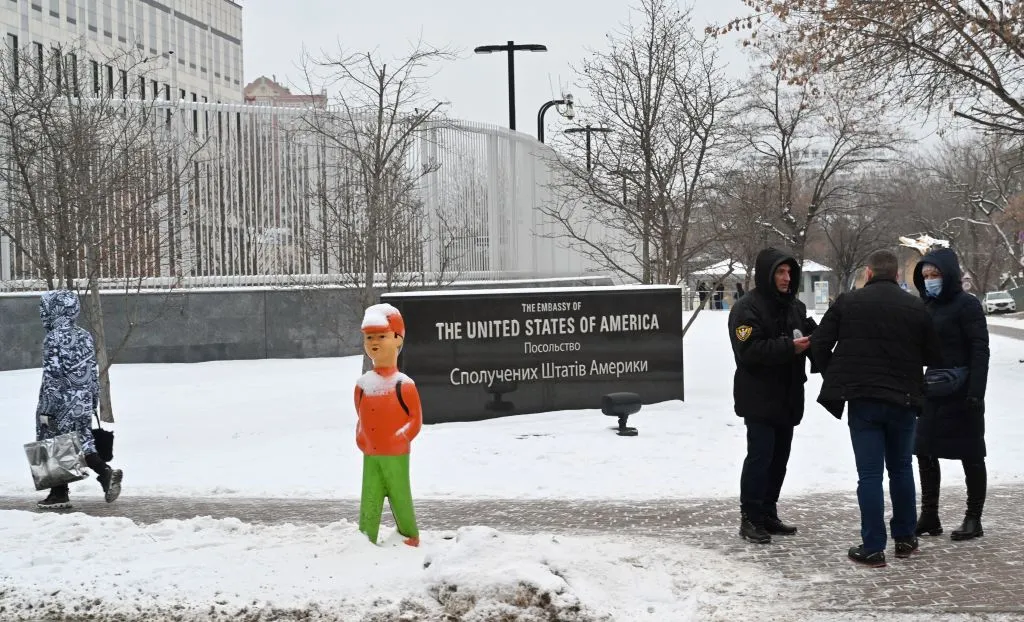
The U.S. began evacuating its embassy in Kyiv on Saturday as intelligence sources warn a Russian invasion could begin at any moment, Politicoreports.
Per Politico, the "State Department said Saturday that almost all of its 200 staff based in Kyiv will be required to leave" but that "embassy will keep a small number of 'core' diplomats in Kyiv and will maintain a small consular service in Lviv, which is further away from a potential conflict zone."
Russia announced Saturday it is also cutting back its diplomatic presence in Ukraine. According to The Wall Street Journal, "Russian Foreign Ministry spokeswoman Maria Zakharova said Russia had decided on a 'certain optimization' of staffing … because it feared 'certain provocations by the Kyiv regime or third nations.'"
The Week
Escape your echo chamber. Get the facts behind the news, plus analysis from multiple perspectives.
Join more than 350,000 subscribers and keep yourself informed with a selection of The Week’s most interesting, enlightening and entertaining stories - plus daily puzzles.
Join more than 350,000 subscribers and keep yourself informed with a selection of The Week’s most interesting, enlightening and entertaining stories - plus daily puzzles.
Zakharova's attempt to portray Ukraine as the potential aggressor fit with U.S. intelligence reports that Russia could conduct a "false flag" operation — in which Russians posing as Ukrainians would launch attacks on Russian forces — ahead of its invasion.
National Security Adviser Jake Sullivan warned Friday that all American civilians should leave Ukraine "as soon as possible," and that if they failed to do so in the next 24 tp 48 hours, there might not be "any other opportunity to leave." On Jan. 22, the State Department ordered the families of U.S. Embassy personnel in Ukraine to evacuate the country.
President Biden spoke with Russian President Vladimir Putin for about an hour on Saturday. According to the official White House summary, Biden "reiterated that a further Russian invasion of Ukraine would produce widespread human suffering and diminish Russia's standing" and said the U.S. "remains prepared to engage in diplomacy" but is "equally prepared for other scenarios."
Sign up to get Today’s Best Articles in your inbox
A free daily email with the day’s biggest news and analysis – and the best features from TheWeek.com
Grayson Quay was the weekend editor at TheWeek.com. His writing has also been published in National Review, the Pittsburgh Post-Gazette, Modern Age, The American Conservative, The Spectator World, and other outlets. Grayson earned his M.A. from Georgetown University in 2019.