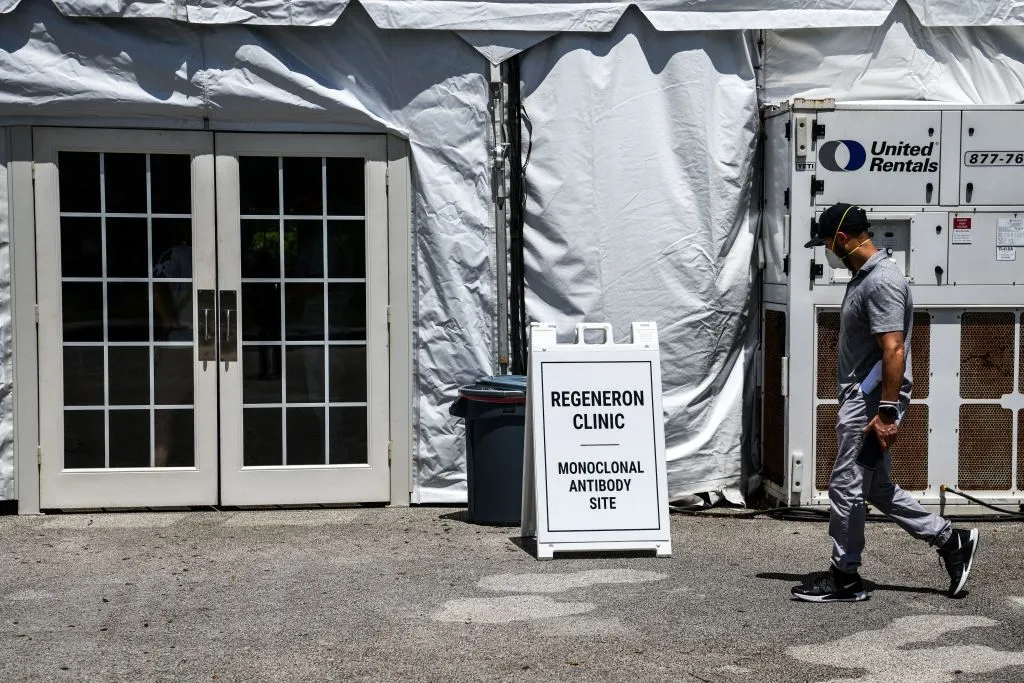
Health officials agree that if you are newly infected with COVID-19 and have an above-average risk of getting seriously ill, you should quickly seek treatment with Regeneron Pharmaceuticals' monoclonal antibody therapy. The federal government is covering the costs, some states have set up free infusion centers, and the antibody cocktail has been shown to reduce hospitalization rates by 70 percent for high-risk COVID-19 patients treated within 10 days.
"They are safe, they are free, they keep people out of the hospital and help keep them alive," Dr. Marcella Nunez-Smith, a senior adviser to the White House's COVID-19 response team, said at an Aug. 12 White House briefing.
But the loudest promotion of Regeneron's experimental treatment is coming from the governors of Texas and Florida, "where vaccinations lag and hospitalizations are soaring with Delta-variant infections" even as the governors "downplay vaccination and other measures that health officials say can prevent illness in the first place," Kaiser Health News reports. Texas Gov. Greg Abbott (R), who received Regeneron's lab-produced antibody cocktail earlier this month, on Wednesday banned government entities from requiring FDA-approved vaccinations.
The Week
Escape your echo chamber. Get the facts behind the news, plus analysis from multiple perspectives.
SUBSCRIBE & SAVE
Sign up for The Week's Free Newsletters
Join more than 350,000 subscribers and keep yourself informed with a selection of The Week’s most interesting, enlightening and entertaining stories - plus daily puzzles.
Join more than 350,000 subscribers and keep yourself informed with a selection of The Week’s most interesting, enlightening and entertaining stories - plus daily puzzles.
Latest Videos FromThe Week US
The FDA approved Regeneron's treatment on an emergency use basis late last year, but few people used it as the vaccines became available and helped crush infections and hospitalizations. Then the Delta variant took hold. Since mid-July, Regeneron deliveries have "soared from 25,000 doses to 125,000 doses per week, with about half shipped to four states: Florida, Texas, Mississippi, and Alabama," Kaiser Health News reports, citing Regeneron spokeswoman Alexandra Bowie.
This "expensive, cumbersome, and difficult-to-use therapy" is "not a substitute for vaccine, by any means," Dr. Christian Ramers, an infectious disease specialist at Family Health Centers of San Diego, tells Kaiser Health News. "It's like playing defense with no offense."
Regeneron's infusions cost about $1,250 a dose, not counting the hundreds of dollars to transport the drug and administer the hour-long infusion, Kaiser Health News notes. "The federal government is also covering the costs of COVID vaccination, at about $20 a dose."
Both of those interventions are much less expensive than hospitalizing COVID-19 patients. But it's "fiscally irresponsible" and "downright despicable for 'small government conservatives' to look to the federal government to dole out the most extravagant rescues for their states when they've so willingly squandered — and impeded — the far more prudent and effective measures" like vaccines and masks, Neil J. Young writes at The Week.