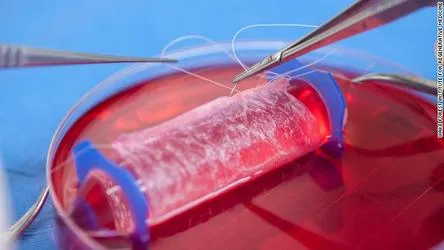
Like scaffolding that props up a building, scientists are now using temporary frameworks to create custom-designed, complex new organs, which they've successfully implanted in several patients. These breakthroughs were revealed in two extraordinary studies on the engineering of body parts published Thursday in The Lancet.
Here's the basics of how the process works: Doctors first extract cells from a patient's muscle and tissue, then use those cells to seed 3-D biodegradable scaffolding of the target organ that they've constructed from scans of the patient's body. After a few weeks in an incubator, the seed cells have spread across the scaffolding to produce a layer of tissue, and the new organ is implanted in the patient. The scaffolding is absorbed into the body as the cells continue to grow.
One team worked on creating nasal cartilage, while another grew new vaginas. "This is a move forward to even more challenging [organs]," Ian Martin, a professor of tissue engineering at University Hospital Basel in Switzerland and co-author of the nasal cartilage study, told CNN. "All these incremental steps finally have demonstrated that it is possible to engineer tissue that can help patients."
The Week
Escape your echo chamber. Get the facts behind the news, plus analysis from multiple perspectives.
SUBSCRIBE & SAVE
Sign up for The Week's Free Newsletters
From our morning news briefing to a weekly Good News Newsletter, get the best of The Week delivered directly to your inbox.
From our morning news briefing to a weekly Good News Newsletter, get the best of The Week delivered directly to your inbox.
Latest Videos From
The reproductive organ study involves four teenagers born with a rare condition called Mayer-Rokitansky-Küster-Hauser Syndrome. The women were all born either without or with a deformed uterus or vagina. According to CNN, after receiving their new sex organs, the patients all indicated that they had "normal levels of desire, arousal, lubrication, orgasm, satisfaction, and painless intercourse." Two of the patients now also menstruate.
The patients in the nasal tissue study were all elderly and had recently undergone cancer surgery. Ordinarily, doctors reconstruct noses with big pieces of cartilage taken from the ear, septum, or ribs — a very painful process. This time, scientists removed a tiny piece of tissue from each patient's nasal septum — roughly half the size of the tip of a pen — and put it onto a scaffold. The cells formed a thin layer of cartilage that was then transplanted to the patient.
Scientists hope that these amazing findings will help more people in the future, including those who need replacement cartilage or whose reproductive systems have been damaged. "Tissue engineering is finally demonstrating that it can deliver on expectations," Martin said.