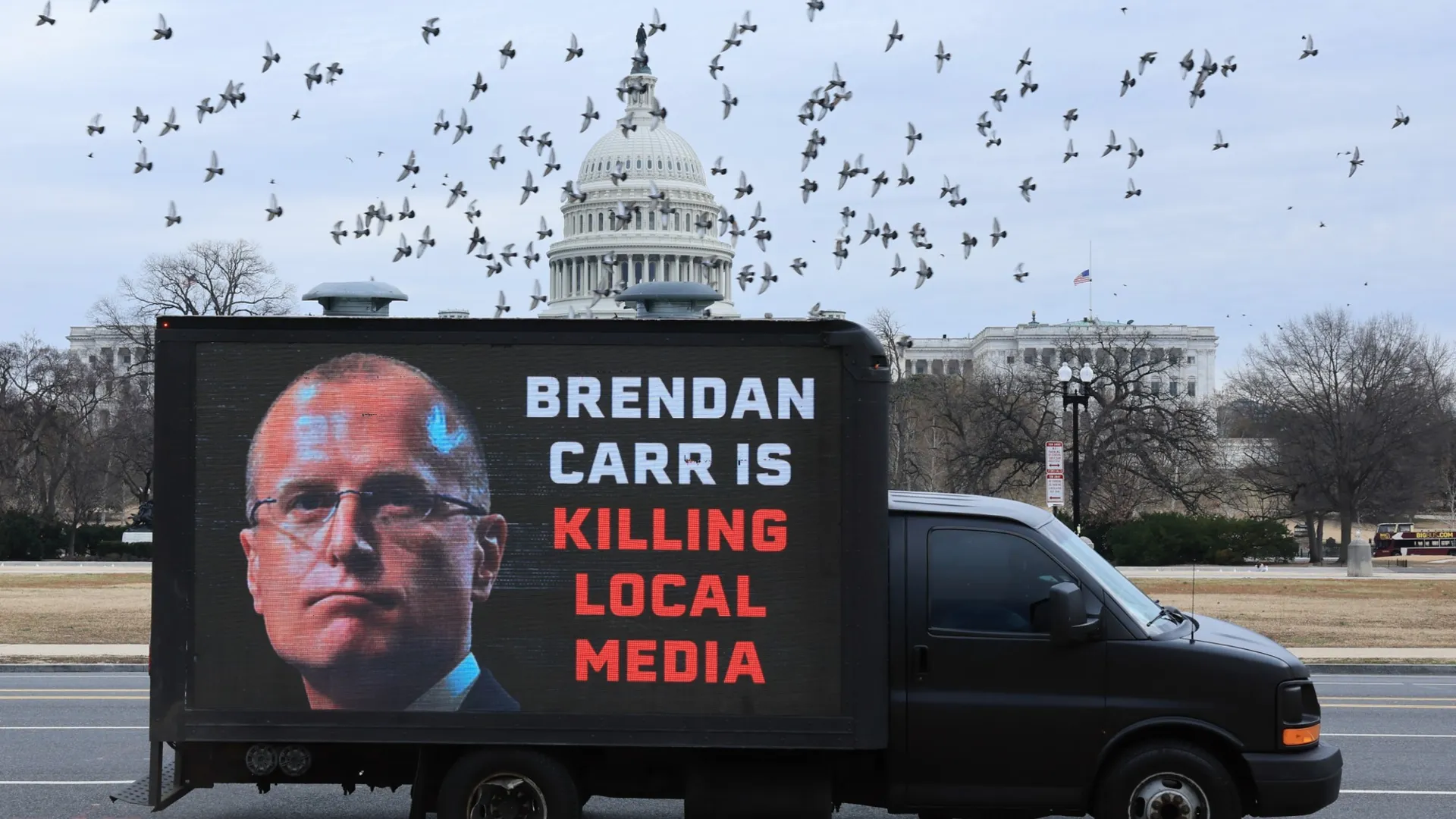
The Federal Communications Commission this month voted to repeal its 39% cap that limits how much of the national television market a single owner can legally own. In doing so, the FCC has supercharged an ongoing debate over media consolidation and monopolies in the Trump era.
Moving forward, the FCC said in a press release, station purchases will be adjudicated “with a granular, case-by-case review.” But concerns over increased monopolization and questions about the commission's authority in this case have some critics crying foul — and predicting a rocky legal road for FCC Chair Brendan Carr.
‘Shift from local to national ownership’
The FCC claims that its 39% ownership cap had “become outdated” and “hindered broadcasters’ ability to compete for viewers and advertising dollars” against digital services that “face no comparable restrictions,” said The Wall Street Journal. Removing the cap will “foster a competitive media market, enhance localism and promote investment in trusted sources,” said the FCC in its release.
The Week
Escape your echo chamber. Get the facts behind the news, plus analysis from multiple perspectives.
SUBSCRIBE & SAVE
Sign up for The Week's Free Newsletters
Join more than 350,000 subscribers and keep yourself informed with a selection of The Week’s most interesting, enlightening and entertaining stories - plus daily puzzles.
Join more than 350,000 subscribers and keep yourself informed with a selection of The Week’s most interesting, enlightening and entertaining stories - plus daily puzzles.
Latest Videos FromThe Week US
But the change is a “big win” for media companies “aligned with President Donald Trump and the Republican Party,” said CNN. If allowed to stand, removing the cap means “big station group owners” will be able to “buy up more TV stations, furthering a shift from local to national ownership.” Companies including “Nexstar, Fox, CBS parent Paramount and E.W. Scripps” already sit “at or near the 39% ownership limit,” said the Journal. “Industry analysts” have similarly “identified Sinclair and Gray Media as potential acquirers” should the restrictions remain loosened.
Carr’s “rationale” for the change is to “balance the power between local broadcasters and networks,” said Anna Gomez, the FCC’s lone Democrat and sole “no” vote on removing the rule cap, per NPR. In practice, the FCC is “putting its thumb on the scale” on behalf of “content that this administration likes and against content that it dislikes.” The rule change comes as ABC and Disney have sued the FCC for allegedly violating their First Amendment rights as part of a broader ongoing fight between the broadcaster and the regulator.
‘Serious concerns’
The FCC’s new rule is “already facing legal challenges,” with experts warning of a “real chance the agency loses in court,” said Axios. Some observers, including a surprising array of conservative lawmakers, are skeptical of the FCC’s legal ability to make the changes in the first place.
Despite being a Republican who supports “deregulation and the Trump administration,” my “ultimate loyalty rests with the Constitution, which gives certain prerogatives to Congress,” said former GOP Majority Leader Tom DeLay, who helped set the 39% cap in 2004, at Daily Wire. Chair Carr “cannot defy or modify laws enacted by Congress” and should instead “ask Congress to pass a law giving him authority to do that.” Said Sen. Ted Cruz (R-Texas) in a statement to Politico, “I’ve raised serious concerns that the commission lacks the authority to carry that out without congressional authorization.”
The 39% ownership cap was enacted by Congress to “protect localism, viewpoint diversity and consumer choice,” said Hunter Wilson, the spokesperson for the American Television Alliance lobbying group, to Variety. The FCC has “ignored Congressional intent” and “opened the door to unchecked ‘Big Broadcast’ consolidation that will drive up costs for viewers and reduce local news programming.”