Sign up to get Today’s Best Articles in your inbox
Join 350,000+ subscribers and keep yourself informed with a selection of
The Week’s most interesting, enlightening and entertaining stories - plus daily puzzles.
You are now subscribed
Your newsletter sign-up was successful
Want to add more newsletters?
An account already exists for this email address, please log in.
Humanitarian corridor agreements collapse as Russia continues shelling
A ceasefire agreement intended to created "humanitarian corridors" that would allow civilians to escape the embattled Ukrainian cities of Mariupol and Volnovakha fell apart as Russian forces continued shelling the cities, The Associated Pressreported.
According to Reuters, Russia announced Saturday morning that military forces encircling Mariupol and Volnovakha would stop firing for five hours on Saturday afternoon so civilians could safely leave, but Ukrainian officials said the invaders never kept up their side of the bargain.
"The Russian side is not holding to the ceasefire and has continued firing on Mariupol," said Kyrylo Tymoshenko, the deputy head of Ukrainian President Volodymyr Zelensky's office. Ukrainian and Russian negotiators had reached an initial agreement for a humanitarian corridor out of the encircled port city on Thursday. Ukrainian Deputy Prime Minister Iryna Vereshchuk said Russia continued firing on Volnovakha as well.
The Week
Escape your echo chamber. Get the facts behind the news, plus analysis from multiple perspectives.
Join more than 350,000 subscribers and keep yourself informed with a selection of The Week’s most interesting, enlightening and entertaining stories - plus daily puzzles.
Join more than 350,000 subscribers and keep yourself informed with a selection of The Week’s most interesting, enlightening and entertaining stories - plus daily puzzles.
Shelling also continued in the vicinity of Kyiv. Radio Free Europe shared video shot in the Ukrainian city of Irpin — a 30-minute drive from the Kyiv city center — on Friday that showed Russian artillery fire striking a high-rise apartment building.
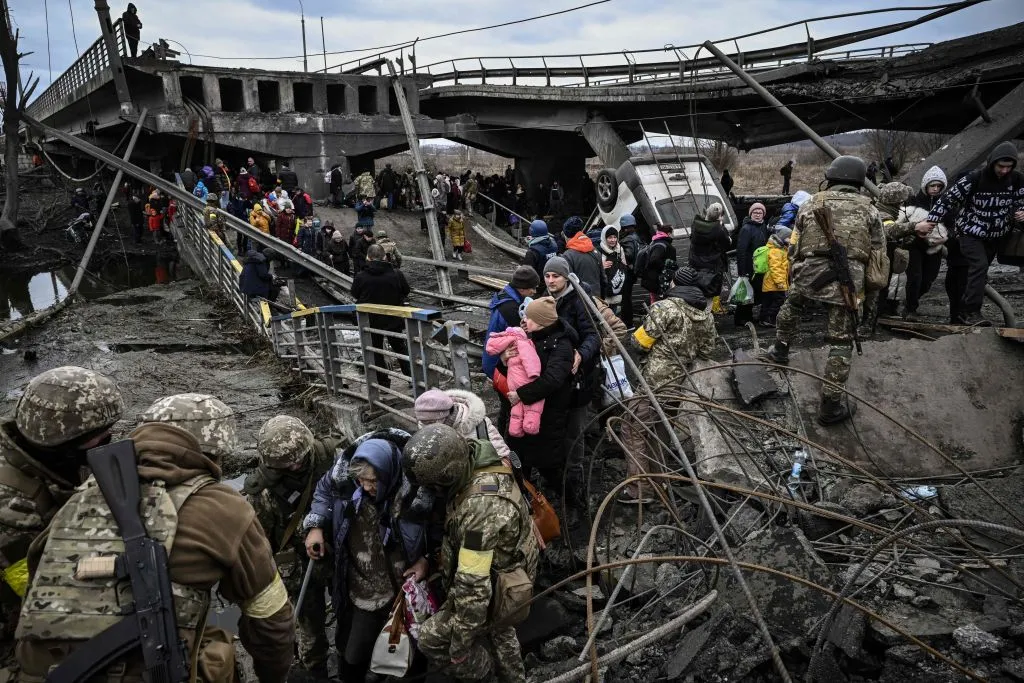
According to The Wall Street Journal, Russia has destroyed a bridge that separates Irpin from Kyiv, forcing civilians fleeing to the capital to "climb down and under the span and then navigate a precarious pathway, their suitcases and pets in their hands."
Ukrainian special forces armed with U.S.- and British-made anti-tank weapons say they have repulsed Russian forces from Irpin for several days in a row.
Sign up to get Today’s Best Articles in your inbox
A free daily email with the day’s biggest news and analysis – and the best features from TheWeek.com
Grayson Quay was the weekend editor at TheWeek.com. His writing has also been published in National Review, the Pittsburgh Post-Gazette, Modern Age, The American Conservative, The Spectator World, and other outlets. Grayson earned his M.A. from Georgetown University in 2019.