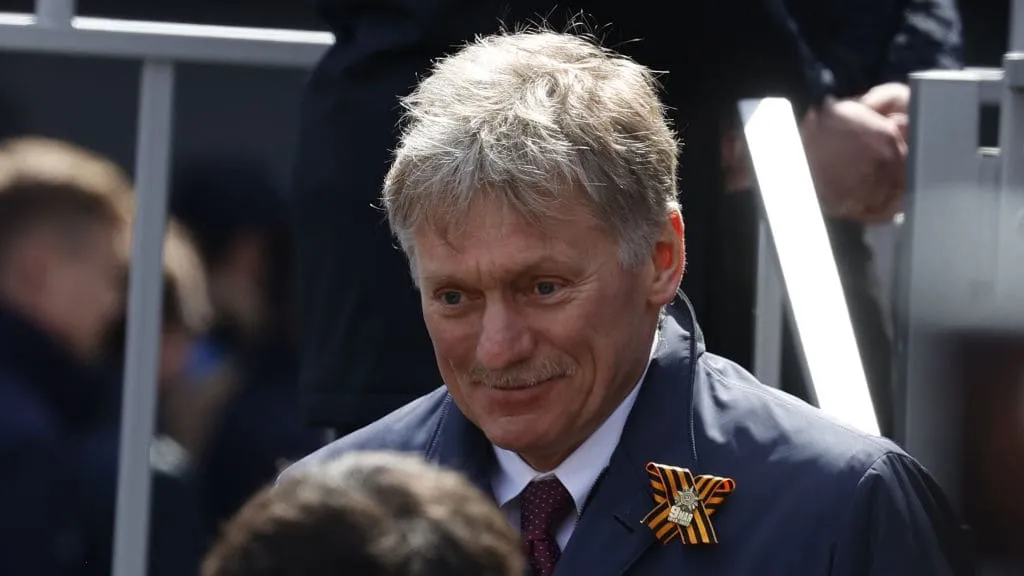
Kremlin spokesman: Geneva Conventions likely don't apply to Americans captured in Ukraine
Dmitry Peskov, spokesman for the Kremlin, told NBC News during an interview on Monday that he couldn't guarantee that two Americans captured by Russia in Ukraine won't face the death penalty.
"It depends on the investigation," Peskov said. The captured men — Alexander Drueke, 39, and Andy Huynh, 27 — are both military veterans, and Peskov accused them of being "involved in illegal activities" in Ukraine, including "firing at our military guys. They were endangering their lives."
Peskov went on to promise "there will be a court, and there will be a court decision," adding that "they should be punished" for being "soldiers of fortune." Peskov would not tell NBC News whether Drueke and Huynh are being held in Russia or by pro-Russia forces in eastern Ukraine, but said since they are not members of Ukraine's army, they are likely not covered by Geneva Conventions for prisoners of war. Russia's state-controlled RT network reported on Friday that Drueke and Huynh are being held by separatists.
The Week
Escape your echo chamber. Get the facts behind the news, plus analysis from multiple perspectives.
Sign up for The Week's Free Newsletters
From our morning news briefing to a weekly Good News Newsletter, get the best of The Week delivered directly to your inbox.
In early March, Ukraine's government said more than 20,000 people from 52 countries volunteered to fight against Russia with the International Legion of Ukraine. When asked by NBC News, a spokesman for the foreign legion on Monday said he could not "confirm or deny" whether Drueke and Huynh were part of the force. Last week, Drueke's mother said he was in Ukraine on an advisory level, rather than as a fighter.
A free daily email with the biggest news stories of the day – and the best features from TheWeek.com
Catherine Garcia has worked as a senior writer at The Week since 2014. Her writing and reporting have appeared in Entertainment Weekly, The New York Times, Wirecutter, NBC News and "The Book of Jezebel," among others. She's a graduate of the University of Redlands and the Columbia University Graduate School of Journalism.
-
Moon dust has earthly elements thanks to a magnetic bridgeUnder the radar The substances could help supply a lunar base
-
World’s oldest rock art discovered in IndonesiaUnder the Radar Ancient handprint on Sulawesi cave wall suggests complexity of thought, challenging long-held belief that human intelligence erupted in Europe
-
Claude Code: the viral AI coding app making a splash in techThe Explainer Engineers and noncoders alike are helping the app go viral
-
What is ‘Arctic Sentry’ and will it deter Russia and China?Today’s Big Question Nato considers joint operation and intelligence sharing in Arctic region, in face of Trump’s threats to seize Greenland for ‘protection’
-
What would a UK deployment to Ukraine look like?Today's Big Question Security agreement commits British and French forces in event of ceasefire
-
Would Europe defend Greenland from US aggression?Today’s Big Question ‘Mildness’ of EU pushback against Trump provocation ‘illustrates the bind Europe finds itself in’
-
Did Trump just end the US-Europe alliance?Today's Big Question New US national security policy drops ‘grenade’ on Europe and should serve as ‘the mother of all wake-up calls’
-
Is conscription the answer to Europe’s security woes?Today's Big Question How best to boost troop numbers to deal with Russian threat is ‘prompting fierce and soul-searching debates’
-
Trump peace deal: an offer Zelenskyy can’t refuse?Today’s Big Question ‘Unpalatable’ US plan may strengthen embattled Ukrainian president at home
-
Vladimir Putin’s ‘nuclear tsunami’ missileThe Explainer Russian president has boasted that there is no way to intercept the new weapon
-
The Baltic ‘bog belt’ plan to protect Europe from RussiaUnder the Radar Reviving lost wetland on Nato’s eastern flank would fuse ‘two European priorities that increasingly compete for attention and funding: defence and climate’