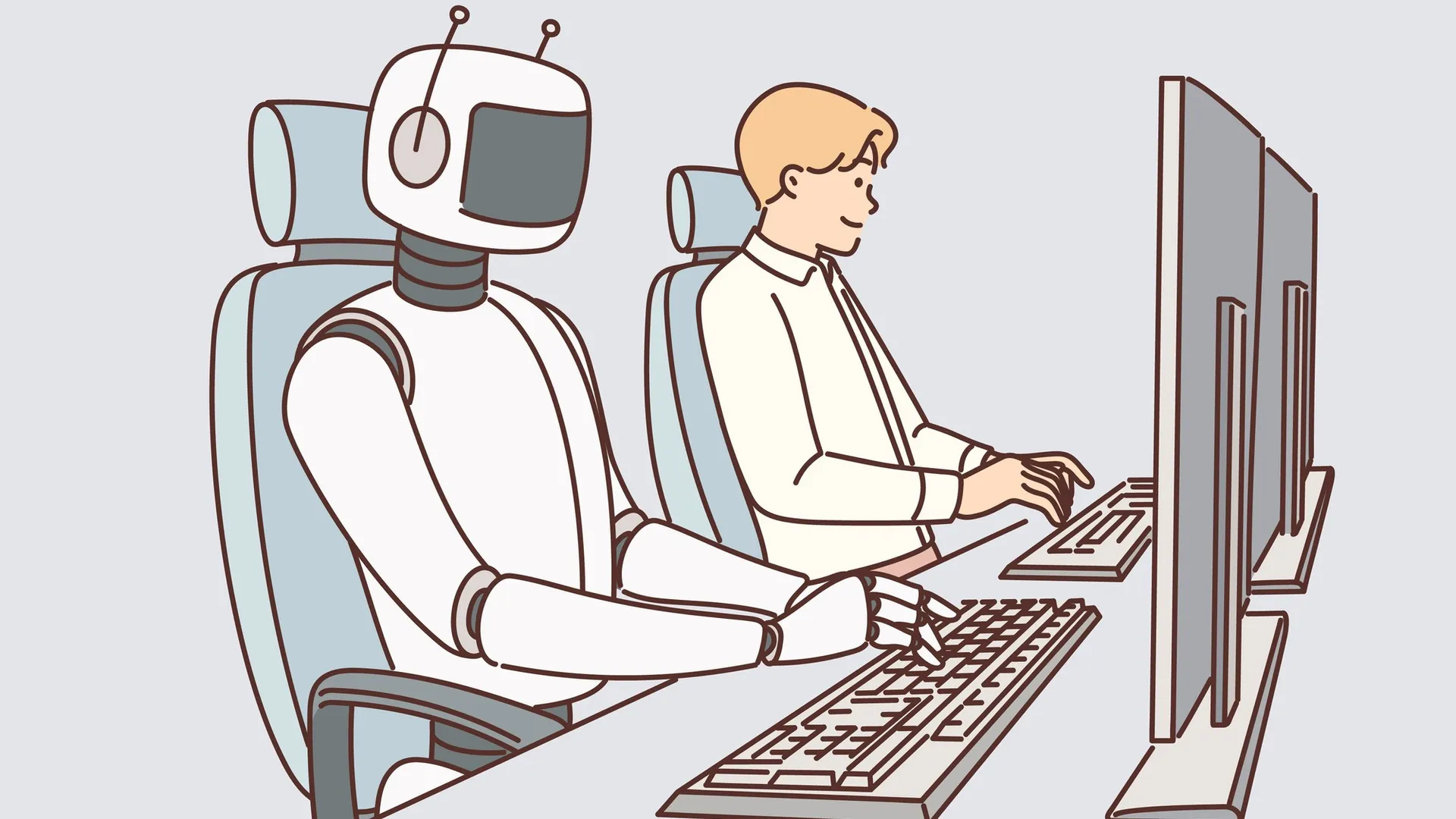
AI may be making workers complacent. As more professions begin to rely on artificial intelligence technology, certain skills will be lost as a result. This phenomenon, known as ‘deskilling,’ is emerging in many industries and could lead to problems down the road.
What is deskilling?
The danger of AI has moved from “apocalypse to atrophy,” said The Atlantic. As the technology becomes more advanced, people are leaning on it and losing the ability to perform certain tasks without assistance. For example, doctors were found to be less adept at finding precancerous growths during colonoscopies after just three months of using an AI tool designed to spot them, according to a study published in the Lancet Gastroenterology and Hepatology.
The study sparked worry about AI use in the medical sphere, with many questioning if “just three months of using an AI tool could erode the skills of the experienced physicians,” what might the future look like for medical students learning the skills, said The New York Times. “We’re increasingly calling it never-skilling,” Adam Rodman, the director of AI programs at Beth Israel Deaconess Medical Center, said to the Times.
The Week
Escape your echo chamber. Get the facts behind the news, plus analysis from multiple perspectives.
SUBSCRIBE & SAVE
Sign up for The Week's Free Newsletters
Join more than 350,000 subscribers and keep yourself informed with a selection of The Week’s most interesting, enlightening and entertaining stories - plus daily puzzles.
Join more than 350,000 subscribers and keep yourself informed with a selection of The Week’s most interesting, enlightening and entertaining stories - plus daily puzzles.
Latest Videos FromThe Week
Deskilling has been observed across a wide array of fields. Therapists may be “allowing themselves to become passive in the act of therapy,” essentially becoming a “supervisor over the AI use for therapy” and limiting their “reflexive diagnostic thinking,” said Forbes. In the tech field, computer coding has been increasingly replaced by AI, leaving human coders to do “integration, monitoring and higher-level analysis,” said the American Enterprise Institute. In education, many students are using AI to write essays or do research. But the “term paper, for all its tedium, teaches a discipline that’s hard to reproduce in conversation: building an argument step by step, weighing evidence, organizing material, honing a voice,” said The Atlantic.
How bad is it?
Deskilling is not strictly a bad thing. “Every advance has cost something,” said The Atlantic. “Literacy dulled feats of memory but created new powers of analysis. Calculators did a number on mental arithmetic; they also enabled more people to ‘do the math.’” While the Lancet study caused some worry, it only analyzed one skill of a group of physicians and did not “evaluate individual doctors to determine whether they lost skills over time,” said Physicians Weekly.
It was also an observational study, meaning AI cannot be pinpointed as a cause for the lower accuracy in detection. In addition, a different study found that incorporating AI raised cancer detection rates by approximately 20%. The AI usage was “plainly beneficial, regardless of whether individual clinicians became fractionally less sharp," said The Atlantic.
However, problems arise when a lack of access to technology hinders a person’s ability to do a job. “Like a lifeguard who spends most days watching capable swimmers in calm water, such human supervisors rarely need to act — but when they do, they must act fast, and deftly,” said The Atlantic. AI tools are “not available in every health system,” and a “doctor accustomed to using it might be asked by a new employer to function without it,” said the Times. As of now, AI still requires human oversight in most cases. The “most talented, well-rounded and adaptable will likely prosper,” said the American Enterprise Institute. “The less talented may have difficulty finding and retaining quality jobs.”
Going forward, it will be important for workers to hone skills while analyzing how AI could help without taking over. “None of us likes to see hard-won abilities discarded as obsolete, which is why we have to resist the tug of sentimentality,” said The Atlantic.