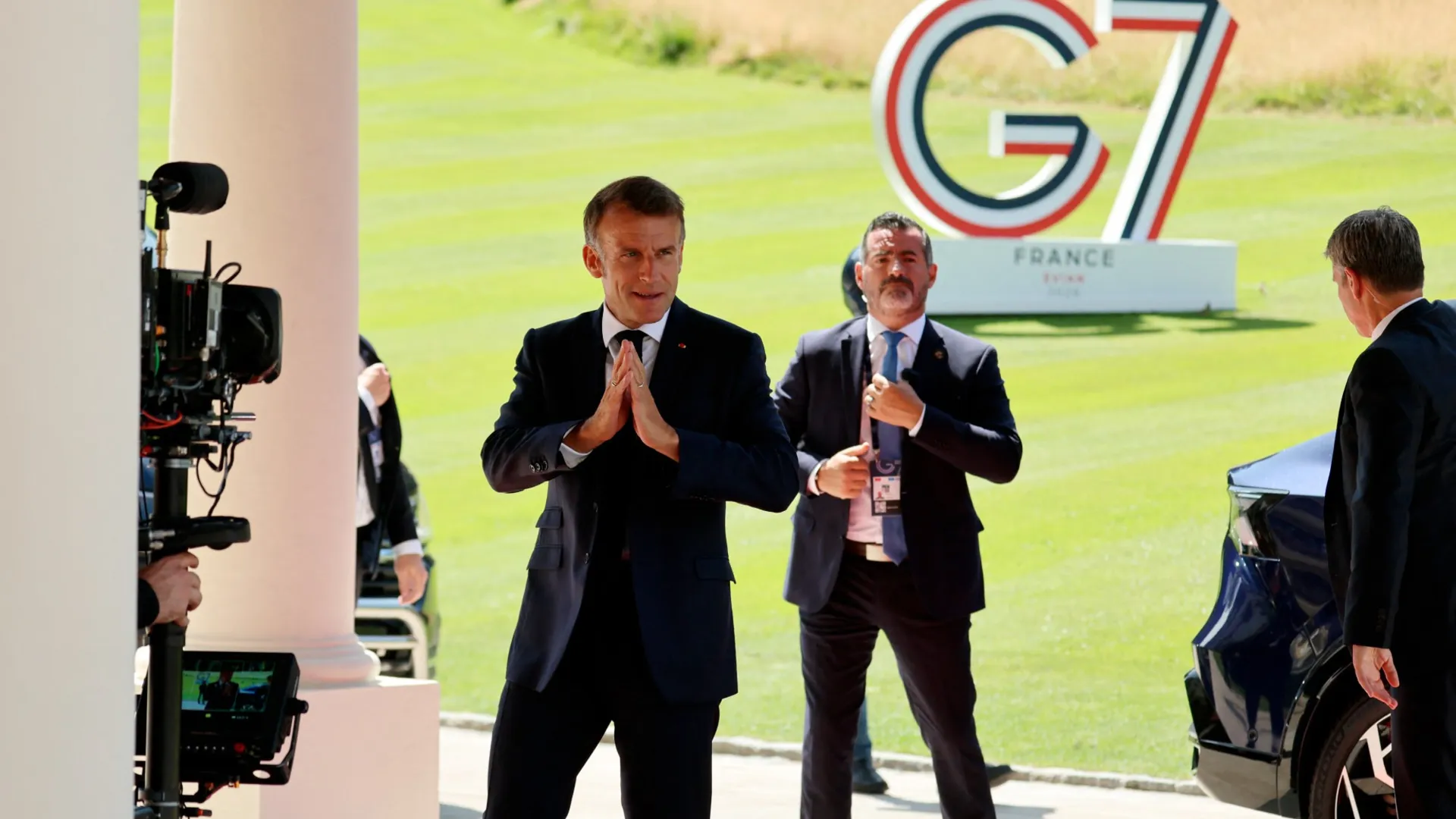
Emmanuel Macron has home-field advantage during the ongoing G7 summit in the resort town of Évian-les-Bains, and the French president wants the involved countries to help him deal with Chinese trade, which he feels is unbalanced. Though China isn’t a G7 member, it has an advantage of its own given its power in the global trade market. So Macron may have to perform a delicate balancing act.
The French president largely expects the G7 nations to “converge on the need to tackle a flood of subsidized Chinese exports that is disrupting global markets,” said Politico. But it is becoming increasingly clear that “credible action is one deliverable he won’t be able to land.” Macron is pushing for Europe and the U.S. to come together for a solution, but meetings are “unlikely to deliver answers to the problem.”
The problem is two-pronged: Beijing is “curling its lip” at Macron, while Europe and the U.S. are “diverging on how to contain China’s $1.2 trillion trade surplus,” said Politico. Macron wants the EU to present a unified front on China, and Europe has “made strides on its China policy since the Covid-19 pandemic” but “still struggles to align internally,” said The Chicago Council on Global Affairs. And the “squeeze is tightening from both directions.”
The Week
Escape your echo chamber. Get the facts behind the news, plus analysis from multiple perspectives.
SUBSCRIBE & SAVE
Sign up for The Week's Free Newsletters
Join more than 350,000 subscribers and keep yourself informed with a selection of The Week’s most interesting, enlightening and entertaining stories - plus daily puzzles.
Join more than 350,000 subscribers and keep yourself informed with a selection of The Week’s most interesting, enlightening and entertaining stories - plus daily puzzles.
Latest Videos FromThe Week US
France and Macron’s ultimate goal during the summit is to “make the reduction of global imbalances and inequalities the priority and position the G7 as a space for dialogue among the major advanced industrialized democracies,” said the Chicago Council. Macron also believes that talks between China and France “signal a ‘new willingness’ by China, the U.S. and Europe to coordinate economic approaches,” said Bloomberg.
The American factor also looms large, as President Donald Trump appears to be “ready to use the G7 stage to berate allies for what he views as inadequate support,” said the Council on Foreign Relations. With this in mind, Macron’s “challenge may be less about advancing his personal initiatives than managing the summit itself.” He may find himself “confronting two sets of competing summit agendas: the one it planned and the one that geopolitical events — and Trump — have created.”
What next?
The Évian-les-Bains summit will be Macron’s last; his term as French president expires in 2027, and he is ineligible to run again. The United States is hosting the next G7 summit, meaning Macron “will seek to keep the flame alive as he passes the torch to the United States,” said the Council on Foreign Relations. China, meanwhile, maintains that it is ready and willing to engage in economic cooperation with the EU, even as these discussions come “against the backdrop of talks in Europe over possible new restrictions to counter China’s export surge,” said Bloomberg.
“All countries should uphold openness and cooperation, take an objective view of the comparative advantages of different countries, foster a free and facilitative trading environment and practice true multilateralism,” Chinese Vice Premier Zhang Guoqing said during a conference call with France, according to Chinese state news agency Xinhua. He also “called for prioritizing development, improving global governance and promoting inclusive growth of the world economy.”